


- 1 The Hidden Problem With “Standard” Agreements
- 2 What a Pre-Signing Risk Report Actually Does
- 3 Why Plain English Matters
- 4 The Risk Score: A Fast First Signal
- 5 Key Risks That Are Easy to Miss
- 6 Negotiation Becomes Easier When the Risks Are Clear
- 7 Suggested Revisions Can Save Time
- 8 Who Benefits Most From This Type of Tool?
- 9 A First Protective Layer, Not a Replacement for a Lawyer
- 10 Why This Matters in Everyday Business
- 11 Sign Smarter, Not Faster


Most people know they should read a contract before signing it. The real problem is that reading does not always mean understanding. A document may look simple, polite, and standard at first glance, while still containing terms that can affect payment, deadlines, intellectual property, liability, confidentiality, or the ability to terminate the agreement later.
This is exactly where modern document review tools are becoming useful. Services such as BrieflyGo help users take a closer look at important documents before making a commitment. Instead of trying to decode dense legal language alone, a person can upload a contract, NDA, statement of work, employment agreement, client agreement, or another important file and receive a plain-English risk report.
The goal is not to replace professional legal advice. The goal is to avoid signing blindly. For freelancers, consultants, creators, startups, agencies, and small business owners, this first protective layer can make the difference between a smooth working relationship and an expensive misunderstanding.
The Hidden Problem With “Standard” Agreements
One of the most common mistakes people make is assuming that a document is safe because it looks standard. A client may send a template. A platform may provide a ready-made agreement. A business partner may say, “Everyone signs this version.” But even standard documents can contain clauses that are vague, one-sided, outdated, or simply unsuitable for a specific deal.
For example, a service agreement may include a payment clause that does not clearly define when payment is due. A consulting contract may give the client broad rights to work product before the consultant has been paid. An NDA may contain confidentiality obligations with no reasonable time limit. An employment-related document may include restrictions that affect future opportunities.
None of these issues always appear dangerous at first sight. They often sit quietly inside familiar sections such as “Liability,” “Termination,” “Ownership,” “Payment Terms,” or “Confidentiality.” That is why a quick scan is not enough.
What a Pre-Signing Risk Report Actually Does
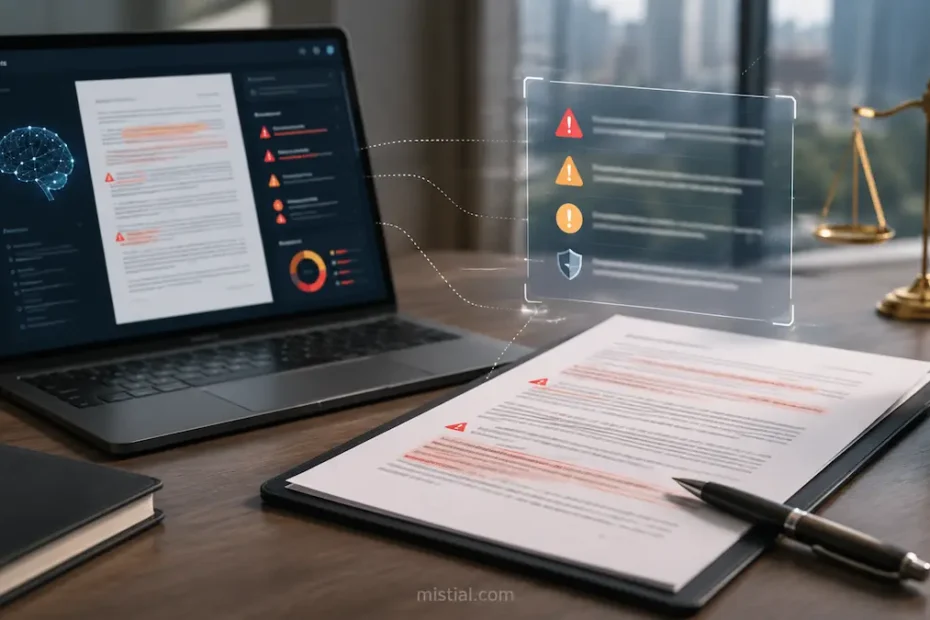
A pre-signing risk report is designed to make the document easier to understand before the user signs it. It reviews the text, identifies potentially risky clauses, and explains them in clear language.
The value is not only in finding legal-looking terms. The real value is in translating those terms into practical consequences. Instead of simply seeing a clause about liability, the user can understand whether the clause may expose them to excessive financial responsibility. Instead of reading a termination section and moving on, the user can see whether the other party has more freedom to exit the agreement than they do.
This kind of report usually focuses on several key areas:
- financial risks;
- unclear or one-sided obligations;
- payment and deadline terms;
- intellectual property ownership;
- confidentiality duties;
- termination rights;
- limitation of liability;
- hidden restrictions;
- unclear responsibilities;
- negotiation points.
For many people, this is not about becoming a legal expert. It is about knowing what questions to ask before they put their signature on the document.
Why Plain English Matters
Legal language can be intimidating even when the document itself is not very long. A person may understand every word separately but still miss the overall meaning of a clause. Words such as “indemnify,” “exclusive,” “perpetual,” “irrevocable,” “sole discretion,” or “without limitation” can carry consequences that are not obvious to someone outside the legal field.
A plain-English summary helps close that gap. It turns complex wording into practical explanations. Instead of leaving the user with a long paragraph full of formal language, the report explains what the clause may mean in everyday business terms.
For a freelancer, that may mean understanding whether a client can delay payment. For a startup, it may mean spotting terms that affect ownership of product ideas or software. For an agency, it may mean checking whether the scope of work is clear enough to prevent unpaid extra tasks. For a consultant, it may mean noticing whether the termination clause protects both sides fairly.
The Risk Score: A Fast First Signal
One useful feature of a pre-signing review is a risk score. It gives the user a quick overview of the document’s overall risk level before they study the details. This does not mean the score should be treated as a final decision. A low-risk document can still contain a clause worth discussing, and a high-risk document may still be negotiable.
However, the score creates a helpful starting point. It allows users to quickly understand whether the document looks generally balanced or whether they should slow down and review it more carefully. This is especially important when someone is under pressure to sign quickly.
In business, speed often creates risk. A client wants the agreement signed today. A new partner says the document is urgent. A platform asks for acceptance before a project can start. In these moments, a clear risk report can help users pause, evaluate, and respond with better questions.
Key Risks That Are Easy to Miss
Some risks are obvious. If a document says payment may never be required, most people will notice. But many real-world risks are more subtle. They may appear as broad wording, missing definitions, unclear deadlines, or obligations that apply only to one side.
Common examples include:
- Unclear payment timing: the contract says payment will be made after approval, but does not define when approval must happen.
- Broad intellectual property transfer: the user may give away rights earlier than expected or before payment is received.
- One-sided termination: one party can exit easily, while the other remains locked in.
- Unlimited liability: the user may accept responsibility for damages without a reasonable cap.
- Vague scope of work: the agreement does not clearly define what is included and what counts as extra work.
- Hidden restrictions: clauses may limit future clients, projects, employment, or use of created materials.
These issues do not always mean the document should be rejected. Often, they simply mean the user should ask for clarification or suggest safer wording before signing.
Negotiation Becomes Easier When the Risks Are Clear
Many people hesitate to negotiate because they do not know what to say. They may feel that asking questions will make them look difficult or unprofessional. In reality, clear negotiation often prevents conflict later.
A good pre-signing report does not only point out problems. It can also help the user prepare practical questions. For example:
- Can we define the payment deadline more clearly?
- Can IP ownership transfer only after full payment?
- Can liability be limited to a reasonable amount?
- Can both parties have equal termination rights?
- Can we clarify what is included in the scope of work?
- Can we add a process for change requests?
This turns negotiation from an emotional conversation into a practical business discussion. Instead of saying, “I do not like this contract,” the user can say, “This clause may create uncertainty around payment timing. Can we adjust the wording?”
Suggested Revisions Can Save Time
Another helpful part of a pre-signing risk report is suggested revisions. These are safer wording examples that users can bring into the conversation with the other party. They are not a substitute for a lawyer, but they can help users understand what a more balanced version of a clause might look like.
For instance, if a payment clause is vague, a suggested revision may show how to include a clear deadline. If an intellectual property clause is too broad, a revision may suggest tying ownership transfer to completed payment. If a termination clause is one-sided, the report may suggest wording that gives both parties a fair exit process.
This is useful because many people can recognize that something feels wrong but struggle to propose an alternative. Better wording examples make the next step more concrete.
Who Benefits Most From This Type of Tool?
Pre-signing document review is especially useful for people and businesses that often deal with contracts but do not have legal support available for every document.
Freelancers can use it before accepting client agreements, creative contracts, or platform documents. Small agencies can use it to review statements of work, service agreements, and subcontractor terms. Startups can use it before signing partnership documents, vendor contracts, or early client agreements. Consultants can use it to check project scope, payment terms, and liability language. Creators can use it to better understand licensing, ownership, and usage rights.
Even experienced professionals can benefit from a second layer of review. Familiarity with contracts does not make someone immune to hidden traps. In fact, people who sign documents frequently may become more likely to skim them too quickly.
A First Protective Layer, Not a Replacement for a Lawyer
It is important to understand the role of tools like brieflygo.com. They do not provide legal advice and do not replace a qualified lawyer. Some documents are too important, too complex, or too high-value to rely only on an automated report.
However, this does not make the tool less useful. It simply defines its correct place in the process. A pre-signing risk report can help users understand the document, identify questions, spot risky clauses, and prepare for a better conversation. If the document still looks serious or unclear after that, the user can take the report to a lawyer and have a more focused discussion.
In other words, the report helps users become better prepared. It can reduce confusion, save time, and make professional legal review more efficient when that review is needed.
Why This Matters in Everyday Business
Contracts are not just formalities. They define how people get paid, who owns the work, what happens if something goes wrong, and how the relationship can end. When these terms are unclear, even a promising project can become stressful.
A well-reviewed agreement protects both sides. It sets expectations early. It reduces the chance of conflict. It makes responsibilities easier to understand. Most importantly, it gives the signer a chance to make an informed decision before obligations become real.
That is the main value of a pre-signing risk report: it helps people slow down at the right moment. Before the signature. Before the dispute. Before the missed payment. Before the misunderstanding.
Sign Smarter, Not Faster
In a world where documents are shared, accepted, and signed faster than ever, careful review has become more important, not less. Digital signing makes agreements convenient, but it can also make people move too quickly. A few minutes of review before signing can prevent weeks or months of problems later.
BrieflyGo’s core message is simple: upload your document, get a clear risk report, and sign smarter. For anyone who regularly deals with contracts, NDAs, SOWs, client agreements, or employment-related documents, this approach can provide a valuable first layer of protection.
You do not need to become a lawyer to ask better questions. You do not need to understand every legal phrase to recognize that a clause deserves attention. You simply need a clearer view of what you are being asked to accept.
And that clarity can change the entire signing experience.

