


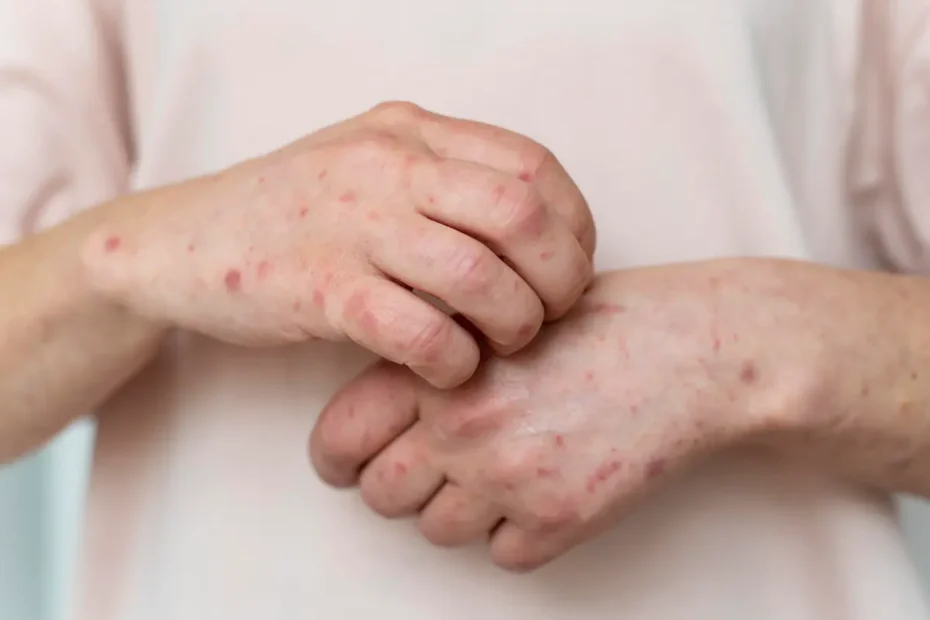


Psoriasis is a condition in which a person’s immune system mistakenly attacks healthy skin cells. As a result, flaky plaques appear on its surface, which can itch a lot and even hurt. Sometimes the disease is also accompanied by inflammation of the joints and eyes.
What is psoriasis
Psoriasis is a chronic autoimmune disease in which red, scaly patches appear on the surface of the skin. They are often called plaques.
Psoriasis is not contagious; it is an autoimmune disease, not an infectious disease.
Psoriasis is manifested by inflammation of the skin, as well as abnormally rapid growth and exfoliation of cells (keratinocytes) that make up the stratum corneum – the epidermis. Normally, it is completely updated in a month, and in people with psoriasis, this process is many times accelerated and takes an average of 3-4 days.
In addition to skin lesions, the disease causes inflammation of the joints (in about 30% of cases). A little less often – in 10% of cases – psoriasis leads to inflammation of the choroid (uveitis).
Prevalence of psoriasis
Psoriasis most often affects people 15-35 years old, but in general the disease can manifest itself at any age. The first peak of the onset of pathology occurs at 15–20 years, the second at 55–60.
On average, psoriasis affects approximately 1-2% of people worldwide. In Russia, according to the clinical recommendations of the Russian Ministry of Health, in 2021 the prevalence of the disease was 243.7 cases per 100,000 population.
Types of psoriasis
Like many chronic diseases, psoriasis is distinguished by stages, severity, and also by the form of manifestation.
By stage
There are three stages in psoriasis: progressive, stationary and regression (remission).
In the progressive stage, red spots appear on the skin. Merging, they form large scaly plaques with a pronounced red contour along the edges – it is called an erythematous corolla, or growth corolla. New plaques are very itchy and can hurt.
Injured areas of the skin are especially prone to the appearance of new spots: a psoriatic plaque can quickly develop in the place of friction (for example, on clothes), as well as in the area of a scratch or comb. Doctors call this phenomenon the Koebner phenomenon.
This phenomenon, also known as the “isomorphic reaction”, was discovered by the German dermatologist Heinrich Koebner in 1872. The doctor noticed that in some patients with psoriasis in places of trauma, for example, after scratches, injections or bruises, new plaques appear on the skin.
The stationary stage is the stabilization phase. Plaques stop growing, but continue to bother and peel off. A new rash and spots usually do not appear.
The stage of regression occurs when the manifestations of psoriasis begin to disappear. Peeling passes, plaques brighten and flatten. Symptoms in this phase decrease.
By severity
To assess the severity of psoriasis, doctors use the PASI (Psoriasis Area and Severity Index) system – an index for assessing the severity and prevalence of psoriasis. It requires a professional analysis of such parameters as the severity of erythema, infiltration, peeling, and the calculation of the area affected by skin rashes.
Depending on the results of the examination, doctors distinguish mild, moderate and severe degrees of the disease.
By shape
According to the clinical picture of manifestations, several main forms of psoriasis are distinguished: vulgar, inverse, seborrheic, exudative, guttate, pustular, psoriasis of the palms and soles, and psoriatic erythroderma.
Vulgar (ordinary) psoriasis is one of the most common forms, which accounts for about 90% of all cases of the disease. First, red spots appear on the skin, which in a few days transform into convex scaly plaques. As the plaques develop, they merge into large itchy and scaly lesions. Then the state passes into the stage of stabilization and regression: the manifestations of the disease temporarily recede and the person’s well-being improves.
The most common places where psoriasis vulgaris appears are the extensor (outer) part of the skin of the elbows and knees. Also, foci appear on the trunk and scalp.
Inverse (“reverse”) psoriasis proceeds in the same way as ordinary psoriasis. The difference lies only in the location of the foci: they do not appear on the extensor (outer) part of the knees and elbows, but on the flexion (inner) – that is, under the knee, under the armpits and in the elbow area, as well as in the neck, eyelids, navel, inguinal folds. The skin in these places is more tender, moist and often rubs against clothes. Because of this, it may itch more than with the usual form of the disease, but the peeling in these places is less pronounced.
Seborrheic psoriasis proceeds in the same way as ordinary psoriasis, but its foci are located in places with a large number of glands that secrete sebum. This is the scalp, behind the ear folds, cheeks and nasolabial region of the face, forehead, chest and back (mainly the upper part).
Exudative psoriasis is a type of disease in which, in addition to peeling, exudate also appears in the lesion. It is a liquid containing protein, some blood cells, and other substances. Exudate can be released from the capillaries during inflammation.
The crust on the surface of the plaques in the exudative form of the disease is usually dense, grayish-yellow, sometimes slightly moist. This type of psoriasis most often occurs in people with endocrine disorders: thyroid pathologies, type 2 diabetes, or obesity.
Guttate psoriasis is not manifested by plaques on the skin, but by numerous papules – swollen dots of bright red color with peeling in the center. Papules can vary in size from about 1 to 10 mm. They cover mainly the trunk, arms and legs.
Guttate psoriasis usually occurs in children after streptococcal infections (eg, tonsillitis). It is treated somewhat better than other types of psoriasis, but in some cases it can turn into an ordinary (vulgar) form.
Pustular psoriasis is characterized by the appearance of multiple pustules on a red erythematous background. Pustules are formations that look very similar to pimples. Such psoriasis can be the result of infectious diseases, stress, hormonal failure, improper medication or inadequate use of ointments. Initially, numerous pustules appear on the red spots. Then they merge into one large purulent spot (or “purulent lake”).
The generalized form of pustular psoriasis is difficult to tolerate: with episodes of fever, weakness, as well as severe pain and burning of the skin. In parallel, there may be a change in the nails, pain in the joints.
Psoriasis of the palms and soles – typical psoriatic rashes appear in the palms and soles, less often occurs in the form of localized pustular psoriasis. It can also affect and deform the nails – they thicken, become cloudy and uneven.
Erythrodermic psoriasis is quite rare and is considered an extremely severe form of the disease. There is reddening of about 90% of the body, severe itching and pain appear, the skin swells, flakes off. Often the temperature rises and the lymph nodes become inflamed.
Usually, this type of psoriasis is the result of an exacerbation of another form of the disease due to improper treatment or adverse environmental factors (for example, sunburn in advanced psoriasis vulgaris, inadequate use of irritating external agents, or intravenous administration of glucocorticosteroids).
Symptoms of psoriasis
The manifestations of psoriasis vary depending on the type of disease and its severity.
Common symptoms and signs of psoriasis:
- red, raised, scaly patches on the skin;
- itching in the area of \u200b\u200bfoci of inflammation and peeling;
- change in nails: point impressions, thickening and crumbling of the plate, its discharge;
- joint pain (sometimes).
For an accurate diagnosis, you need to contact a specialized specialist – a dermatologist.
The mechanism of development of psoriasis
Psoriasis is an autoimmune disease.
All autoimmune pathologies are associated with an error in the functioning of the immune system. Normally, it “scans” the body around the clock and searches for pathogen cells by foreign protein molecules that distinguish them from “normal” cells characteristic of the body.
As soon as foreign protein molecules are detected, the immune system activates special immune cells – T-lymphocytes, which should destroy the enemy.
But for some people, the “friend or foe” recognition system can break down. As a result, the immune system begins to attack healthy cells of individual organs or tissues, provokes inflammation in their locations and in every possible way harms your body, which, in fact, must protect.
This is what happens with psoriasis: the immune system attacks the skin. It activates T-lymphocytes and “sets” them on skin cells. Once they reach their destination, T-lymphocytes release substances that cause inflammation, called cytokines. They provoke the first symptoms: redness, swelling, itching and pain.
Under the influence of cytokines, an inflammatory process develops, and skin cells begin to actively divide – this is how active peeling occurs and a convex plaque is formed.
Since the process of cell renewal is accelerated by almost ten times, the main cells of the epidermis (keratinocytes) do not have time to form properly. Therefore, they cannot fulfill their barrier function.
As a result, the stratum corneum becomes permeable and ceases to protect the deeper layers of the skin from the environment and moisture loss. All this leads to more inflammation.
Until the immune system calms down, the disease will progress and the symptoms will increase.
Causes of psoriasis
The exact reasons why psoriasis develops are not yet fully understood. However, many studies agree that the development of psoriasis is related to genetics, as well as lifestyle, comorbidities, and adverse environmental factors.
Genetics
The disease is often inherited from parents to children. Psoriasis is mainly associated with the gene system HLA-C. It codes for a protein that allows the immune system to recognize its own (harmless) cells.
In patients with psoriasis in the HLA-C gene, doctors are more likely than in other people to detect a special genetic marker – HLA-Cw6. However, its presence speaks only of a predisposition to the disease. Not all people with the HLA-Cw6 marker necessarily have psoriasis, and not all patients diagnosed with the disease have a similar genetic change.
Lifestyle
It is believed that permanent damage to the skin, frequent friction, sunburn and hypothermia can be triggers for the development of the disease. Especially if there is a hereditary predisposition in the form of a genetic marker HLA-Cw6 or close relatives suffering from psoriasis.
Another risk factor includes constant stress, alcohol abuse and smoking – all this adversely affects the metabolism, the functioning of internal organs and the immune system.
Associated pathologies
Some types of psoriasis, such as guttate psoriasis, may appear after a streptococcal infection.
Also, the risk of developing pathology is increased in people with autoimmune diseases. These include, for example, type 1 diabetes mellitus, Crohn’s disease, systemic lupus erythematosus and rheumatoid arthritis.
In such diseases, the general mechanism of the immune system is disturbed: it perceives some of its own cells as something alien, reacts with inflammation and destroys them. Accordingly, the risk that she will mistakenly add other cells to the “black list” increases.
Complications of psoriasis
Psoriasis is based on a malfunctioning immune system and chronic systemic inflammation. It develops due to the constant aggression of immune cells towards healthy tissues.
Autoimmune processes differ in that they can spread: the immune system is able to include other healthy cells in the list of “enemies” at any time.
For example, against the background of psoriasis, Crohn’s disease or ulcerative colitis can develop if the immune system mistakenly attacks the tissues of the gastrointestinal tract.
In addition to autoimmune diseases, people with psoriasis are prone to various endocrine pathologies (metabolic syndrome, obesity, type 2 diabetes mellitus), cardiovascular diseases (hypertension, heart attack) and other dysfunctions of internal organs. All this is associated with a chronic inflammatory process that affects the hormonal background and interferes with normal metabolism.
A separate complication is psoriatic arthritis. It occurs in about 30% of people with psoriasis.
In psoriatic arthritis, the immune system attacks the connective tissue, most often affecting the joints of the lower extremities. Inflammation of the articular structures develops, the skin in the affected area may turn red, swelling appears, as well as pain and / or stiffness when trying to bend or straighten the joint.
In 10% of people with psoriasis, the pathology spreads to the eyes and develops uveitis. The choroid of the eye becomes inflamed, which leads to decreased vision and discomfort.
In addition to physiological complications, psoriasis can affect a person’s mental health. A change in appearance, poor skin condition and unbearable itching can cause self-doubt and lead to a depressive disorder.
Diagnosis of psoriasis
A dermatologist deals with the diagnosis of skin diseases, including psoriasis.
At the appointment, the doctor will ask about the symptoms and how long ago they appeared. Then he will ask about skin diseases from the next of kin: parents, brothers and sisters. A family history allows the specialist to immediately assume diseases that can be inherited – psoriasis is one of them.
The doctor will also ask about situations that provoke the appearance of new rashes and exacerbation of symptoms. For example, new psoriatic lesions may occur after taking a hot bath or prolonged exposure to the sun. In some patients, plaques appear at injection sites, scratches, after rubbing the skin against clothing – this is how the Koebner phenomenon characteristic of psoriasis manifests itself.
An important point in establishing the diagnosis is the examination of the rash. With insufficient completeness of the picture of the disease, a specialist can observe rashes in dynamics, prescribe a histological examination of the skin (biopsy).
If the doctor is not sure that plaques on the skin are psoriasis, a biopsy and a histological examination of the skin are prescribed.

