


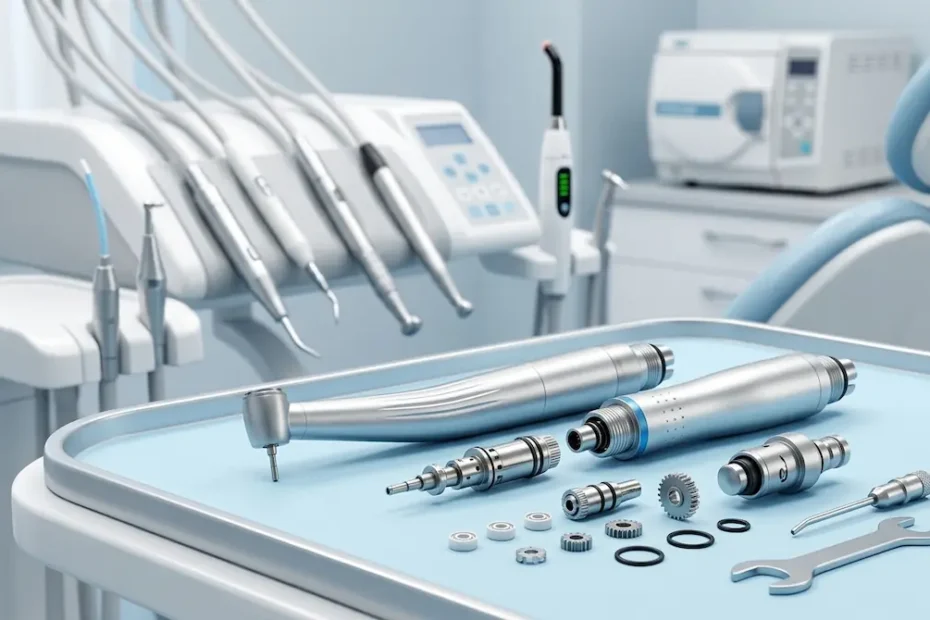


Dental handpieces represent one of the most critical instruments in contemporary clinical practice. These precision-engineered tools enable dentists to perform a wide range of procedures with accuracy, efficiency, and patient comfort. From cavity preparation to endodontic treatments and prophylaxis, handpieces are the mechanical heart of the operatory. Understanding their technical specifications, maintenance requirements, and available repair services is essential for any dental practice aiming to maintain high standards of care while controlling operational costs. This article explores the core technical aspects of dental handpieces, the importance of timely repairs, and the broader landscape of related dental equipment.
Technical Overview of Dental Handpieces
Dental handpieces are broadly categorized into high-speed and low-speed models, each designed for specific clinical applications. High-speed handpieces, typically powered by air turbines, operate at rotational speeds between 300,000 and 450,000 RPM. They incorporate a miniature turbine rotor housed within precision ceramic or stainless-steel bearings. The design includes a push-button or friction-grip chuck system that securely holds burs ranging from 1.59 mm to 1.6 mm in diameter. Integrated water and air spray channels provide cooling and debris removal, while fiber-optic bundles or built-in LED lighting ensure clear visibility in the oral cavity.
Low-speed handpieces, on the other hand, function at 5,000 to 40,000 RPM and are primarily used for polishing, finishing restorations, and endodontic procedures. These units often feature a modular design consisting of a micromotor (electric or air-driven) connected to interchangeable attachments. The two most common attachments are straight handpieces and contra-angle handpieces. Contra-angle models, with their distinctive 1:1 or 1:5 gear ratios, allow clinicians to access posterior regions comfortably while maintaining optimal torque and control.
Key technical components shared across handpiece types include the rotor assembly, ball bearings, drive shaft, and spray system. Bearings must withstand extreme rotational forces and repeated sterilization cycles at 135°C. Modern handpieces also integrate advanced features such as anti-retraction valves to prevent cross-contamination and quick-connect couplings for seamless integration with delivery units. Material selection—titanium bodies for reduced weight, stainless steel for durability, and ceramic bearings for quieter operation—directly impacts performance and longevity.
Maintenance Challenges and the Role of Quality Repair Parts
Regular use subjects handpieces to significant mechanical stress. Common failure points include bearing wear, turbine imbalance, clogged spray channels, and O-ring degradation. Without proper maintenance, these issues lead to reduced cutting efficiency, excessive noise, vibration, and ultimately costly downtime. Professional repair services address these problems through complete disassembly, ultrasonic cleaning, component replacement, and dynamic balancing.
In the first half of any effective maintenance strategy, practitioners should prioritize original or OEM-equivalent parts. For example, sourcing high-quality Contra angle repair parts ensures compatibility and restores full functionality without compromising the handpiece’s original specifications. These kits typically include precision bearings, O-rings, washers, and drive gears specifically engineered for contra-angle models. Using certified components minimizes the risk of premature failure and maintains the manufacturer’s warranty where applicable.
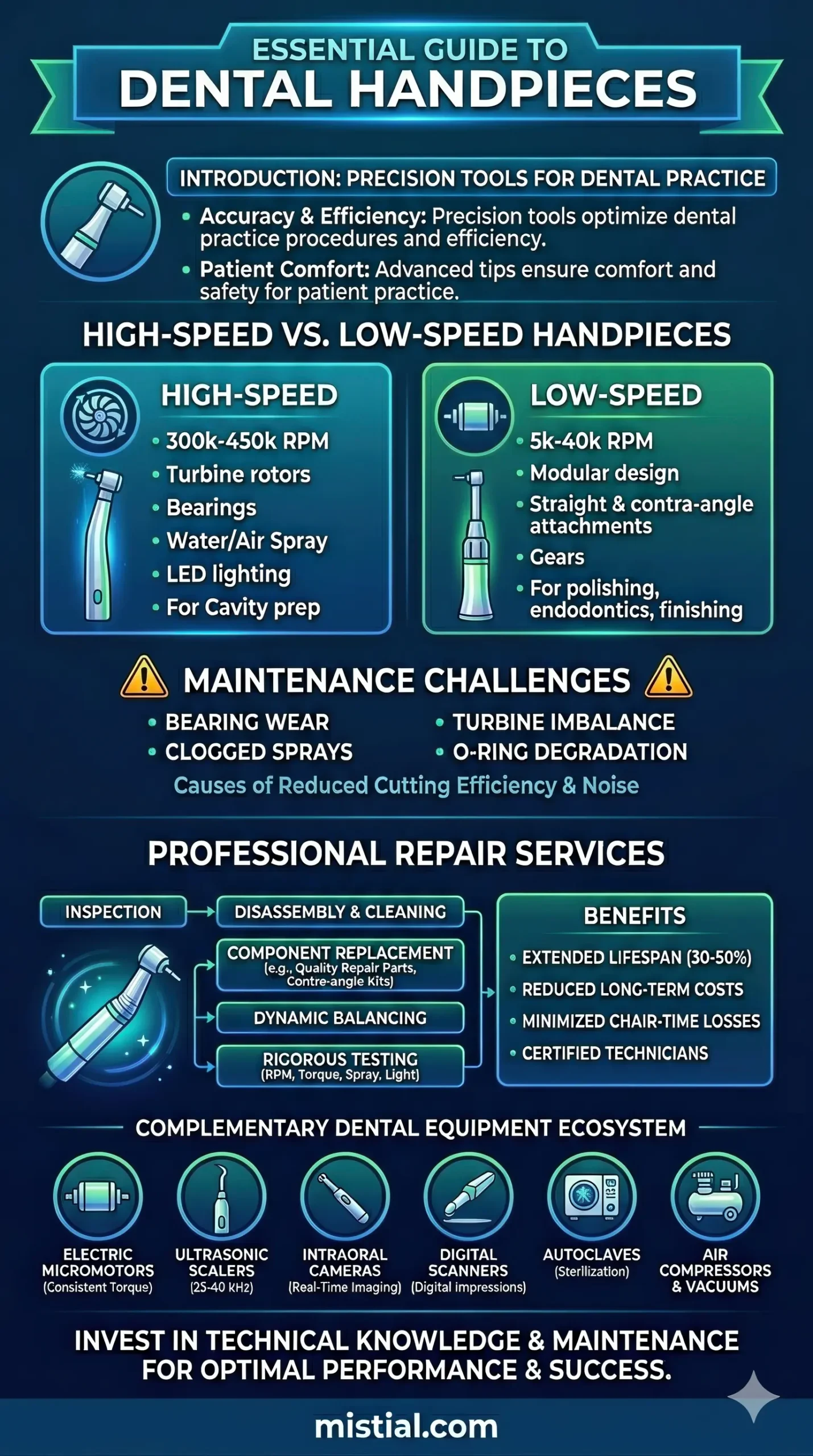
Infographic Essential Guide to Dental Handpieces: Technical Insights, Professional Repair Services, and Equipment Variations
Professional Repair Services: Processes and Benefits
Reputable dental handpiece repair services follow a standardized, ISO-compliant workflow. The process begins with a detailed incoming inspection using magnification and pressure testing to identify leaks or mechanical play. Technicians then disassemble the handpiece in a clean-room environment, removing the turbine, bearings, and chuck mechanism. Each component undergoes ultrasonic cleaning followed by lubrication with specialized autoclavable oils. Worn parts are replaced, and the turbine is dynamically balanced to eliminate vibration at high speeds.
After reassembly, every repaired handpiece undergoes rigorous performance testing: RPM verification, torque measurement, water spray pattern analysis, and fiber-optic light intensity checks. Only units meeting factory specifications are returned to the client, usually with a detailed service report and extended warranty—often six months or longer.
Outsourcing repairs to specialized providers offers several advantages over in-house attempts. Certified technicians possess proprietary tools and calibration equipment unavailable in most clinics. Moreover, professional services reduce long-term costs by extending handpiece lifespan by 30–50 % compared to continued use of failing units. Practices also benefit from minimized chair-time losses and enhanced infection control, as properly repaired instruments maintain optimal sterilization compatibility.
Exploring Different Dental Equipment Beyond Handpieces
While handpieces dominate daily procedures, modern dental practices rely on an ecosystem of complementary equipment. Electric micromotors provide consistent torque across speed ranges and are increasingly replacing traditional air-driven systems due to their quiet operation and precise speed control. Ultrasonic scalers, another essential category, utilize piezoelectric or magnetostrictive technology to generate vibrations at 25–40 kHz for efficient calculus removal with minimal enamel damage.
Intraoral cameras and digital impression scanners have transformed diagnostics and patient communication. These devices integrate seamlessly with handpiece delivery units, allowing real-time imaging during procedures. Autoclaves and washer-disinfectors represent the backbone of infection prevention, ensuring all rotary instruments meet stringent sterilization standards.
Air compressors and vacuum systems, though often overlooked, directly influence handpiece performance. Stable air pressure (typically 2.5–3.5 bar) prevents turbine slowdown, while reliable suction maintains a clear operative field. LED curing lights with wavelengths of 385–515 nm ensure predictable polymerization of composite materials, complementing the finishing work performed by low-speed handpieces.
Conclusion: Investing in Knowledge and Maintenance
Dental handpieces embody a sophisticated blend of mechanical engineering and clinical ergonomics. Their reliable operation depends on a thorough understanding of technical specifications, proactive maintenance, and access to professional repair services. By selecting quality components—such as dedicated contra-angle repair kits—and partnering with experienced technicians, practices can achieve optimal performance, extend equipment life, and deliver superior patient outcomes.
Ultimately, the investment in technical knowledge and specialized repair services translates into reduced overhead, fewer emergencies, and greater clinical confidence. As dental technology continues to evolve with brushless motors, AI-assisted diagnostics, and enhanced ergonomics, staying informed remains the most effective strategy for long-term success. Practices that prioritize equipment care today will be best positioned to meet the demands of tomorrow’s dentistry.

