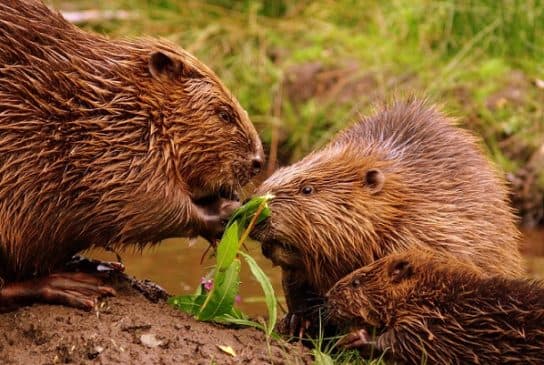


The beaver family includes the largest rodents in the world after the capybara. They have a massive body and a flattened tail. Representatives of this family are excellent swimmers. They have a fairly wide distribution area. This family includes several species of animals, each of which has a distinctive feature.
Description and appearance of representatives of the beaver family
Beavers belong to the mammalian family of the rodent order. It is interesting to note that earlier they were referred to the suborder squirrel-like. However, today they are listed as representatives of the Castorimorpha order.
For reference: The modern English name beaver comes from Old English beofor, befor or bebr, and is related to the German Biber and Dutch bever.
A distinctive feature of the beaver is its appearance, thanks to which it is easy to recognize it among other rodents. The body length of the animal can reach 1.5 meters. It is interesting to note that females are often larger than males. Representatives of this species have a slightly blunt muzzle, which is decorated with small ears. The beaver also has paws. They are short but strong.
Particularly noteworthy is the animal’s fur, which is highly valued. Wool consists of 2 layers at once:
- on top are hard guard reddish-brown hair;
- underneath there is a dense gray undercoat that protects the individual from hypothermia.
The body of the individual smoothly passes into the tail. It is black in color and covered with scales. The tail of beavers is wide and rather flattened. There are 2 glands near its base. They produce an odoriferous substance called beaver spray.
Beaver species
Despite the fact that earlier several subfamilies belonged to the beaver family, today there are only three species of them:
- ordinary (river);
- Canadian;
- American.
It should be noted that earlier the Canadian species was considered a subspecies of the river. However, serious genetic studies were carried out, during which it was revealed that these are completely different species.
Common or river beaver (Castor fiber)


This is the most common type. Mostly distributed in Europe. Inhabits Scandinavian countries, Poland, Germany, Belarus, France, Ukraine. Also found in China and Russia. The river beaver has also been found in Mongolia.
On average, the body length of representatives of this species is 1.2 meters. The weight of an adult varies between 30 kilograms. Shortened paws. They have 5 fingers each, decorated with powerful, flat claws. The hind legs are stronger than the front ones. Swimming membranes are located between the toes.
The tail is paddle-shaped. Its length exceeds 25 cm. The width is 9-12 cm. At the base, the tail is slightly lowered, while its main part is covered with small horny scales.
Fun fact: Underwater, the ear holes and nostrils close. In addition, there are unique blinking membranes on the eyes.
A distinctive feature of this species is its beautiful fur. It consists of coarse guard hairs and a thick, soft undercoat. Most often, the fur is dyed light chestnut. However, common beavers can also be found with dark brown and black “fur coats”.
Canadian beaver (Castor canadensis)


Another species of the beaver family that has survived to this day. Individuals have a standard body structure for all members of this subfamily. Its length is 100 cm. The body is rounded with a wide chest and short head. The average weight of an adult animal is 28 kilograms.
The Canadian beaver has thick black-cinnamon or reddish fur.
The tail is oval in shape with a pointed end. Its length reaches 27 cm, while its width is 12 cm. The surface of the tail is covered with black scales.
The Canadian beaver is not as widespread as the common species. It inhabits mainly Canada and North America. It is also found in Alaska, Mexico and the United States. A number of Scandinavian countries were also brought to Russia, but they did not take root everywhere.
American beaver, distinguished as a special species


Stocky mammals with a compact body and short legs. They are aquatic rodents that have a range of adaptations that make them good swimmers. An additional set of clear eyelids that close over the eyes allow animals to see underwater.
After protection and settlement measures, the range of the American beaver has been almost restored.
How the beaver swims
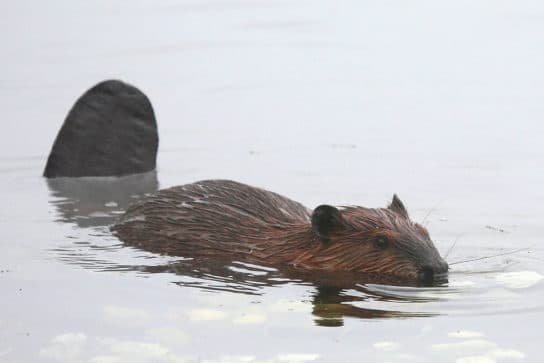
Few people know, but representatives of this family swim at a speed of 8 km. at one o’clock. Animals can stay underwater for 10-15 minutes. They are able to dive to a depth of 1 meter.
Interesting fact: In the process of immersion under water, the beaver’s pulse slows down by 2 times. Thus, it is only 55-60 beats per minute.
During swimming, the animal uses only its hind legs. On the surface of the water, it moves by pushing the hind legs in turn. Under water, uses pushes at the same time with 2 paws. The forelegs of the individual are pressed to the chest. The tail serves as a kind of rudder used to change direction.
Where beavers live
Initially, representatives of the beaver family were widespread throughout Europe and Asia. They were not only on Sakhalin and Kamchatka. However, the economic activity of people and uncontrolled hunting greatly influenced the number of individuals, as a result of which their habitat was also reduced.
Today beavers live in France, Scandinavia, Germany, Belarus, Russia. They are often found in the Northern Trans-Urals, China and Asia.
The animals settle in the area where deciduous trees and shrubs predominate along the river banks. It should be noted that beavers prefer rivers with a slow flow, oxbow lakes, ponds, lakes, reservoirs, irrigation canals and quarries. The animals avoid fast and wide bodies of water, which are capable of freezing to the very bottom in the winter season.
Rodent diet
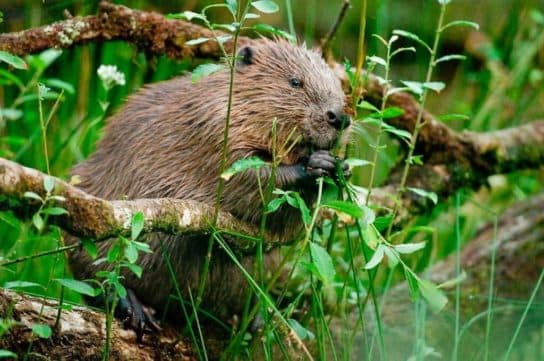
The beaver family eats only plant foods. The basis of their diet is the bark and shoots of birch, willow, aspen, poplar. The animals are not averse to feasting on herbaceous plants. For example, iris, water lilies, reeds.
For reference: It is quite common to notice that beavers are gnawing alder and oak. However, they do this not for the purpose of saturation. Rodents use these trees for various buildings.
The volume of food eaten by a beaver per day is 20% of its weight. The animal’s menu depends on the season. In summer, it is dominated by grass. In winter, beavers eat mainly the bark of trees. In the fall, rodents create reserves from woody food. They hide them under water, and get them only towards the end of winter. It is interesting to note that the animals are trying to sink their reserves. This is to ensure that the food does not grow into the ice.

Lifestyle
The peak of activity is at night. During the day, individuals are in their burrows. With the onset of dusk, the animals go in search of food. In the middle of the night, the beavers begin construction. It is worth noting that in winter, representatives of this family do not hibernate, but they spend most of their time in the den.
Beavers live in families. They form pairs of a female and a male, which eventually produce offspring. One colony can consist of 10 individuals. A large family is divided into several groups living in different burrows. At a certain time, they leave their shelter, and begin to comb and lick each other.
To communicate with each other, the animals use a special sound reminiscent of whining. Cubs attract the attention of their parents by crying and squeaking. Often, the sounds they reproduce are similar to meows. In times of danger, the rodent begins to hiss and clang its teeth. It gives alarm signals with the help of its tail, which it begins to forcefully knock on the surface of the water.
What kind of housing beavers build
Housing of representatives of the beaver family is of great interest. They are able to create 2 types of housing: burrows and lodges. An interesting feature of such buildings is the entrance, which is always located under water. In this way, beavers take care of their safety. Rodents dig holes in the steep bank. This building has more than 5 exits, making it look like a labyrinth.


The second type of housing is being built where it is not possible to dig holes. Most often these are gentle and low swampy shores and shallows. The huts look like a cone-shaped heap of brushwood. Silt or earth is used to fix them.
Video about the beaver family