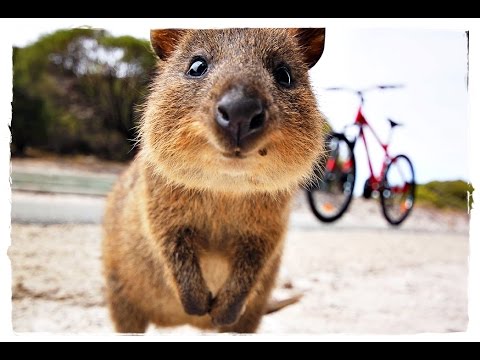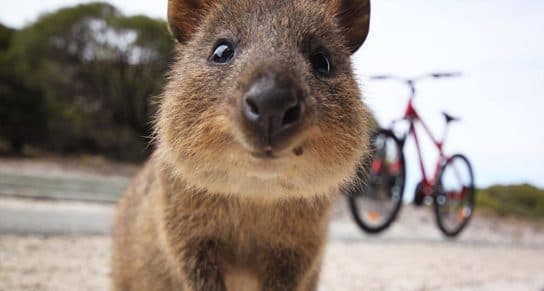


Quokka belongs to the kangaroo family and strongly resembles a large kangaroo in appearance. However, the size of this animal is very modest – it is no larger than an ordinary domestic cat.
Kwokka – description
The kangaroo family includes many species of animals that have a lot of differences. But the quokka has a specific feature inherent only in her – too short a tail. This body element is actively used in all kangaroo animals as a support. Thanks to the tail, the vast majority of kangaroo species are able to defend themselves, striking the enemy with strong hind legs. Quokka’s small tail does not allow this.
This small jumping animal is covered with medium-sized hair. The color is usually reddish, sometimes with gray tints. The entire visible surface of the quokka’s body is covered with fur, except for the tail and tips of the paws. The skin in these places is dark, almost black.
The hind legs of the quokka are powerful, allowing for jumping. The forelegs are much shorter and weaker. With their help, the animal picks up and holds food. Quokka feeds on grass, leaves, shoots and tree fruits.


Quokka lifestyle
Historically, the quokka, like other kangaroos, was widespread throughout almost the entire territory of Australia (list of animals in Australia). But with the beginning of the active settlement of the mainland, the population began to decline sharply. Moreover, the reason for this was not banal poaching or industrial development, but the imported animals.
Quokka is a defenseless creature. She does not know how to fight like a large kangaroo, and is not adapted to meet predators. Moreover! There have never been large predatory animals in its habitat. Therefore, ordinary cats and dogs, which people brought with them, became the main enemies and destroyers of the quokkas.
Today, this small animal lives on the islands of Bald, Rottnest and Penguin, located near Australia. Also found on the mainland in the area of the city of Albany. The typical habitat of the quokka is dry grassy fields with dense bushes.


When living conditions become uncomfortable, quokkas are able to undertake migrations and move to atypical places. So, during a severe drought, they massively move to swampy areas, where they find an acceptable amount of water and air humidity.
The quokka is a nocturnal animal. She has good enough eyesight, a keen sense of smell and hearing. In the daytime, the animals show little activity, often hiding in the bush.
Quokka has a very interesting playback feature. After mating, the female forms not one, but two embryos at once. Moreover, one of them begins to develop, and the second goes into a pause phase.
Like all representatives of the kangaroo family, the quokka has a bag for carrying offspring. She gives birth to one cub and feeds him in a bag for a long time. At this time, the second embryo begins to develop and is born after its “older brother” leaves the mother’s bag. Thus, the female goes through the stages of two pregnancies after only one meeting with the male.
Quokka and man
Scientists have assigned the status of “vulnerable species” to quokka. This means that without taking measures for accounting and preservation, the number of animals can begin to decline critically. Considering that it takes root well in artificial conditions, a person often keeps a quokka at home. In various zoos and tourist spots, you can touch and even feed the kwokka. The amazingly touching face of this animal rarely leaves tourists indifferent, and the amazing photogenicity surprises and most often leads to whole photo sessions.


Interesting facts about quokka