


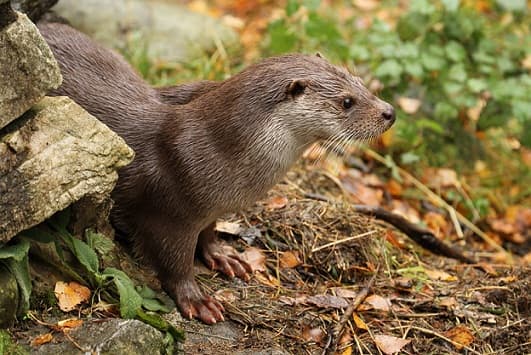


This animal, which is a predator, has an external resemblance to a mink. The Caucasian otter belongs to the class of mammals, the order of carnivores and the weasel family.
Description
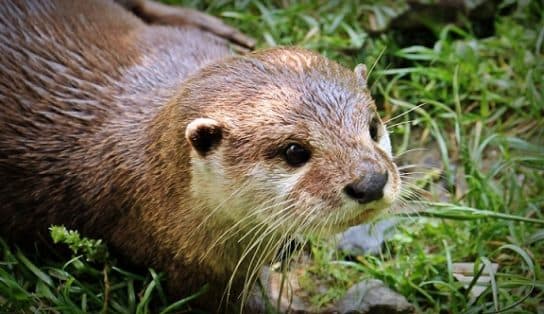
The length of the body, including the tail, is 120 cm. The body is elongated and flexible. The weight of adult predators varies from 5 to 9 kg. The neck of the animal is short, it looks elegant on a thin body. The ears are completely covered with fur, there are membranes on small paws. The tail of the predator is long, it becomes already towards the end. The animal’s coat is even and dense, but rather low. The fur is two-layered: the first layer is thick and thick, and the second, that is, the lower one is thin and consists of wavy hairs. The back of the Caucasian otter is brown, the abdomen is light-colored, the wool in this place has a silvery sheen. At the base, the hair is white, at the ends it is brown.


Habitat
The otter inhabits water bodies in the Transcaucasia, in the north and west of the Caucasus, and in some territories of Asia Minor. In the Western Caucasus, the otter lives near the tributaries of the Kuban Belaya and Zelenchuk, Teberda. The animal can also be found in the valley of the Baksan and Chegem, Urukh and Cherek rivers. Today, the predator can be found in the mountains; they prefer to live in rivers located no higher than 2500 m above water level. The beast also inhabits artificial reservoirs, rice systems and ditches.
In the past, the Caucasian otter also lived in many rivers that flow into the Black Sea. Now the Caucasian otter inhabits the lower reaches of the Sulak and Terek, it is noticed in Abkhazia and in the tributaries of the Caspian. This animal also inhabits the territory of Georgia and Azerbaijan. On the territory of Dagestan, the Caucasian otter was seen in the lower reaches of the Samur and Sulak.
The diet
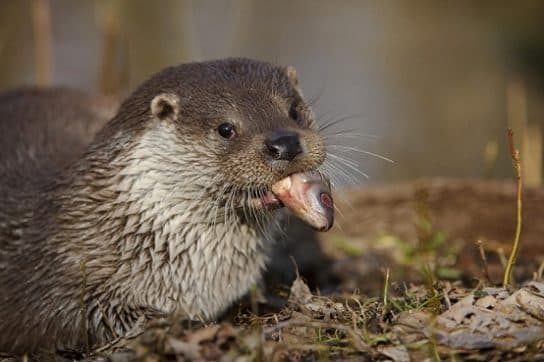
The Caucasian otter eats fish, the diet consists almost entirely of fish, namely 80 percent. The predator also eats frogs and crayfish, amphibians. The otter often attacks mice and other rodents. The animal can also eat plants. This representative of the weasel hunts very actively. He catches fish by the tails, moreover, he tries to hunt gracefully.
In the Kuban, the Caucasian otter catches crucian carp, sometimes it can feed on pike or trout. This nimble hunter never begins to fish until he has eaten up the already caught prey.

Lifestyle
The otter is a secretive animal that is active mostly at night. The animal has a well-developed hearing and sense of smell.
Due to the fact that the predator inhabits the shores of fresh water reservoirs, the animal digs up its “dwellings” in places that are hidden under water, under snags. The animal has many temporary shelters, but cubs are born only in a permanent burrow. The otter can also settle in the burrows of the muskrat, in the gullies on the banks.

Reproduction
The breeding season begins in the spring and ends in the summer. The male notices that the female is ready to mate if she creates marks with the help of the smelling secretion. After that, males begin to fight in order to win the favor of the expectant mother. Females become sexually mature at two years old and males at three.
The expectant mother is carrying the cubs for two months. Usually 2-4 babies are born. The mother is caring, she looks after the children up to a year. Babies are born in a “fur coat”, but absolutely blind. Their weight at the time of birth is about 100 g. After a couple of weeks, the cubs begin to see. And after 2 months they begin to hunt with their mother and learn to swim. At the same time, the cubs’ teeth grow and they begin to eat meat. Although, despite this, the otters are still too small and still keep close to their mother.
Voice
The otter can hiss when someone scares her. When playing with congeners, the animal usually squeals and makes sounds similar to chirping.
Protective status
The Caucasian otter is listed in the Red Book of the Krasnodar Territory and the Kuban as a species whose population is rapidly declining. Only the population of the western Caucasus is more stable.
Such changes occurred due to the felling of trees, which affected the balance of mountain reservoirs. Water pollution by factories also caused a decrease in the number of predators – many fish died. Because of this, the species completely disappeared from the banks of the Anchez River, and only a few are found near Psekups. Poaching is another cause of extinction.


Security
The Caucasian otter is protected in the Caucasian Nature Reserve, which is home to about 260 animals. The species is also protected in the Tuapse, Krymsk and Krasnogorsk zakazniks. The predator is also bred in the Teberda Nature Reserve, where it is considered a rare species.
Interesting Facts
- The otter is easy to tame. Many people keep this predator at home or use it to catch fish. Caucasian otters have a good memory. If an animal has a master, he will always remember him and never forget the name given to him.
- Caucasian otters are beneficial to fishing because they consume non-commercial fish species. This is due to the fact that it is easier to catch a sick fish.
- The Caucasian otter leads a solitary life; it mates only during the rutting season. However, during and after pregnancy, the parents live together for about a year.
- Sexual dimorphism is expressed in size, males are larger than females.
- They have valves in the nose and ears, which prevent moisture from entering during immersion.
- The Caucasian otter eats about 1 kg of fish per day. The predator eats small specimens in the water, and pulls out large specimens and puts them on the shore, where he eats them.
- Most of the life of the Caucasian otter is spent hunting. The animal can travel about 300 meters in the water to catch up with the victim. The predator can stay under water for 2 minutes. When the representative of the weasel is full to the dump, it still continues to hunt in order to catch fish and play with it.
- The Caucasian otter loves cleanliness; after a hearty meal, she cleans her fur.
- When the winter season ends, the animal uses the layer between the ice and the water surface to watch its prey.
- This predator has a fairly fast metabolism. Food digestion and assimilation takes place in an hour. This can be explained by the fact that the animal spends a lot of energy, stays in ice water for a long time, and there heat quickly leaves the otter’s body.
- The Caucasian otter is a cautious animal, but it knows how to have fun. In summer, the animals often lie under the sun, resting after a long hunt. In winter, the animals slide down the hill. After themselves, they leave a trail in the snow. The belly of the otter is used as ice, and the hills are steep banks. After such games, the animal usually cools in the water, whistling loudly and squealing.
- The Caucasian otter hunts frogs during the day only in the bypass tunnels.
- The area of the territory in which the otter hunts varies from 2 to 18 km.
- In water, the animal develops a speed of about 0.9 m / s, and when hunting, the indicator is only 0.26. The maximum that the animal is capable of is 3 m per second.
- Each individual has its own territory. Sometimes the sites overlap. Territories of males are usually larger.
Enemies
The Caucasian otter has many natural enemies. The animal is hunted by wolves and bears, representatives of the hawk and falcon family. Often these predators attack young animals. Foxes can hunt wounded and sick individuals. Other common competitors are the striped raccoon and mink.

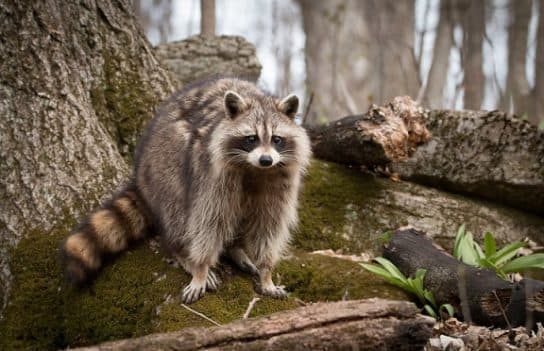
The striped raccoon is a natural enemy of the Caucasian otter
Video about the Caucasian otter


