


- 1 What Defines a Volcano Type?
- 2 Main Types of Volcanoes
- 3 Comparison of Volcano Types
- 4 How Volcano Types Affect Real Life
- 5 Infographic “Understanding Types of Volcanoes”
- 6 Typical Mistakes When Thinking About Volcanoes
- 7 FAQ: Common Questions About Types of Volcanoes
- 8 Short Version: What to Do Right Now
- 9 Sources Used


Have you ever seen footage of a volcano and wondered why some eruptions look like slow rivers of lava, while others explode like bombs?
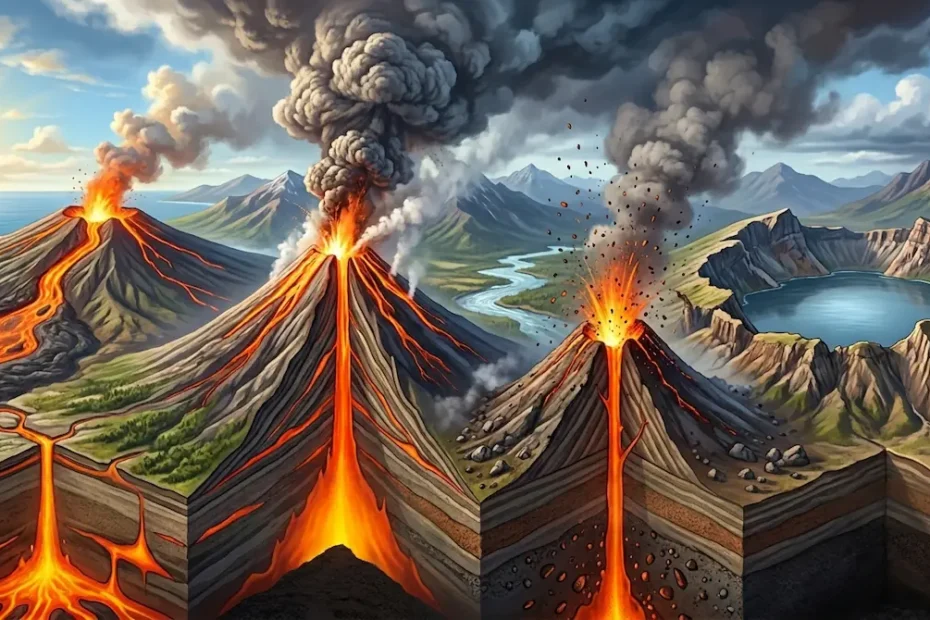
It’s easy to assume all volcanoes behave the same. But in reality, they differ dramatically — in shape, structure, eruption style, and level of danger. Understanding the types of volcanoes isn’t just about geography. It explains why certain regions face slow-moving lava flows, while others deal with sudden, destructive explosions.
This article breaks it down clearly. No jargon overload. Just what you need to actually understand how volcanoes work — and why their differences matter in real life.
What Defines a Volcano Type?
Before diving into categories, it’s important to understand what determines a volcano’s type. It’s not random.
The main factors are:
- Magma composition (how thick or fluid it is)
- Gas content (how much pressure builds up)
- Eruption style (explosive vs. gentle)
- Structure over time (how layers accumulate)
These elements combine to create distinct forms — each with its own behavior and risks.
“The viscosity of magma is the key control on eruption style.” — U.S. Geological Survey (USGS)
Main Types of Volcanoes
There are several recognized types of volcanoes, but four major categories cover most cases.
1. Shield Volcanoes
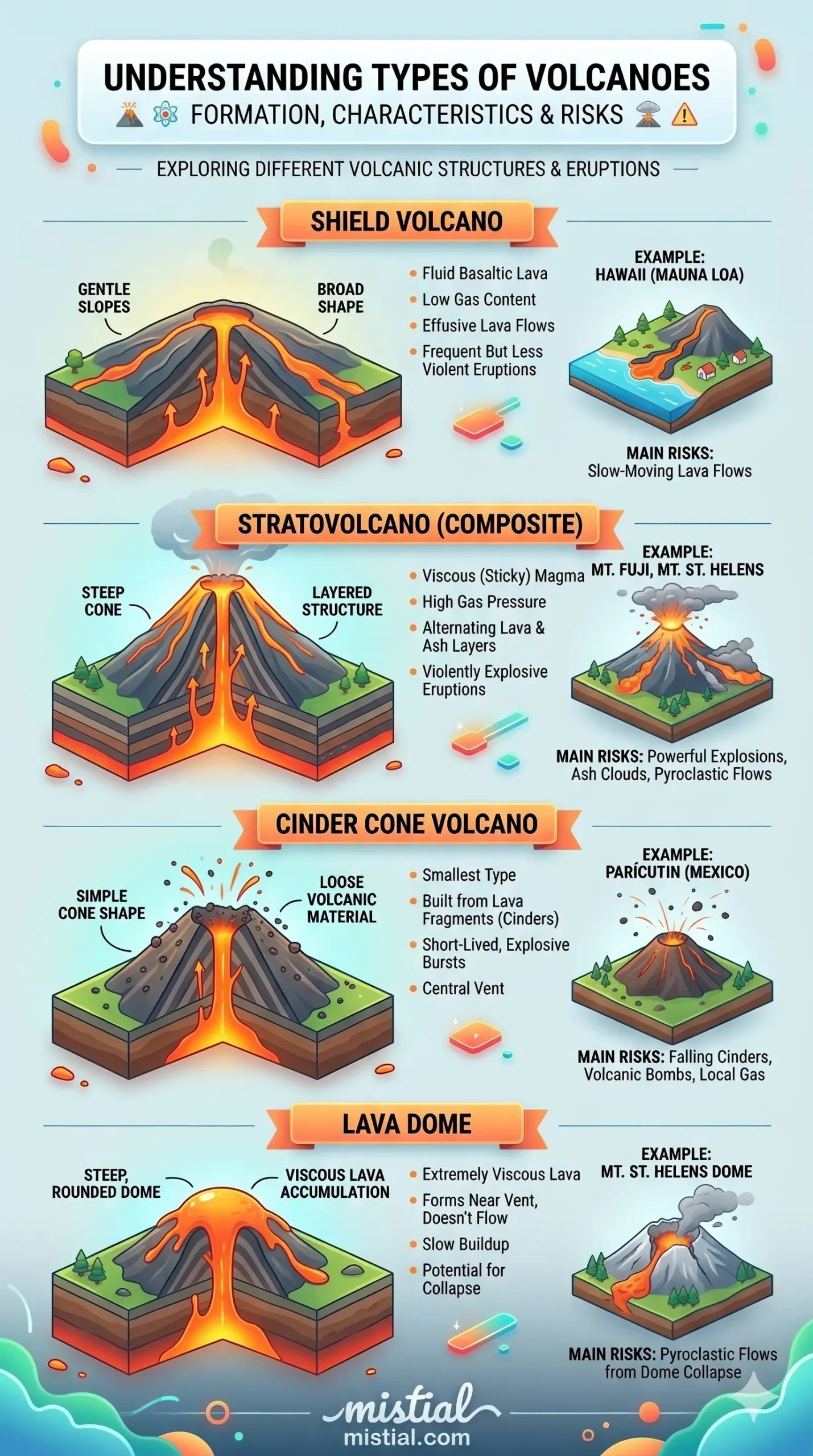
Shield volcanoes are wide, gently sloping, and often massive in size. Instead of explosive eruptions, they produce slow-moving lava flows.
Think of them as “lava fountains” rather than “lava bombs.”
How they form
They are built by repeated eruptions of fluid (low-viscosity) basaltic lava, which spreads easily over large distances.
Key characteristics
- Broad, dome-like shape
- Low slope angles
- Frequent but less violent eruptions
- Large surface area
Real-life example
Hawaiian volcanoes are classic shield volcanoes. Lava can flow for kilometers, sometimes threatening homes — but usually allowing time to evacuate.
What it means in practice: The danger is not sudden explosions, but slow destruction of land and infrastructure.
2. Stratovolcanoes (Composite Volcanoes)
If you picture a “classic volcano” — steep, cone-shaped, and explosive — you’re probably thinking of a stratovolcano.
How they form
They are built from alternating layers of lava, ash, and volcanic debris. This layering creates unstable pressure conditions.
Key characteristics
- Steep sides
- Layered structure
- Explosive eruptions
- Thicker, more viscous magma
Real-life example
Mount Fuji in Japan and Mount St. Helens in the U.S. are well-known stratovolcanoes.
What it means in practice: These volcanoes are among the most dangerous. Eruptions can be sudden and highly destructive, producing ash clouds, pyroclastic flows, and lahars (mudflows).
3. Cinder Cone Volcanoes
These are the simplest and often smallest type of volcano. But don’t underestimate them.
How they form
They form from explosive eruptions that eject fragments of lava into the air. These fragments fall back and pile up around the vent.
Key characteristics
- Small, steep cone shape
- Short-lived eruptions
- Loose volcanic material (cinders)
Real-life example
Parícutin in Mexico formed suddenly in a farmer’s field in 1943 and grew rapidly over a few years.
What it means in practice: They can appear quickly and disrupt local areas, but are usually less globally destructive.
4. Lava Domes
Lava domes look very different from typical volcanoes. Instead of flowing outward, lava piles up near the vent.
How they form
They are created by very thick, viscous magma that doesn’t travel far. It accumulates and forms a dome-like structure.
Key characteristics
- Steep, rounded shape
- Highly viscous lava
- Potential for sudden collapse
Real-life example
The dome inside Mount St. Helens formed after its major eruption.
What it means in practice: Lava domes can become unstable. When they collapse, they may trigger dangerous pyroclastic flows.
Comparison of Volcano Types
| Type | Shape | Magma Type | Eruption Style | Main Risk |
|---|---|---|---|---|
| Shield | Wide, gentle slopes | Low viscosity (fluid) | Effusive (lava flows) | Slow-moving lava |
| Stratovolcano | Steep cone | High viscosity | Explosive | Ash, pyroclastic flows |
| Cinder Cone | Small, steep cone | Variable | Short, explosive bursts | Local ash and debris |
| Lava Dome | Rounded dome | Very high viscosity | Slow buildup, sudden collapse | Pyroclastic flows |
How Volcano Types Affect Real Life
Understanding volcano types is not just academic. It directly impacts:
- Evacuation planning
- Urban development
- Risk assessment
- Emergency response timing
For example:
- In Hawaii, people monitor lava flow paths.
- Near stratovolcanoes, authorities watch gas pressure and seismic activity closely.
- In volcanic regions, building codes may reflect eruption risks.
The type of volcano determines how much warning you get — and what kind of danger to expect.
Infographic “Understanding Types of Volcanoes”
Infographic “Understanding Types of Volcanoes”
Typical Mistakes When Thinking About Volcanoes
1. “All volcanoes are explosive”
Many eruptions are slow and predictable. Shield volcanoes rarely explode dramatically.
2. “If it’s quiet, it’s safe”
Some volcanoes remain dormant for decades — then erupt suddenly.
3. “Lava is the biggest danger”
In many cases, ash clouds and pyroclastic flows are far more dangerous than lava itself.
4. “Volcanoes only exist in remote areas”
Millions of people live near active volcanoes. Cities like Naples (near Mount Vesuvius) are prime examples.
FAQ: Common Questions About Types of Volcanoes
Which type of volcano is the most dangerous?
Stratovolcanoes are generally considered the most dangerous due to their explosive eruptions and complex hazards.
Are shield volcanoes safe?
They are usually less explosive, but still dangerous. Lava flows can destroy homes and infrastructure.
Can a volcano change its type?
Not exactly, but its behavior can evolve over time depending on magma composition and tectonic conditions.
Why are some eruptions explosive?
It depends on gas pressure and magma thickness. Thick magma traps gases, leading to explosive releases.
Do all volcanoes erupt regularly?
No. Some erupt frequently, others may stay dormant for centuries.
How do scientists predict eruptions?
They monitor seismic activity, gas emissions, ground deformation, and temperature changes.
Short Version: What to Do Right Now
- Understand the type of volcano in your region (if applicable)
- Follow official geological or emergency updates
- Learn evacuation routes in volcanic zones
- Do not rely on myths or outdated information
- Stay informed through reliable scientific sources
Sources Used
- U.S. Geological Survey (USGS) — Volcano Hazards Program
- Smithsonian Institution — Global Volcanism Program
- Encyclopaedia Britannica — Volcano Types and Eruptions
- National Geographic — Volcanoes and Eruption Styles
- Sigurdsson, H. (Ed.). Encyclopedia of Volcanoes

