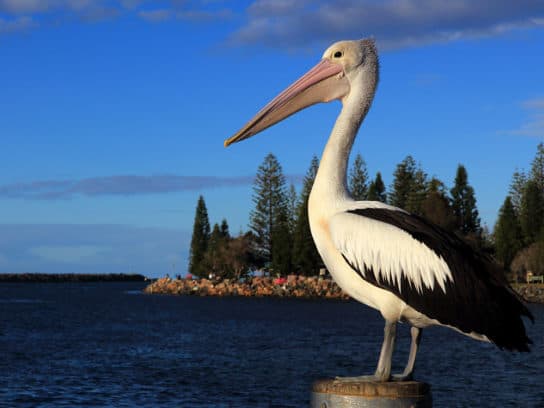


There are 8 types of pelicans on the planet. These are waterfowl, carnivorous birds, they fish on the ocean coast and / or on lakes and rivers. Pelicans use webbed feet to move quickly in the water; they grab fish with their long beaks – the main source of food. Many species dive and swim deep underwater to catch their prey.
Pelican
Description of the pelican
All pelican species have legs with four webbed toes. Paws are short, so pelicans look awkward on land, but when they get into the water, they become graceful swimmers and hunters.
All birds have large beaks with a throat sac with which they catch prey and drain water. The sacs are also part of mating rituals and regulate body temperature. Pelicans have a large wingspan, they skillfully fly in the air, and not only swim in the water.
Pink pelican


Curly pelican


Pelican habitat
Pelicans live on all continents except Antarctica. DNA studies have shown that pelicans belong to three main species:
- Old World (gray, pink and Australian);
- great white pelican;
- New World (brown, American white and Peruvian).
Pelicans fish in rivers, lakes, deltas and estuaries. But sometimes they hunt amphibians, turtles, crustaceans, insects, birds and mammals. Some species nest on the coast near the seas and oceans, others near the large continental lakes.

Diet and behavior of pelicans
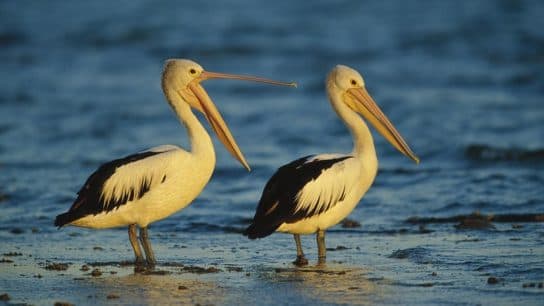
Pelicans grab their prey with their beaks and then drain the water from the pouches before swallowing live food. At this moment, gulls and terns are trying to steal fish from their beak. Birds hunt singly or in groups. Pelicans dive into the water at high speed, catch prey. Some pelicans migrate long distances, others are sedentary.
Pelicans are social creatures, they build nests in colonies, sometimes birdwatchers number thousands of pairs in one place. The largest species – great whites, American whites, Australian pelicans and Dalmatians – nest on the ground. Lesser pelicans build nests in trees, bushes, or on rock ledges. Each pelican species builds nests of individual size and complexity.
How pelicans breed
The breeding season for pelicans depends on the species. Some species give birth to offspring annually or every two years. Others lay eggs during specific seasons or all year round. Pelican egg color:
- chalky;
- reddish;
- pale green;
- blue.
Pelican mothers lay eggs in clutches. The number of eggs depends on the species, from one to six at a time, and the eggs are incubated for 24 to 57 days.
Male and female pelicans jointly build nests and hatch eggs. Dad chooses a nesting site, collects sticks, feathers, leaves and other debris, and mom builds a nest. After the female lays eggs, dad and mom take turns standing on them with webbed paws.
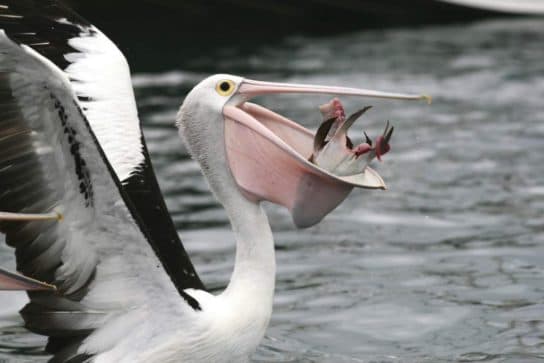
Both parents take care of the chickens, feed them with regurgitated fish. Many of the species take care of offspring up to 18 months of age. Young pelicans take 3 to 5 years to reach sexual maturity.
Interesting Facts
- The oldest pelican fossil found, 30 million years old. The skull was dug up in Oligocene sediments in France.
- Birds breathe through the mouth, as their nostrils are closed by the cornea of the beak.
- The average lifespan of pelicans in nature ranges from 10 to 30 years, depending on the species.
- They easily hold up to 13 liters of water in the throat bag.
- Pelicans fly up like eagles thanks to their giant wings.
- The Great White Pelican is the heaviest species, weighing between 9 and 15 kg.
- These birds travel in flocks in the form of a wedge elongated in a row.
Pelicans – video