


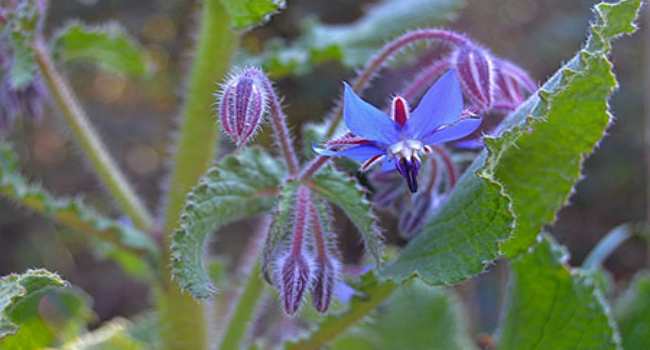


Many plant species are undeservedly forgotten by mankind. Borago, a cucumber herb, which some consider a weed, can also be safely attributed to such herbs. True, in Asian countries and even in Europe, it is cultivated and respected as a vegetable and medicinal crop. In addition to its beautiful blue flowers and a pleasant cucumber scent, it has traditionally been used to treat internal and external diseases. For these reasons, you need to learn in more detail about all the beneficial properties of borago and how safe it is, whether it has contraindications.
Borago is an annual plant. It belongs to the monotypic genus of flowering plants from the borage family of the same name. According to botanists, the only species of this genus of plants is borage medicinal, in the common people known as borage, borage grass, borage.
The name of the plant comes from the medieval Latin “burra”, which means “hairy”. However, there is an alternative version, which says that it is a derivative of the Latin “corago” or “courage”.
A similar type of plant has been known since the days of Ancient Rome. True, for a long time it was referred to as a weed and was not particularly respected.
According to scientists, it originally spread from Syria. Today, wild borage can be seen in Asia Minor, North Africa, South America and Southern Europe. Although, in European countries, it is cultivated specifically as a vegetable crop.
The Slavs, however, still consider this annual plant with a coarse-haired covering of leaves and stems, which can grow up to one meter in height, as a useless weed. Therefore, not everyone uses borage for food.
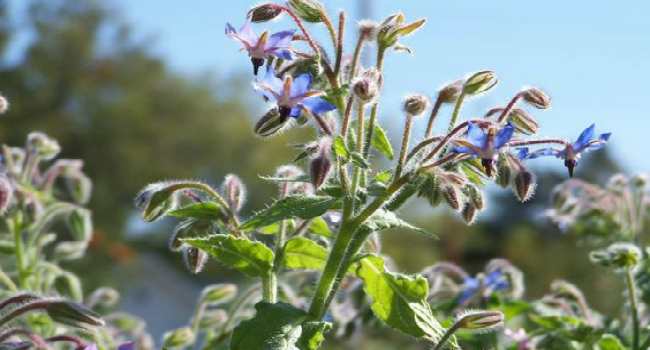
Externally, borage is characterized by:
- straight thick ribbed stem (sometimes ascending);
- branching at the top;
- oval or elliptical basal and lower leaves;
- short, blunt at the top, petioles;
- the presence of hard whitish hairs on the entire aerial surface;
- purple (or dark blue) star-shaped flowers on long legs, gathered in curls;
- oblong-ovoid fruit-nuts;
- taproot.
Flowering occurs in June-August, attracting a lot of bees, which is important for pollination of other plants in the garden and vegetable garden. Fruit ripening occurs from July to September.
Those who do not ignore the value of borage most often plant it between potato bushes. Borage herb is believed to reduce the spread of the Colorado potato beetle by as much as 95%.
Borago composition
Borage leaves were once used in Europe exclusively as a remedy. There is a mention of him in the writings of Pliny, Dioscorides, Galen. Now this plant is most often grown as one of the first green salad plants.
As you know, any kind of herbaceous plants can be considered a dietary product. The well-known borage plant (also called borage herb or borage) is one of these products.
The fact is that the composition of this plant is not so poor and contains:
- protein (or protein);
- carbohydrates;
- saponins;
- mucous substances;
- tannin;
- essential oils (mostly found in flowers);
- organic acids (citric and malic);
- a lot of ascorbic acid;
- beta-carotene;
- a number of minerals (among them potassium salts are especially prominent);
The total calorie content of 100 g of the borage plant is only 21 kilocalories.
In terms of the energy percentage (proteins, fats and carbohydrates), it is represented by 34/0/58%.
Useful properties of borago
In ancient times, cucumber herb was known as an excellent medicine. Today, it has moved into a food product and is grown for the leaves, which are rich not only in many beneficial nutrients, but also have a cucumber smell.
Soothing;
Laxatives
Anti-inflammatory;
Diuretic;
Diaphoretic;
Stimulating.
The main beneficial properties of cucumber herb include:
- toning the body;
- getting rid of depression;
- increased mood;
- getting rid of articular rheumatism;
- removal of the manifestations of gout;
- regulation of metabolic processes;
- general sedative effect;
- can function as a mild laxative;
- has a diuretic effect;
- reduces elevated body temperature due to diaphoretic effects on the body;
- for the gastrointestinal tract, it performs an enveloping function;
- inflammatory processes in the kidneys and intestines are prevented;
- the leaves are used for diseases of the liver and gallbladder;
- the risks of developing cardiovascular diseases are reduced;
- blood pressure stabilizes in hypertensive patients;
- “bad” cholesterol is removed;
- blood glucose is normalized;
- can be used as a natural detoxifier for the body.
Borago culinary uses
Borage is cultivated in Europe for a reason. After all, the taste of its young leaves is distinguished by a pronounced fresh borage aroma mixed with green onions.
Most often, borage (or rather, its leaves) are used for making salads, vinaigrettes, sauces (tomato, sour cream, mustard), borscht (best for green sorrel), garnish for fish and meat. The combination of borage leaves with minced meat, minced meat and fried fish is considered especially correct.
Borage flowers are usually candied. It’s just that the flowers of the plant are considered an excellent honey plant and therefore are very sweet in this form.
The root of the plant is also actively used. Dug it out in the fall:
- added to cheeses, sour cream and cottage cheese;
- use as a perfume for any tinctures;
- used as a basis for the production of wines and beer;
- add (like leaves) to refreshing alcoholic and non-alcoholic drinks;
- used in the production of syrup and essences with the aroma of cucumber herb.
In general terms, cucumber herb is widely used in the alcoholic beverage and confectionery industries. For example, in Iran, flowers are harvested during the flowering period, dried and used as herbal natural tea.
To remove the “prickly” it is recommended to knead the leaves a little or roll them out with a rolling pin.
Borago contraindications and harm
Of course, borage leaves are a great alternative to fresh cucumbers. But their use in food should be limited and not exceed the recommended dosages. Therefore, it is not recommended to use leaves (both fresh and dried; it is customary to steam the latter or make decoctions from them) for more than a month. In fact, this is the main contraindication.
More about borage – cucumber grass in this video


