


- 1 Why TikTok Ads Feel Different (And Why That Matters)
- 2 What Changed in TikTok Ads Strategy for 2026
- 3 Core TikTok Ads Funnel (Simplified)
- 4 Creative Frameworks That Work Right Now
- 5 Typical Mistakes in TikTok Ads
- 6 How to Structure Testing (Without Wasting Budget)
- 7 Budget Strategy: Where Most People Get It Wrong
- 8 Organic + Paid: The Overlooked Combination
- 9 What Makes People Actually Click
- 10 FAQ: TikTok Ads Strategy 2026
- 11 Short Version: What to Do Right Now
- 12 Sources


Ever launched an ad that looked perfect on paper… but completely flopped in real life? You’re not alone. TikTok doesn’t reward polished marketing — it rewards relevance. And in 2026, that gap is even wider.
What worked a year ago can quietly stop working today. Trends move faster. Users scroll harder. And brands that treat TikTok like a traditional ad platform usually end up paying for impressions instead of results.
This guide breaks down what actually works now — not theory, but practical strategy you can apply immediately.
Why TikTok Ads Feel Different (And Why That Matters)
Most platforms interrupt users. TikTok blends into their behavior.
That single difference changes everything:
- Users don’t want ads — they want content
- Creative matters more than targeting
- Authenticity beats production quality
- Speed of iteration is a competitive advantage
In short: you’re not buying attention — you’re earning it.
“TikTok is not a social media platform. It’s a content engine with an ad layer on top.”
What Changed in TikTok Ads Strategy for 2026
1. Creative Is the Targeting
Algorithmic targeting has improved to the point where your audience is often found through content signals — not manual settings.
This means:
- Hooks matter more than interests
- Visual context matters more than demographics
- Storytelling drives delivery
Example: A skincare brand targeting “women 25–34” may underperform compared to a video showing “morning acne routine before work.”
2. Shorter Isn’t Always Better
While fast hooks still matter, longer videos are increasingly rewarded if they retain attention.
What works now:
- 15–35 seconds for impulse products
- 30–60 seconds for problem-solution storytelling
- 60+ seconds for education or trust-building
The key is not length — it’s retention.
3. Native Look Is Non-Negotiable
If your ad looks like an ad, users scroll.
Winning creatives often:
- Use phone-style filming
- Include imperfections
- Start mid-action (not with branding)
- Feel like organic posts
Core TikTok Ads Funnel (Simplified)
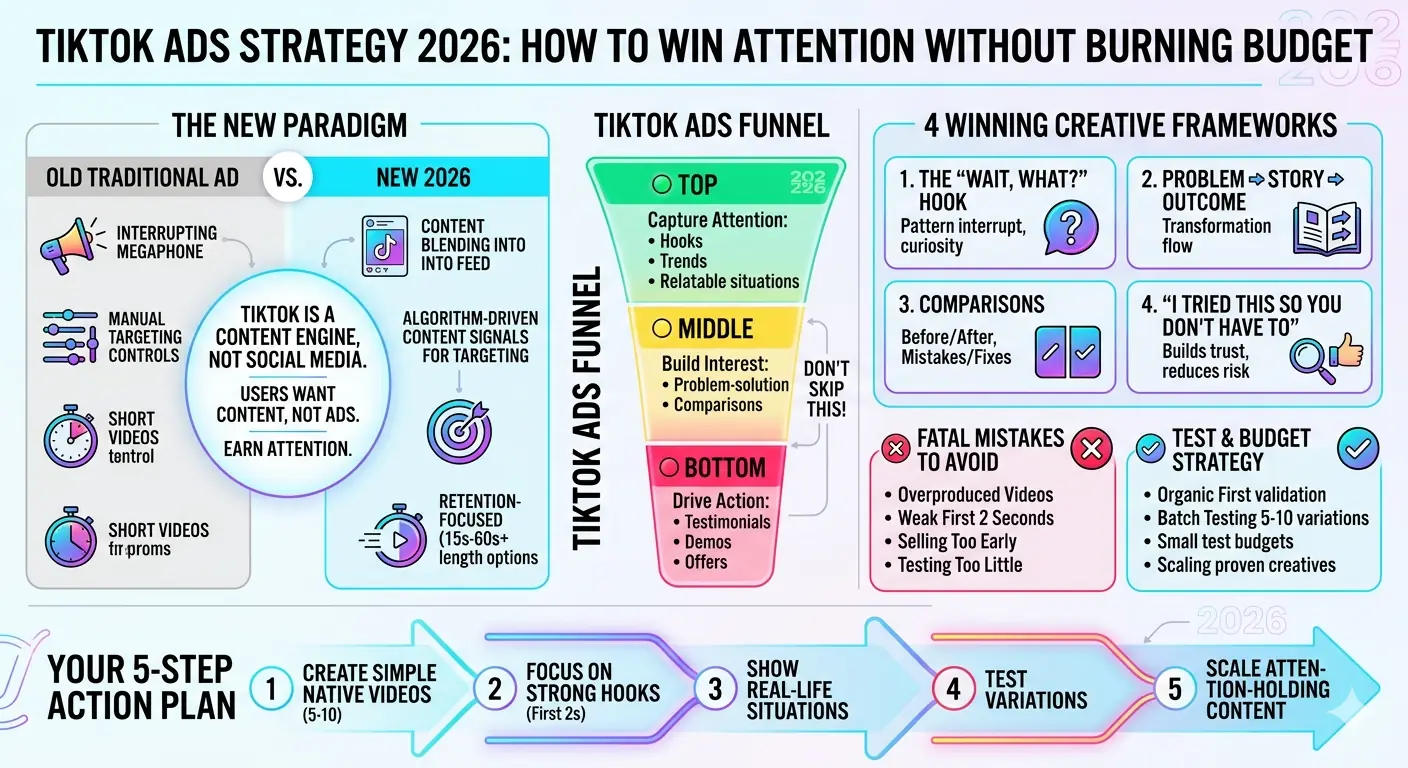
Infographic TikTok Ads Strategy 2026: How to Win Attention Without Burning Budget
A strong TikTok ads strategy in 2026 is not just about running campaigns — it’s about building a system.
| Stage | Goal | Content Type |
|---|---|---|
| Top of Funnel | Capture attention | Hooks, trends, relatable situations |
| Middle of Funnel | Build interest | Problem-solution, comparisons |
| Bottom of Funnel | Drive action | Testimonials, demos, offers |
Important: Many brands skip the middle — and that’s where trust is built.
Creative Frameworks That Work Right Now
1. The “Wait, What?” Hook
Pattern interrupt + curiosity.
Example:
- “I thought this product was a scam until…”
- “No one tells you this about…”
2. Problem → Micro Story → Outcome
Instead of listing features, show transformation.
Structure:
- Relatable pain
- Short personal experience
- Visible result
3. Comparison Content
Users love contrasts.
- Before / after
- Cheap vs expensive
- Common mistake vs better approach
4. “I Tried This So You Don’t Have To”
Reduces risk for the viewer and builds trust quickly.
Typical Mistakes in TikTok Ads
1. Overproduced Videos
High production can reduce performance because it breaks the native feel.
2. Weak First 2 Seconds
If nothing happens instantly, users leave.
3. Selling Too Early
Pushing a product before building context kills engagement.
4. Testing Too Little
One or two creatives is not testing — it’s guessing.
How to Structure Testing (Without Wasting Budget)
Instead of trying to perfect one ad, build volume.
- Create 5–10 variations of the same idea
- Change only one variable at a time (hook, angle, CTA)
- Let data run before making decisions
- Scale what retains attention, not just what gets clicks
Think in batches, not individual ads.
Budget Strategy: Where Most People Get It Wrong
Throwing money at ads doesn’t fix weak creatives.
In 2026, a better approach:
- Start with small test budgets
- Scale only proven creatives
- Refresh content frequently
- Accept creative fatigue as normal
Reality: ads don’t die — they get ignored.
Organic + Paid: The Overlooked Combination
Some of the best-performing ads start as organic posts.
Why this works:
- Organic validates content before spending
- Engagement signals help ad performance
- Lower risk during testing
Many brands now:
- Post content organically
- Identify top performers
- Turn them into ads
What Makes People Actually Click
Clicks don’t come from features. They come from relevance.
Users act when they feel:
- “This is about me”
- “I’ve had this problem”
- “This might actually work”
“People don’t buy products. They buy relief, identity, or improvement.”
FAQ: TikTok Ads Strategy 2026
How much should I spend to start TikTok ads?
Start with a testing mindset rather than a fixed number. The goal is to validate creatives first, not scale immediately.
How many creatives do I need?
More than you think. A small set limits learning. Testing multiple angles increases your chances of finding what resonates.
Do I need influencers for TikTok ads?
Not necessarily. But using real people — including creators — often improves performance because it feels more authentic.
How long does it take to see results?
Some signals appear quickly (like watch time), but stable performance usually requires multiple iterations.
Can TikTok ads work for serious or “boring” industries?
Yes, if you focus on human problems instead of technical details. Even complex services can be simplified through storytelling.
Is it better to follow trends or create original content?
Both approaches work. Trends give reach; original ideas build differentiation.
Short Version: What to Do Right Now
- Create 5–10 simple, native-style videos
- Focus on strong hooks in the first 2 seconds
- Use real-life situations, not product descriptions
- Test variations instead of chasing perfection
- Scale only what holds attention and drives engagement
Sources
- TikTok Business Help Center and Advertising Guidelines
- “Contagious: How to Build Word of Mouth in the Digital Age” — Jonah Berger
- “Made to Stick” — Chip Heath & Dan Heath
- eMarketer reports on social media advertising trends
- Think with Google — consumer behavior insights

