


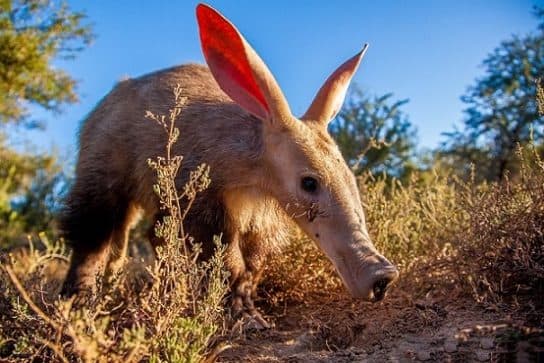


Aardvark is perhaps the most amazing and unusual animal on the African continent. Local tribes call the aardvark abu-delaf, which translated into Russian sounds like “the father of claws.”
Description
Those who first saw the aardvark describe it like this: ears like a hare, a piglet like a pig, and a tail like a kangaroo. An adult aardvark reaches one and a half meters in length, and the length of its powerful and muscular tail can reach 70 centimeters. Adult aardvarks are slightly more than half a meter high. Abu Delaf’s weight reaches one hundred kilograms. The body of the animal is covered with tough brownish bristles. The muzzle of the aardvark is elongated with many long and hard tactile hairs (vibrissae), and at the end there is a patch with round nostrils. Aardvark’s ears grow up to 20 centimeters. Also, the aardvark has glues and a rather long tongue.
The aardvark has powerful limbs. On the front legs there are 4 toes with powerful and long claws, and on the hind legs there are 5. At the time of digging holes and obtaining food, the aardvark rests completely on its hind feet for greater stability.


The habitat of the aardvark
Currently, the aardvark can be found only on the African continent, south of the Sahara. In choosing a habitat, aardvark is unpretentious, however, on the continent it avoids dense equatorial forests, swamps and rocky terrain, since it is quite difficult to dig there.
Aardvark is comfortable in the savannah and places that are flooded during the rainy season.


What eats aardvark
Aardvarks are nocturnal animals and during hunting cover large territories, approximately 10-12 kilometers per night. Interestingly, the aardvark walks along the paths already known to itself. Aardvark advances, tilting its muzzle to the ground, and very loudly inhales air (sniffing) in search of ants and termites, which make up the main diet. Also, aardvark does not refuse insects, which also crawled out of their holes in search of food. When the desired prey is found, the aardvark with its powerful front paws tears apart the shelter of termites or ants. With a long, sticky saliva, tongue, it collects insects very quickly. Aardvark can eat about 50 thousand insects in one night.
As a rule, in the dry season, aardvarks feed mainly on ants, but termites prefer to feed during the rainy season.


Natural enemies
This cute little animal has a lot of enemies in its natural habitat, since the aardvark is quite clumsy and slow.
So the main enemies of adult aardvarks include the lion and cheetah, as well as humans. Hyena dogs often attack the aardvark.
Since the abu-delaf is a very shy animal, at the slightest danger, or rather even a hint of danger, he immediately hides in his hole or buries himself underground. However, if there is no way out or the enemy has crept very close to the aardvark, it can successfully defend itself with its front claws.
For the young, pythons are a great danger.
Interesting Facts
- Scientists consider the aardvark a living fossil, since its ancient genetic makeup is very well preserved, and its genus is classified as one of the most ancient among mammals of the infraclass placental.
- Due to the special structure of the nose, the aardvark sniffs very noisily or grunts quietly. But when the animal is very frightened, it emits a fairly loud bellowing cry.
- Females bear cubs for about seven months. Aardvark is born about two kilograms in weight and half a meter long. The cub switches to the main food only after 4 months. Before that, he feeds exclusively on breast milk.
- Aardvark digs holes at an astonishing speed. In 5 minutes, the aardvark pulls out a hole one meter deep.
- This animal got its bizarre name thanks to its teeth. Such a structure of teeth is no longer found in any representative of living nature. His teeth are made up of dentinal tubules fused together. They do not have enamel and roots, and are in constant growth.
Video about aardvark


