


The most graceful and dangerous predator of the entire cat family. The name comes from the name of the state of Bangladesh, where it is considered the national animal.
Appearance
The body color of this species is mainly red with dark and brown stripes. The chest is covered with white hair. The eyes match the base coat color and have a yellow tint. It is not uncommon in nature to meet a white Bengal tiger with bright blue eyes. This is due to a specific gene mutation. Such species are artificially bred. A formidable predator, the Bengal tiger attracts attention with its large size. Its body can vary from 180 to 317 centimeters in length, and this is without taking into account the length of the tail, which will add another 90 centimeters in length. Weight can range from 227 to 272 kilograms.

The Bengal tiger’s trademark is its sharp and long claws. For fruitful hunting, this representative is endowed with very powerful jaws, well-developed hearing aids and sharp eyesight. Sexual dimorphism lies in size. Females are much smaller than males. The difference may be 3 meters in length. The life span of this species in the wild ranges from 8 to 10 years. Extremely rare individuals can live up to 15 years, inhabiting the territory of wild fauna. In captivity, the Bengal tiger can live up to a maximum of 18 years.
Habitat
Due to their characteristic color, Bengal tigers are well adapted to all the features of their natural habitat. This species is considered popular in Pakistan, Eastern Iran, central and northern India, Nepal, Myanmar, Bhutan and Bangladesh. Some individuals settled at the mouth of the Indus and Ganges rivers. As a habitat, they prefer to inhabit the tropical jungle, rocky expanses and savannahs. At the moment, there are only 2.5 thousand individuals of Bengal tigers.

Bengal Tiger Range Map
Nutrition
The prey of the Bengal tiger can be literally any large representative of the fauna. They attack animals such as wild boars, roe deer, goats, elephants, deer, and guars. Quite often they can hunt red wolves, foxes, leopards and even crocodiles. As a small snack, he prefers to eat frogs, fish, snakes, birds and badgers. In the absence of a potential victim, it can also feed on carrion. In order to satisfy hunger, a Bengal tiger needs at least 40 kilograms of meat per meal. Bengal tigers are extremely patient when hunting. They can watch their future prey for several hours, waiting for the right moment to attack. The victim dies from a bite in the neck.
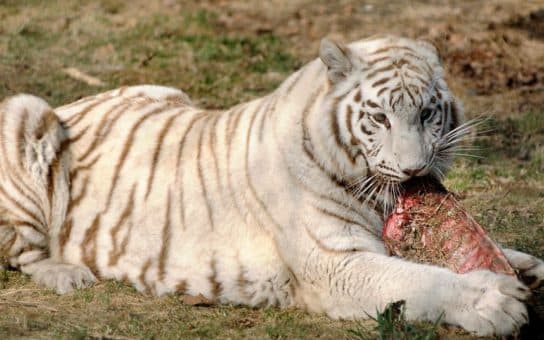
The Bengal tiger kills large predators by breaking the spine. He transfers the already dead prey to a secluded place where he can safely eat. It is noteworthy that the female’s eating habits are slightly different from the male’s. Whereas males eat fish and rodents only in extremely rare cases, females prefer these mammals as their main diet. It is likely that this is due to the smaller size of the female.
Reproduction
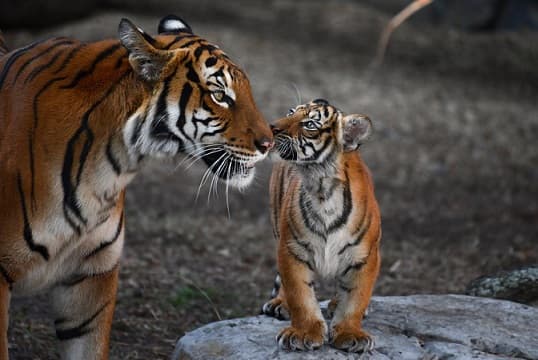
Most Bengal tigers have a breeding season of one year and peak in November. The mating process takes place on the territory of the female. The resulting pair is together for 20 to 80 days, depending on the duration of the estrous cycle. After the end of the cycle, the male leaves the territory of the female and continues its solitary life. The gestation period of Bengal tigers lasts from 98 to 110 days. From two to four kittens with a weight of up to 1300 grams are born. Kittens are born completely blind and deaf. Even small animals do not have teeth, so they are completely dependent on the female. The mother takes care of her offspring and, for two months, feeds them with milk, and only then begins to feed them with meat.
Only by three weeks of life do the cubs develop milk teeth, which then change with permanent canines at the age of three months. And already at two months they follow their mother during the hunt in order to learn how to get food. By the age of one year, small Bengal tigers become extremely agile and are able to kill a small mammal. But they hunt only in small flocks. However, being not yet quite adults, they themselves can become prey for hyenas and lions. After three years, the grown males leave in search of their own territory, and many females remain in the mother’s territory.
Behavior
The Bengal tiger can spend some time in the water, especially during periods of extreme heat and drought. Also, this species is extremely jealous of its territory. In order to scare off unnecessary animals, he marks his area with urine and secretes a special secret from the glands. Even trees are marked by marking them with their claws. They can guard territories up to 2500 square meters. As an exception, he can only admit a female of his own species to his site. And they, in turn, are much more calm about their relatives in their space.

Lifestyle
Many people consider the Bengal tiger to be an aggressive predator that can even attack humans. However, this is not the case. By themselves, these individuals are extremely shy and do not like to go beyond the boundaries of their territories. But you should not provoke this predatory beast, because in the absence of alternative prey, it can easily deal with a person. The Bengal tiger attacks large prey in the form of a leopard and a crocodile only in case of inability to find other animals or various injuries and old age.
Red Book and preservation of the species
Literally a hundred years ago, the population of Bengal tigers numbered up to 50 thousand representatives, and since the 70s, the number has sharply decreased several times. Such a decrease in the population is due to the selfish hunting of people for the carcasses of these animals. Then people endowed the bones of this predator with healing power, and its wool has always been held in high esteem on the black market. Some people killed Bengal tigers just for their meat. At the present stage of development of society, all actions that threaten the life of these tigers are illegal. The Bengal tiger is listed in the Red Book as an endangered species.
