


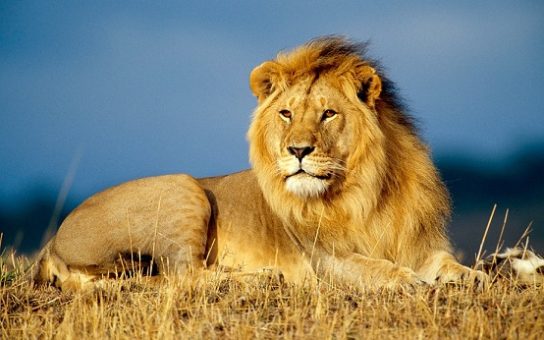
The African lion (Panthera leo) is a predator from the genus of panthers, belongs to the feline family, and is considered the largest cat in the world. In the 19th and 20th centuries, the number of this species declined sharply due to human activities. Having no direct enemies in their own habitat, lions are constantly being destroyed by poachers and safari lovers.
Description
While it is quite difficult to distinguish between representatives of different sexes in other mammals, in lions, gender differences are visible with the naked eye. The male from the female is distinguished not only by the size of the body, but also by the huge mane around the head.
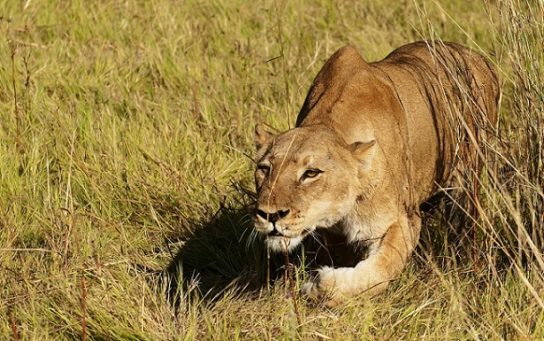
Representatives of a weak stature do not have such decoration, scientists associate this with the fact that it is the lady who plays the role of the breadwinner, and the elongated vegetation on the skin would not allow her to sneak up on the living creatures in the thick grass.
African lions are considered heavyweights among felines, the weight of males can reach 250 kg, and the body length is up to 4 m with the tail and up to 3 m without it. Smaller cats – they weigh up to 180 kg, and the body length does not exceed 3 meters.
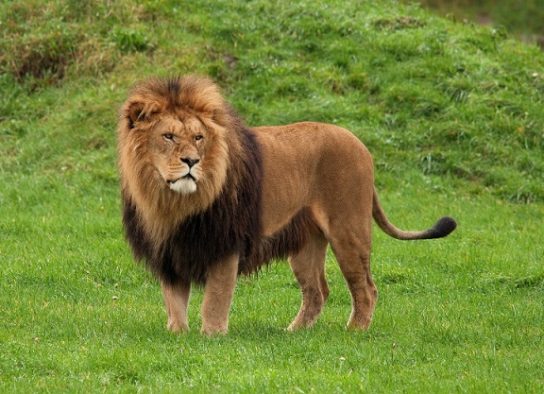
The body of this king of beasts is strong and dense with powerful muscles rolling under the skin. The color of the short, dense coat is most often sandy yellow or cream. Adult lions on their heads wear a luxurious mane of a darker, reddish color with black markings, it descends from the crown and covers part of the back and chest. The older the male is, the thicker his hair is; little boy lion cubs have no such decoration at all. The ears of African lions are small and rounded; before puberty, kittens have light dots in the auricle. The tail is long and smooth-haired, only at its very end there is a fluffy brush.
Habitat
In ancient times, lions could be found on all continents of the globe, at this time, only some regions can boast of having this formidable handsome man. If earlier African lions were common throughout the African continent and even Asia, now Asians are found only in Indian Gujarat, where the climate and vegetation are suitable for them, their number does not exceed 523 individuals. The Africans remained only in Burkina Faso and Congo, there are no more than 2,000 of them.
Lifestyle
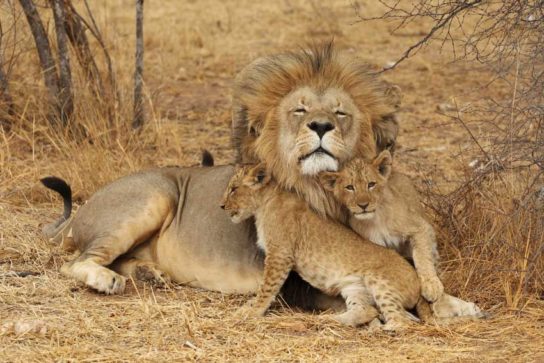
From representatives of other feline species, lions are distinguished by their clannishness: they live in exceptionally large families – prides consisting of several dozen individuals, in which one or two males play the dominant role. All other inhabitants of the family are females and cubs.
The strong half of the pride plays the role of defenders, they drive away from their clan other males who have not yet had time to acquire their own harem. The fight is ongoing, weaker males or young animals never give up trying to beat off other people’s wives.
The cruel truth of nature: if a stranger wins a duel, he will kill all the lion cubs so that the females are more quickly ready to mate and procreate.
For each pride, a certain territory is assigned, with a length of several square kilometers. Every evening the leader notifies the neighbors of the presence of a master in this area with a loud roar and a roar, which can be heard at a distance of 8-9 km.

When young lion cubs grow up and do not need additional care, at about 3 years old, their fathers expel them from the clan. They must leave not only their family, but the entire territory for hunting. Lionesses always stay with their relatives and are protected by the stronger sex as the greatest value.
Reproduction
The estrus period for tigresses of the same clan begins at the same time. This is not only a physiological feature, but also a vital necessity. At the same time, they become pregnant and carry babies for 100-110 days. In one lamb, 3-5 babies up to 30 cm long appear at once, mothers arrange for them to lie in crevices between stones or rocks – this serves as additional protection from both enemies and the scorching sun.
For several months, young mothers with children live separately from the rest. They unite with each other and jointly look after both their own and other’s kittens. During the hunt, the bulk of the lionesses leave the roost, only a few females are engaged in looking after the offspring: it is they who feed and guard all the lion cubs at once.
The average life expectancy of African lions in the natural environment is up to 15-17 years, in captivity it can last up to 30.
Nutrition
The main food of African lions is cloven-hoofed animals that live in the wide expanses of the savannah: llamas, zebras, antelopes. In times of famine, they can encroach on the life of hippos, although it is difficult to defeat them and the meat does not differ in special taste; do not disdain rodents and snakes.
African lion hunting – video
Only lionesses are engaged in food in prides, males do not participate in the hunt and prefer to spend all their free time on vacation, preferably under the crowns of trees. Only lone lions can independently get their own food, and then when hunger is palpable enough. The wives deliver food to the fathers of the families. Until the male eats, the cubs and wives do not touch the game and are content only with the remnants of the feast.
Each adult African lion needs to consume up to 7 kg of meat per day, so the females always hunt together. They hunt down victims, chase, drive away from the herd and surround. They can accelerate during the pursuit up to 80 km / h, although they cover only short distances. Long distances are dangerous for lions, because their hearts are too small and they can not bear excessive stress.
African lion female on the hunt
Interesting Facts
- In ancient Egypt, the lion was considered a deity and kept in temples and palaces as guards;
- There are white lions, but this is not a separate subspecies, but just a genetic mutation, such individuals do not survive in the wild and are often kept in reserves;
- The existence of black lions has not been scientifically confirmed.
