


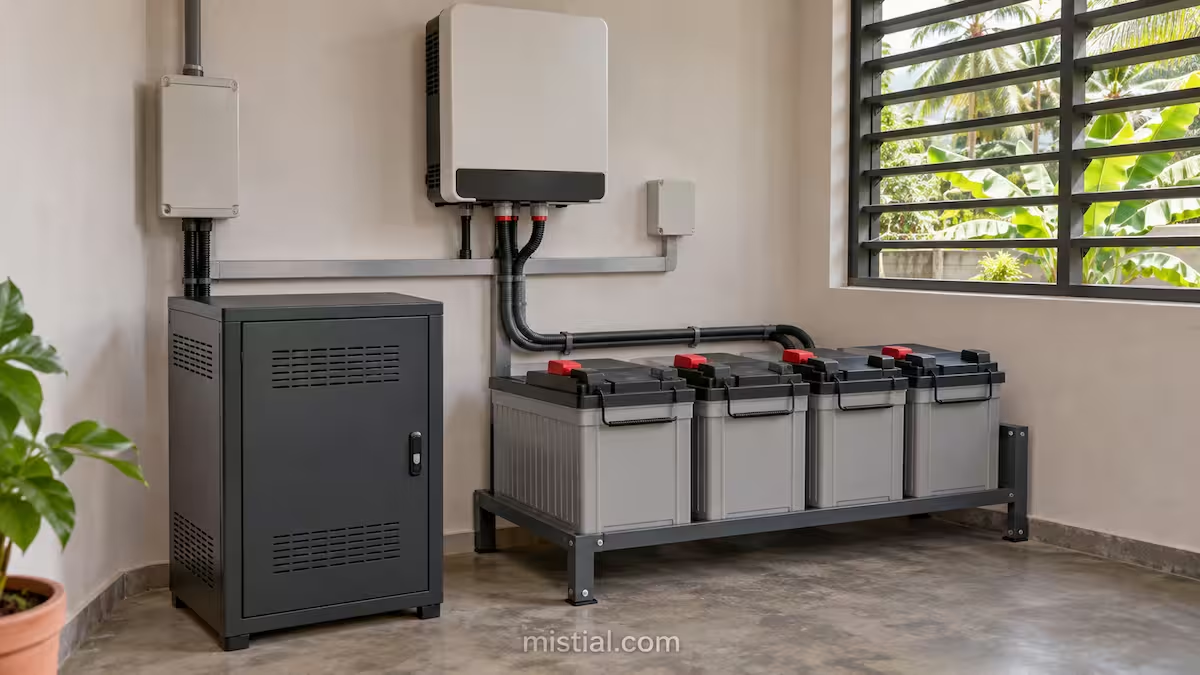
Heat is the quiet enemy of every battery. In a Nigerian home, a battery may spend years at temperatures that would be considered a stress test in a European laboratory. The chemistry and the installation decide how well it copes. This is where lithium iron phosphate and lead-acid part ways.
Lead-acid batteries are familiar and relatively cheap up front, but they have a shorter life when discharged deeply and when kept warm. A typical deep-cycle battery may deliver a few hundred cycles at moderate depth, and fewer at high temperature. Watering, equalising and terminal cleaning are part of ownership. In a hot room with irregular maintenance, the real life can be much shorter than the label suggests.
Lithium iron phosphate, usually shortened to LFP, is more tolerant of heat and much more efficient at accepting and delivering charge. It also has a flatter discharge curve, so the inverter sees a steadier voltage. The cycle life is typically several times that of a lead-acid pack, and there is no watering. The trade-off is a higher purchase price and the need for a battery management system.
Usable capacity is the fair comparison. A lead-acid pack should not be discharged below about half its capacity if it is to last, so a 10 kWh label may give 5 kWh of usable energy. An LFP pack can often be discharged much deeper, so a smaller nameplate can deliver the same daily energy. Comparing nameplate kilowatt-hours without the depth of discharge is misleading.
Charging behaviour also differs. Lead-acid wants a long absorption phase and can sulfate if kept partially charged. LFP accepts current quickly and does not need a long float. In a solar system, the faster acceptance means more of the midday sun goes into the battery instead of being curtailed. That efficiency shows up in the daily yield, especially on short winter days.
Heat tolerance does not mean heat immunity. LFP is safer and more stable than older lithium chemistries, but it still ages faster at high temperature. The installation should keep the battery out of direct sun, provide ventilation and avoid placing it next to a generator, a welding set or a hot roof. A shaded, ventilated room can add years to any chemistry.
A 5.12 kWh LFP home battery is a reasonable starting point for a family that wants a few hours of essential energy without deep cycling every night. One pack covers refrigeration, lighting and entertainment for part of the evening, and a second pack adds headroom for longer outages. The point is to match the pack to the nightly energy and the desired depth of discharge, not to chase the largest number.
Safety is part of the comparison. LFP has a lower risk of thermal runaway than some other lithium chemistries and does not produce the same corrosive fumes as lead-acid during charging. That makes it easier to place indoors, provided the manufacturer’s ventilation requirements are met. A smoke alarm and a clearly labelled disconnect are sensible additions in any case.
Cost should be compared over the life of the system. Divide the purchase price by the usable kilowatt-hours and the expected cycles. Add the maintenance cost for lead-acid: water, terminals, occasional replacement. Add the value of the space and the weight, since a lead-acid bank of the same usable capacity is much larger and heavier. The initial price difference often narrows over a decade.
The right choice depends on the budget and the use. A small, low-cost backup system may still use lead-acid if it is checked regularly. A home that wants low maintenance, deep daily cycling and a compact footprint is better served by LFP. In Nigerian conditions, the heat tolerance and the lower maintenance are not luxuries. They are the difference between a battery that lasts and one that is replaced early.
