


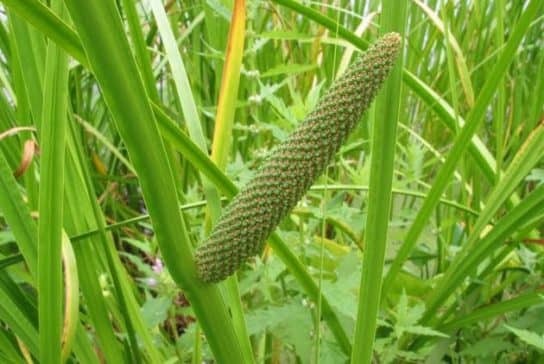


Most of herbaceous plants have unique healing properties and are actively used in medicine, cooking and other fields. Calamus is no exception, which is a representative of the Airnye family. It is believed that the plant first appeared in countries such as India, East and South Asia, and China. After many years, marsh calamus was brought to the territory of our country.
Description and chemical composition
Marsh calamus is a perennial plant that has many additional roots and a main rhizome, which is distinguished by its great thickness and length. The rhizome is greenish-brown in color and has a white core. The plant has a pungent and pungent odor, bitter to the taste.
The maximum height of the marsh calamus stem reaches 120 cm. It should be noted that the leaves of the plant are very long, flat and conical in shape. Calamus belongs to the fruitful plants. The fruits are bright red berries that begin to appear in late spring and bloom until July.
The most common places where calamus blooms are muddy shores of reservoirs and swamps with abundant thickets. Since the plant is not pollinated, reproduction is carried out vegetatively.
The leaves and root of calamus marsh are saturated with many trace elements, namely: essential and tannins, minerals and vitamins, iodine, protein, starch, asarone, calamine alkaloid, calamenone and other components.
Herbaceous plant properties
The main feature of marsh calamus is the presence of medicinal properties, both in the root of the plant and in its leaves. Nowadays, calamus-based essential oil is widely used. It has a characteristic odor and dark color, viscous in consistency. In order not to inhale the harsh aroma, many combine the ingredient with other types of oils, for example, lavender, cedar or citrus.
Essential oil from calamus marsh is used to treat wounds, cracks, ulcers, and is also widely used in cosmetology. The product helps to strengthen hair, relieve irritation and have a bactericidal effect.
Calamus tincture is considered no less popular. It is believed that even impotence can be cured with the help of the remedy.
A decoction from the plant is used to treat the liver, bladder, nervous system and even tuberculosis. For example, in case of heartburn, it is enough to chew the calamus root just a little, and the condition will significantly improve. Rhizome helps to improve appetite, reflex separation of juice in the stomach.
One of the unique properties of calamus marsh is the neutralization of narcotic drugs and suspension of their action.
In addition, the plant helps to relieve toothache and inflammation in the larynx and oral cavity. Regular external use of calamus marsh helps to strengthen tooth enamel and improve gum health.
Contraindications for use
Like any medicine, the use of calamus marsh has side effects. Before using a plant-based product, you should be aware of the contraindications:
- malfunctions of the digestive system;
- gastritis;
- peptic ulcer;
- renal failure;
- poor blood clotting;
- pregnancy and lactation;
- dystonia;
- individual intolerance.
If there is one of the problems, the use of the drug is not recommended. This can adversely affect human health and lead to serious consequences. There are cases when treatment with a marsh calamus drug is carried out externally (compresses and rubbing), then it is allowed to continue using it if an allergic reaction does not occur.

