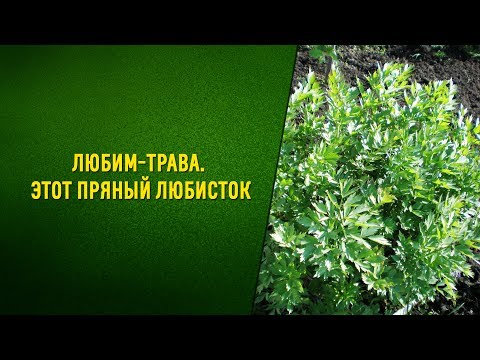
Lovage is a spicy herb belonging to the genus “lovage”, the “celery” or “umbrella” family. The plant has a smell similar to that of celery, bitter and pungent taste.
The herb and lovage root are widely used in cooking, perfumery and as a healing agent in folk medicine.
Description
Iran is considered the homeland of lovage, but now it is found in Europe and America. In the old days, the lovage plant was grown in almost every vegetable garden, as people believed that it brought happiness.
Lovage is a perennial herb with a height of two or more meters. During flowering, light yellow flowers appear. Lovage adapts well to any weather changes and easily tolerates frost.
The stems, leaves and flowers contain essential substances that are widely used in cosmetology, perfumery and in the treatment of many diseases. The greens and roots of lovage contain:
- routine;
- carotene;
- Vitamin C;
- flavonoids;
- mineral and tannins;
- benzoic and acetic acids.
Appearance
Lovage is a tall plant, it reaches a height of 2-2.5 meters. The root system of the plant is thick, branched, large and has a pungent spicy odor.
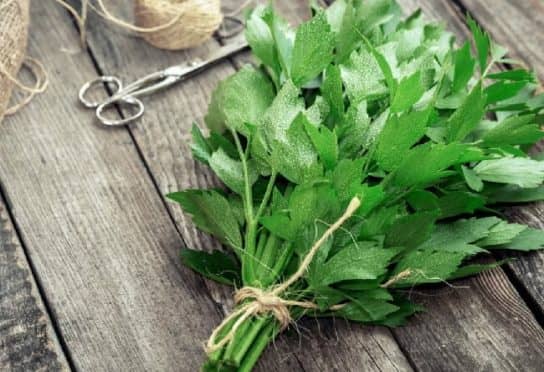

The stem is straight, furrowed and hollow inside. Leaves are dark green, shiny with two or three pinnate cuts:
- The lower leaves are located on petioles about 70 centimeters long;
- the middle leaves have short petioles, smaller in size than the lower ones;
- the upper leaves sit on the stem, have widened depressions and an undeveloped blade.
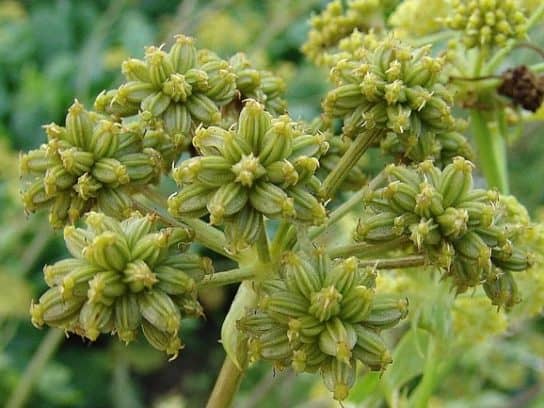
Small flowers form complex umbellate inflorescences with multiple leaves in the form of envelopes. They are whitish-yellow or yellowish-green in color. The perianth is double of five members with five stamens.
The fruit hangs down and is an oval-shaped box with hard, flattened ribs.
Flowering begins in June and ends in August, and fruit ripens in September. The plant has a strong aroma.
Medicinal properties
The lovage herb contains a large number of useful elements, thanks to which it has healing properties.
Lovage, as a medicine, is used to prevent spasms, to relieve inflammatory processes, as an expectorant and diuretic.
The plant helps to improve digestion and appetite, serves to remove excess salts and prevents flatulence, relieves colic in the gastrointestinal tract. Lovage strengthens the immune system, soothes, tones, cleanses the blood, lowers cholesterol levels.
The positive effect of lovage on the human body has a wide range.

Contraindications
Lovage cannot be used if:
- The presence of diseases of pyelonephritis and glomerulonephritis;
- intestinal and stomach ulcer;
- individual intolerance to essential oils;
- internal bleeding;
- pregnancy and lactation;
- with heavy menstruation and the presence of uterine bleeding;
- with hemorrhoids;
- if the child is under 16 years old.
Application
Traditional medicine healers use the roots of the plant to treat diseases such as anemia, gout, migraine, rheumatism, bronchitis, hoarseness, nervous breakdowns, and to heal wounds.
Infusions and decoctions of lovage:
- Disinfect;
- relieve intestinal spasms;
- help with infectious diseases that cause damage to the testicles;
- used: for dermatoses (added to therapeutic baths), with pustular rash, with age spots and baldness;
- drink for heart disease (to improve blood circulation, purify blood, regulate heart activity);
- for potency.
The greens of the lovage plant are used as a seasoning for salads, soups, stews, fried vegetables, seafood dishes.

Recipes
Our ancestors knew many recipes from lovage and roots. They are still used by humans today. To do this, you need to know the disease and make a medicinal product from the plant, observing the dosage and sequence of its preparation.
In asthma and bronchi
1 tablespoon of ground root, pour 250 ml of water, simmer for 15 minutes. After cooling, strain and drink two tablespoons in the morning, at lunchtime and in the evening.
Colic and stomach cramps
Pour 200 ml of boiling water over 1 teaspoon of seeds and leave for one hour. Strain the resulting infusion, drink it all. You can take it only twice a day.
To relieve swelling
Pour 1 teaspoon of chopped root with 200 ml of boiling water, insist for four hours in a container closed with a tight lid. Strain and drink in the morning, at lunchtime and in the evening thirty minutes before eating, 50 ml each.
For colds, to strengthen the immune system
Pour 2 teaspoons of chopped root with 200 ml of water, boil and simmer over the fire for 15 minutes. Infuse the broth in a closed container for four hours. Strain and drink two tablespoons in the morning, at lunchtime and in the evening before meals.
To restore masculine strength
Pour 30 grams of powdered root into 400 ml of water and boil over very low heat for 30 minutes. After cooling, drain. Drink the broth in the morning, at lunchtime and in the evening before meals, 10 grams.
For insomnia and for washing wounds
Pour 1 tablespoon of the root with 250 milliliters of cold water and leave for four hours. Strain the resulting infusion and drink twice during the day.
Moisten or rinse wounds
Dandruff
Pour 1 tablespoon of lovage leaves with 200 milliliters of boiling water and leave for 20 minutes. Strain the infusion and dilute with 500 milliliters of pure water. Rinse hair with infusion after washing.
For acne
Pour 200 ml of boiling water over 1 teaspoon of herbs and boil for five minutes. Pass the resulting broth through a filter and cool. Wipe your face morning and evening.
For pigmentation and freckles
5 grams of root pour 200 ml of boiling water and leave for one hour. Moisten a cotton pad in the solution and apply to the pigmentation site.
Care and cultivation of lovage – video