


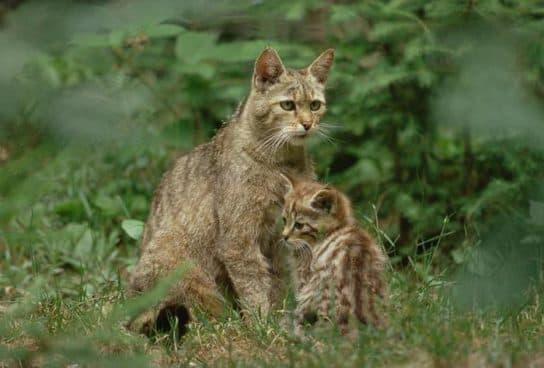


Caucasian forest cat – an animal that belongs to the order of carnivores and the feline family.
Habitat
Representatives of this species live in the Caucasus and Turkey. The animal also inhabits Dagestan and Chechnya, Krasnodar and Stavropol Territories, as well as North Ossetia and the Republic of Adygea. The habitat covers a small part of Armenia and Azerbaijan. The northern border in Russia is located at 45 degrees north latitude.


Habitat
In the Caucasus, the animal lives at about 2000 m above sea level; the forest cat prefers deciduous and coniferous forests. Near the Terek and Kuban rivers, the predator hides in thickets of reeds. The animal loves deaf areas, as it prefers to be invisible. Sometimes the forest cat will hide in buildings or near houses. Hollows and crevices in rocks, burrows of other species often become shelters.

Appearance
The Caucasian forest cat is a large animal. The body weight of males varies from 3.1 to 8 kg, in females this indicator ranges from 3 to 6 kg. The length of the body in males is 50-67 cm, in females – 52-61. The predator’s tail is long – about 20-30 cm. The claws of the animal are sharp. The head is oval. The length of the animal’s ears is 7 cm, they are set wide and do not have tassels at the ends. The forest cat’s eyes are large, it does not have eyelashes. The Caucasian forest cat has white 50-mm vibrissae, their number varies from 7 to 16. The pupil of the animal is vertical, the iris is yellowish. The nose is pink.
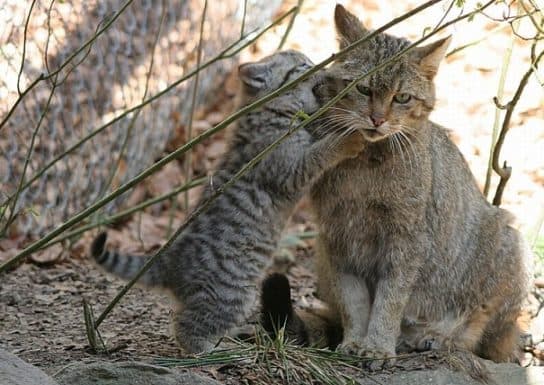

The predator’s coat is dense in winter. Usually the color is gray with red spots, on the ridge, as well as on the head, there is a black stripe. The throat with the belly and groin are reddish. The ocher tinge is noticeable in the undertail area. There are gray spots on the belly of the predator. On the tail of the Caucasian forest cat there are black rings, there are 3-8 of them in total.
What eats
The forest cat can climb trees, but it always hunts on land. The predator’s diet includes rodents and lizards, birds and eggs of other species. In the Kuban River delta, the diet is based on such species as the water rat and the muskrat. In the north of the Caucasus, the animal eats mainly murine rodents. This animal can eat about 20 voles in one meal. The territory of each animal covers approximately 3 km2 sushi.


In the event of a total shortage of the main components of the diet, the forest cat opens the hunt for hares with muskrats, pheasants and young horses. Sometimes a feline catches poultry. The forest cat also has cereals with fruits, carrion and small insects.
Natural enemies
The badger and the raccoon, the fox and the raccoon dog are the enemies of the forest cat. They often fight for food.


Badger is a natural enemy of the Caucasian cat
Reproduction
The rutting period begins at the end of winter – in the spring. During this time, males wipe their secret on the bark of trees to attract females. During the rut, fights among males do not stop.
The forest cat carries cubs for about 70 days. Usually 3-5 babies are born. At the time of birth, they are blind and helpless. The weight of the newborn is 40 g. Vision appears only on the 9th or 12th day. Incisors appear in two weeks, milk teeth are replaced by molars already on the 160th day.

Caucasian cat with kittens
Kittens are born covered with plump hair. The upper part of the body is light in color with brown spots. There are dark stripes on the hind legs. There are already several black rings on the cubs’ tail. There is a bright red spot on the baby’s nose at birth. The mother feeds them with milk for 4 months, but from one and a half months the babies eat mice and rabbits, hares.
Already at 2 months, the cat teaches cubs to hunt. In six months, the males leave, and the females stay with their mother until a year – the onset of puberty. However, offspring often appear only at 3 years old.
Lifestyle
The Caucasian forest cat is more active at night, but in summer the animal hunts during the day. The predator watches the prey for a long time, sitting in ambush, and then catches the game by surprise or starts a chase. If the prey is small, the forest cat grabs it with its claws and bites its neck. For large animals, the predator usually gnaws through the carotid artery.


Red Book
This subspecies of the forest cat is listed in the Red Book of the Russian Federation. This species is rare. The animal is protected in the Teberda Nature Reserve, in the Caucasian Biosphere Reserve. The latter contains only 120 animals. At the moment, the population in the reserve is stable, its number decreases only in winter. The main reason for the extinction of the species is deforestation, the other reason is poaching.
Life in captivity
The Caucasian forest cat loves freedom and has a strong character. The animal is often aggressive and can bite, therefore it is better to choose kittens from catteries. The predator’s diet should consist of fresh meat and fruits.
As a rule, domesticated felines differ from wild relatives in size: they are smaller, their teeth are not so sharp. Such forest cats can be transported in a carrier, do not be afraid to leave with children and train.


Hunting
The Caucasian forest cat can try to catch hamsters, rats and mice in the house, as well as chase birds.
Interesting Facts
- In the past, wild forest cats guarded people’s homes and were actively used for various purposes in war. These animals were quite expensive, they cost as much as an adult bull.
- According to testimonies, Caucasian forest cats were seen already during the reign of the Duke of Wales. They began to be domesticated about 3000 years ago.
- Forest cats usually hiss when pissed off, but they can meow as well.
- Animals migrate frequently in winter.
- In winter, forest cats lose weight, and in summer they gain weight, increasing their body weight several times.
- The maximum lifespan is 21 years, but usually cats die at 13 years old.
- The animal often makes 3-meter jumps while hunting.
- The Caucasian forest cat molts twice a year.
- Where the forest cat is in the vicinity of the jungle cat, it often settles in the so-called “riding” forests, which are located on the slopes of the mountains.
- This representative of the feline swims well, but when “retreating” it hides only in hollows.
- In the Colchis lowland, near Batumi and Poti, forest cats have to walk through mud and wet grass, they constantly swim across fast streams.
Caucasian forest cat – video


