


The famous representative of the feline squad. Belongs to the subspecies of the Bengal tiger. An extremely ancient representative of the fauna, since the remains of these predators are 1.82 million years old. The modern white tiger was only found in 1951 in India.
Appearance
A distinctive feature of this representative is its characteristic white body color. This color is due to a gene mutation, and you can find it in the wild in single copies. The population of this species gained its distribution thanks to the crossing of a unique white tiger with a yellow female. As a result of this crossing, white tigers were born, which develop well and continue their genus in zoos and nurseries. In the wild, he is a rare representative, since his color does not allow him to quietly get his prey.
This representative is an extremely strong and large predator. Growth can range from 2.3 to 2.5 meters in height, and the weight of an adult varies from 180 to 270 kilograms. The spread of indicators is due to the difference in species depending on their habitat and lifestyle. A dangerous predator, the white tiger is endowed with a highly developed jaw apparatus with large, sharp fangs. In total, there are 30 teeth in the mouth of a white tiger. The body is covered with dense and low hair. Black stripes are located on an almost completely white cover. Eye color can be either blue or slightly greenish. It is noteworthy that among the population of white tigers there are also so-called albinos, whose body color is completely white with reddish eyes.
Habitat
White tigers settled in Burma, Nepal, India and Bangladesh. There are representatives of the genus in Asia, from where they lead the population. They settled the islands of Afghanistan, Hindustan, Java and Iran. The population of white tigers in these territories is found in a single specimen per thousand individuals of tigers.


Nutrition
Since this is an absolutely carnivorous predator, the basis of its diet consists exclusively of meat. As a prey, the white tiger prefers to hunt animals such as deer, elk, roe deer, musk deer, tapirs and wild boars. Sometimes they can eat a bird, but mostly partridges and pheasants. Well, like most felines, the white tiger loves to feast on fish.
During the hunt, he stays in ambush, waiting for an opportunity to attack. He can spend a lot of time like that. By themselves, white tigers are extremely smart and accurate predators. They are able to wait for hours for the victim to reach a dead end in order to completely neutralize it. For small mammals, the white tiger is the most feared predator. You cannot run away from him, since he is certainly very fast and agile. It is capable of reaching speeds of 60 kilometers per hour, and when it overtakes the victim, it throws it to the ground and breaks the spine or bites in the neck. Then he drags the dead carcass to his lair to tear it to pieces.
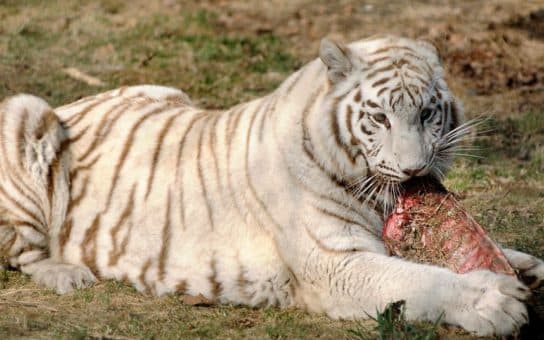

In captivity, these predators feed 6 times a week. They are given fresh meat and various semi-finished meat products. Rabbits and chickens are fed periodically. White tigers starve one day a week, as they have a dense subcutaneous fat layer.
Behavior and character
White tigers are extremely dangerous and aggressive animals. They are very jealous of their territory. In order to preserve their domain, they mark shrubs, trees and rocks with urine. By themselves, white tigers are lonely predators, therefore they do not even accept relatives on their territory. Meeting a person in the wild can mean quick death. In order to weaken the evil temper of white tigers, in captivity they undergo serious training, which is quite dangerous for humans.

Reproduction
The mating period lasts from December to January. There is only one male per female. And if a competitor appears, hot battles take place between the males, which decide who will be the female’s companion. The female can be fertilized during the year for only a few days. The gestation period lasts from 97 to 112 days, and white cubs are born only in March. The female gives birth to no more than four cubs, which weigh from 1.3 kilograms. They are born completely blind. They gain sight at the age of a week. At first, they feed exclusively on mother’s milk. During this period, the female limits the males, since the adult male can attack the cubs. Already at the age of 2 months, little tiger cubs learn to move like their mother. They become full-fledged and ready for an independent life only at the age of 1.5 years. But many cubs spend with their mother until the age of three. Breaking away from the female, small white cubs are in the territory close to her.

Population and status of the species
At the moment, the population of these amazing predators is extremely small in the wild. In total, there are only six thousand white tigers in the world. They are extremely rare. This decline in numbers is associated with the destruction and development of their natural habitat, as well as hunting and poaching, which was widespread throughout the world. By right, the white tiger is listed in the Red Book as an endangered species. Trapping and hunting is prohibited by law everywhere.
Population conservation
In order to increase the number of white tigers and reduce their extinction even more, a number of measures are being taken. In particular, these include:
- A complete ban on hunting. Killing a tiger can lead to imprisonment and hefty fines;
- Implementation of animal tracking systems. A special tracker is hung on the animals, which helps to track health and possible diseases. Their location is also monitored.
- Reserves. Since most of the representatives of white tigers live on the territory of various reserves, it is extremely important to equip the most comfortable conditions for these animals.
It is very important to monitor the health of white tigers, as they are highly susceptible to many diseases. Animals become so painful due to crossing. They often have kidney disease, strabismus, allergies and curvature of the spine.


Without the introduction of measures for the preservation and reproduction of the population, humanity runs the risk of losing another unique representative of the fauna on earth.

