


Ever met a carnivorous insectivorous flower? Meet Sarracenia! It doesn’t just grow – it feeds on: insects, fly spiders. Sarracenia is the most significant and largest of all the subspecies of known carnivorous plants, while differing in the most unusual form.
This flower is a leaf rolled into a trap, starting from the root – and this miracle will not leave anyone indifferent. The bizarre silhouette and unusual coloring of the sarracenia makes it look like fantastic unearthly creatures. Extravagance is the exclusive feature of this plant that distinguishes it from all others.
Description
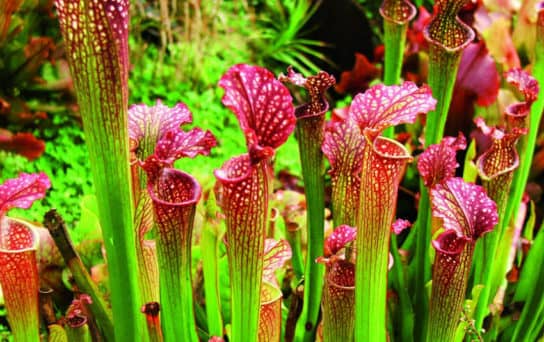

Sarracenia is endemic, i.e. a plant that lives exclusively in the limited range of the North Atlantic. True, one of its species was successfully acclimatized to the swamps of Ireland, where it was accidentally brought.
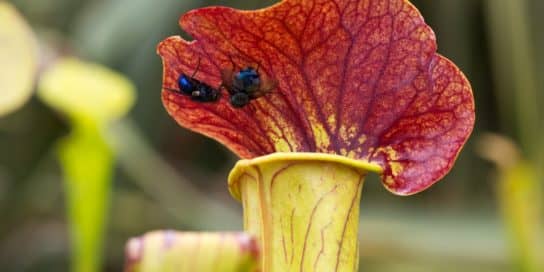
Insects, which are attracted by the amazing aroma of this unusual flower (and it is actively secreted thanks to the special nectar-bearing glands of sarracenia), fall on the hunting leaf – and then the hunt begins! The fly glides down the honey path – and the walls of this trap are equipped with special hairs to allow movement only along one path. Very soon, the insect finds itself in a storage trap – and from there it no longer has the ability to get out. The digestive juices of the plant dissolve the insect – and thus provide the caracenium with not only nutrients, but also increase the content of calcium, magnesium, nitrogen and other minerals.
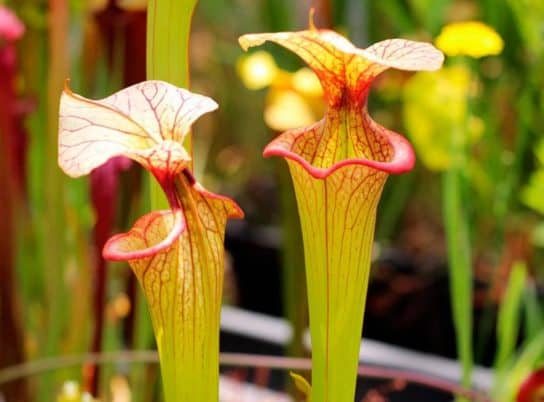

Such trapping pipes are often used by some birds, adapting them as feeders, and pecking out insects that have got there. And not only insects – there is evidence that this flower is capable of digesting even small frogs.
Kinds
The family of these plants consists of several genera, which include not so many species:
- Darlingtonia (only 1 species);
- Heliaphora – 15 species;
- Sarratsennia – it consists of 11 species.
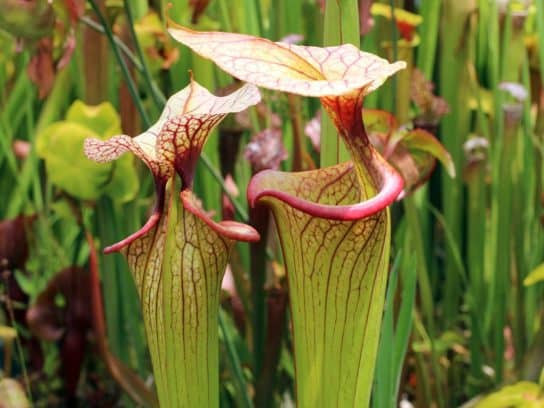

Some of the species of this plant look too decorative – and therefore are cultivated in many countries. Particularly widespread is the yellow sarracenia – a perennial with very large orange flowers and juicy water lilies of leaves. Moreover, at home breeding, the sarracenia is able to live (of course, subject to appropriate care), even without special feeding with insects.
What does it look like
Sarracenia is a perennial marsh grass of the rhizome type, which is one of the largest known insectivorous flowers. The lower parts of the leaves of this species are scaly – and already above them a rosette of large trapping leaves is formed, forming unusual tubular jugs with a wide neck.
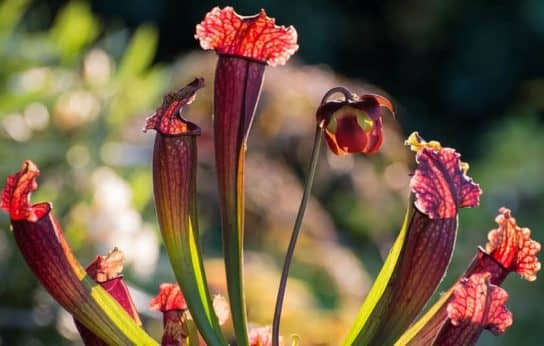

Bright and very large flowers (they have a double perianth!) Rise above the leaves on a leafless peduncle – usually there is one flower for each individual. A special feature of this flower is a giant and very unusual umbrella-shaped column with tiny stigmas on each of the petals.
Some species of such plants are capable of forming extensive thickets, settling in marshy areas. And ribbed jugs of flowers, which vertically extend from the horizontal rhizome, reach gigantic sizes – almost a meter.
Sarracenia feeds on insects – usually small, and is the largest of its subspecies: in order to attract its victims, the flower has a bright and unusual shape.
Rosettes in the form of elongated leaves are formed directly from the root system – and the leaves themselves form water lilies-traps. Inside such traps, a viscous and sticky liquid with digestive characteristics awaits the victim. The water lilies underneath are rather narrow, and expand as they grow. Some part of the sheet forms a kind of canopy-shaped cover.
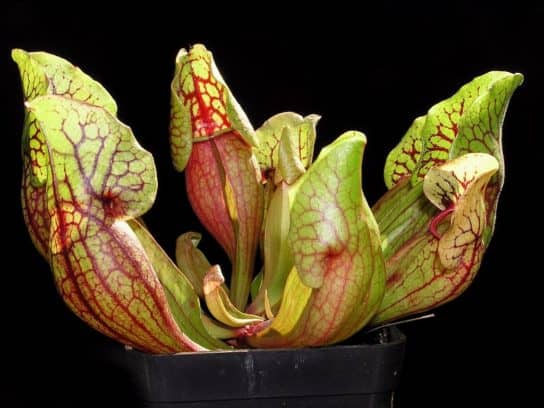
Moreover, unlike other similar flowers, sarracenia is usually referred to as passive plants. The flower does not close the victim – it simply drowns in the digestive juice and is gradually digested in it.
Home care
Sarracenia is one of the predatory flowers that takes root well at home. And caring for him, despite all the features of the plant, does not differ from caring for any other.
This predator is a swamp dweller – therefore, when living in an apartment, it requires abundant lighting (at least 10 hours a day), watering without restriction, and, of course, feeding with the usual food – insects. In response to the care, sarracenia will delight you with abundant and colorful flowering. There are no problems with the reproduction of this plant – sarracenia can reproduce by rosettes, seeds and even parts of the root system. When grown from seed, the first flowers will delight you only after 5 years.

Such a predator can be brought in a room, a greenhouse, on a loggia or a glassed-in balcony, in botanical gardens. The flower will perfectly fit into any landscape – with its emerald leaves, decorated with burgundy veins.
It should be noted that this green representative of the flora has a very negative attitude towards poor water quality – for irrigation, it is required to use filtered or at least settled water.
There are no problems with the soil in sarracenia – it is excellent for acidic soil. It is advisable to add moss, coarse sea sand and charcoal to it. The plant does not need special feeding, since in its homeland it grows quietly in poor substrates.


What eats
Sarracenia is a predator that has gotten used to setting pitcher-shaped traps from its own leaves, feeding its victims with a sweet-smelling juice. Once in the gastric fluid, insects become victims of protozoa, bacteria and rotifers, which gradually break down its body. In the process of such “eating”, substances are produced that are suitable for assimilation by a flower. Initially, of course, this function in young leaves of sarracenia is performed by its own enzymes, but over time this task is taken on by protozoa and invertebrates, helping the flower in the process of digesting food.

