


Venus flytrap or Dionea Is an unusual plant native to the swamps of the eastern United States. It looks like an ordinary flower with a long stem, but it has one interesting feature. He is a predator. The Venus flytrap is engaged in catching and digesting various insects.
What does a predator flower look like?
Outwardly, this is not a particularly noticeable plant, one might say, a grass. The largest size that ordinary leaves can have is only 7 centimeters. True, there are also large leaves on the stem that appear after flowering.
The inflorescence of the Venus flytrap is somewhat similar to the flowers of an ordinary bird cherry. This is the same white delicate flower, with a lot of petals and yellow stamens. It is located on a long stem, which grows to such a size for a reason. The flower is deliberately placed at a great distance from the trap leaves so that they do not get caught by pollinating insects.

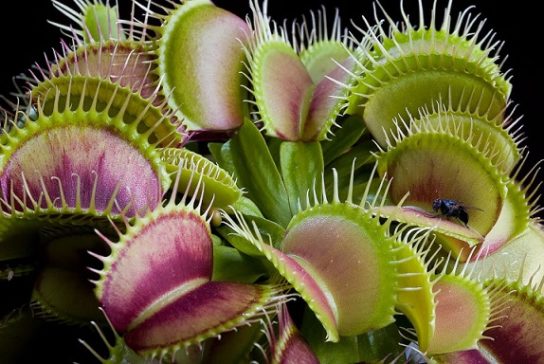
The Venus flytrap grows in swampy areas. The soil here does not have a lot of nutrients. There is especially little nitrogen in it, and it is it that is needed for the normal growth of most plants, including the flycatcher. The process of evolution proceeded in such a way that the flower began to take food for itself not from the soil, but from insects. He has formed a cunning trapping apparatus that instantly closes a suitable victim in itself.
How does this happen?
Leaves intended for catching insects consist of two parts. There are strong hairs on the edge of each part. Another type of hairs, small and thin, densely covers the entire surface of the leaf. They are the most accurate “sensors” that register the contact of the sheet with something.
The trap works by very quickly closing the leaf halves and forming a closed cavity inside. This process is started according to a strict and intricate algorithm. Observations of venus flytraps have shown that leaf collapse occurs after exposure to at least two different hairs, and with an interval of no more than two seconds. Thus, the flower is protected from false alarms when it hits the leaf, for example, raindrops.
If an insect sits on a leaf, then it inevitably stimulates different hairs and the leaf closes. This happens at such a speed that even fast and sharp insects do not have time to escape.
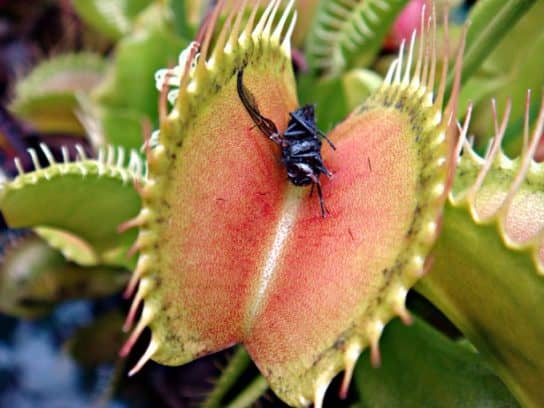

Then there is one more protection: if no one moves inside and the signal hairs are not stimulated, the process of generating digestive enzymes does not start and after a while the trap opens. However, in life, the insect, trying to get out, touches the “sensors” and the “digestive juice” slowly begins to flow into the trap.
Digestion of prey in the Venus flytrap is a long process and takes up to 10 days. After opening the leaf, only an empty shell of chitin remains in it. This substance, which is part of the structure of many insects, the flower is not able to digest.
What does the Venus flytrap eat?
The flower diet is very diverse. This includes almost all insects that can somehow get on the leaf. The only exceptions are very large and strong species. The Venus flytrap “eats” flies, beetles, spiders, grasshoppers and even slugs.
Scientists have identified a certain percentage in the flower menu. For example, a predatory plant consumes 5% of flying insects, 10% of beetles, 10% of grasshoppers, and 30% of spiders. But most often, the Venus flytrap feasts on ants. They occupy 33% of the total amount of digested animals.
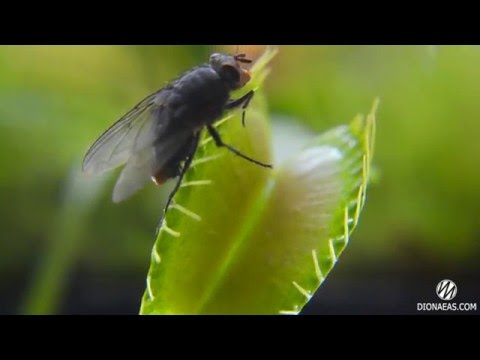
Venus flytrap catches flies – video
Venus flytrap at home
Venus flytrap is a plant that loves warmth, but prefers darkening in the middle of the day, and therefore it should be grown on a southern or western windowsill. In the autumn and spring, there is little light for it and artificial can be used. The optimal temperature is considered to be about 25 degrees, but in winter it should not be allowed to exceed 5 degrees, otherwise the plant will not survive.
You should also often ventilate the room, because the predator loves it. In summer, the flycatcher should be taken out into the garden, as there is more food for it. Watering should be carried out only with boiled and purified water in order to bring the growing conditions closer to natural ones. Watering is in a pan, and sphagnum moss is usually placed in a pot to moisten the soil. In summer, the flycatcher should be sprayed constantly, but only if the humidity is low.
It is impossible to plant a Venus flytrap in the soil rich in minerals – the plant will not be able to assimilate all this and it will become seriously ill. Quartz sand and peat are much better suited. As a growing place, you can use an aquarium that reliably protects against drafts.
Venus flytrap – care and maintenance
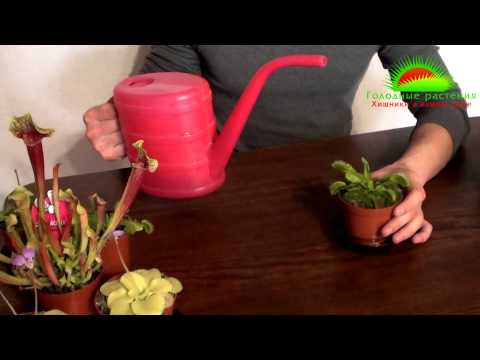
The Venus flytrap does not need fertilization in the sense in which we are used to understanding it. Several times a month she needs to be given food in the form of insects, if such is not available in the room where she grows. All this is needed in order for the plant to receive nitrogen when it needs it. This happens on average every two weeks. It is important to remember that you cannot feed the flycatcher with insects with shells, because it will not be able to digest such food and will get sick.
Sometimes pests can be the cause of disease. For example, aphids and mealy worms. Their food is plant sap. To cure Dionea, you should stock up on insecticides. Otherwise, excessive moisture in the roots, to which low humidity is added, can provoke fungus and gray rot. In this case, it is worth treating it with fungicides. They are also used when damage to any trap is detected by bacteria and it stops digesting bugs and other insects.

