


- 1 What Is Light, Really?
- 2 Reflection: Why You See Yourself in a Mirror
- 3 Refraction: Why Light Bends
- 4 Reflection vs Refraction: What’s the Difference?
- 5 How Our Brain Interprets Light
- 6 Infographic “The Physics of Light: From Reflection to Refraction”
- 7 Typical Mistakes When Understanding Light
- 8 Where This Matters in Real Life
- 9 FAQ: Common Questions About Light Behavior
- 10 Short Version: What to Do Right Now
- 11 Conclusion
- 12 Sources


Why does a spoon look bent in a glass of water? Why can you see your face in a mirror but not on a wall? And why does a swimming pool seem shallower than it actually is?
These are not random visual tricks. They are everyday examples of how light behaves — and how our brain interprets it. Once you understand the physics behind reflection and refraction, the world starts to look… slightly less ordinary.
This article breaks down how light travels, what happens when it hits different surfaces, and why simple phenomena create surprisingly complex effects.
What Is Light, Really?
Before talking about reflection or refraction, it helps to clarify what light actually is.
In physics, light is a form of electromagnetic radiation. It behaves both like a wave and like a stream of particles (photons). This dual nature explains why light can travel in straight lines, reflect like a ball, and bend like a wave.
In everyday life, we don’t need to think about photons. What matters is how light moves and interacts with materials.
Key properties of light
- It travels in straight lines in a uniform medium
- It has a finite speed (about 300,000 km/s in vacuum)
- It changes direction when it hits surfaces or enters new materials
- It can be absorbed, reflected, or transmitted
Everything we see depends on these interactions.
Reflection: Why You See Yourself in a Mirror
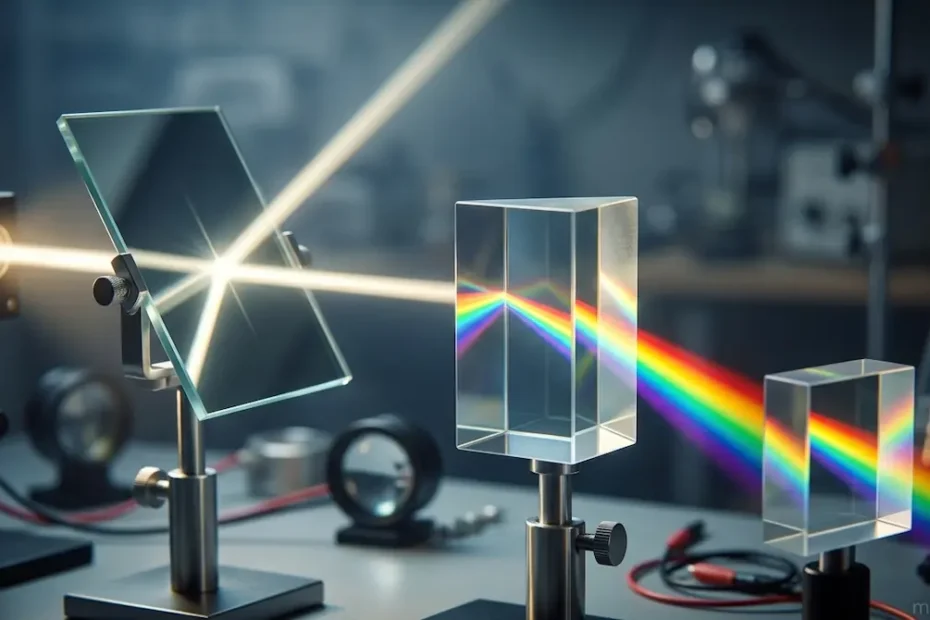
Reflection happens when light bounces off a surface instead of passing through it.
But not all reflections are the same. The difference between a clear mirror image and a blurry reflection on a wall comes down to surface structure.
Two types of reflection
| Type | Surface | Result |
|---|---|---|
| Specular reflection | Smooth (mirror, glass) | Clear image |
| Diffuse reflection | Rough (paper, wall) | Scattered light, no image |
When light hits a smooth surface, it reflects at a predictable angle. When the surface is rough, light scatters in many directions.
The law of reflection
The basic rule is simple:
The angle of incidence equals the angle of reflection.
This is why mirrors work so reliably — your brain can reconstruct an image because the light behaves consistently.
Real-life example
Think about driving at night. When your headlights hit a wet road, the reflection becomes sharper and more mirror-like. That’s because water smooths out the surface, increasing specular reflection.
Refraction: Why Light Bends
Refraction happens when light passes from one medium into another — for example, from air into water or glass.
This is where things get interesting: light doesn’t just continue straight. It changes direction.
Why does refraction happen?
Because light travels at different speeds in different materials.
- In air: faster
- In water or glass: slower
When light slows down, its direction changes. This bending is what we call refraction.
Common everyday examples
- A straw appearing bent in a glass
- A swimming pool looking shallower than it is
- Magnifying lenses enlarging objects
- Rainbows forming in water droplets
All of these are based on the same principle: light changes speed, and therefore direction.
Reflection vs Refraction: What’s the Difference?
| Feature | Reflection | Refraction |
|---|---|---|
| What happens | Light bounces off surface | Light passes through and bends |
| Medium change | No | Yes |
| Main cause | Surface interaction | Speed change |
| Example | Mirror image | Bent straw in water |
In reality, both processes often happen at the same time. For example, when light hits glass, part of it reflects, and part of it refracts.
How Our Brain Interprets Light
Here’s something often overlooked: what you see is not just physics — it’s also perception.
Your brain assumes light travels in straight lines. When refraction bends light, your brain doesn’t “correct” for it. Instead, it creates a slightly inaccurate interpretation.
“We do not see things as they are; we see them as they appear to us.”
This is why illusions caused by light feel so convincing.
Example: why water distorts depth
When you look into water, light rays bend as they leave the surface. Your brain traces them back in straight lines, making objects appear closer than they really are.
This is not a mistake — it’s a shortcut that usually works well in everyday conditions.
Infographic “The Physics of Light: From Reflection to Refraction”
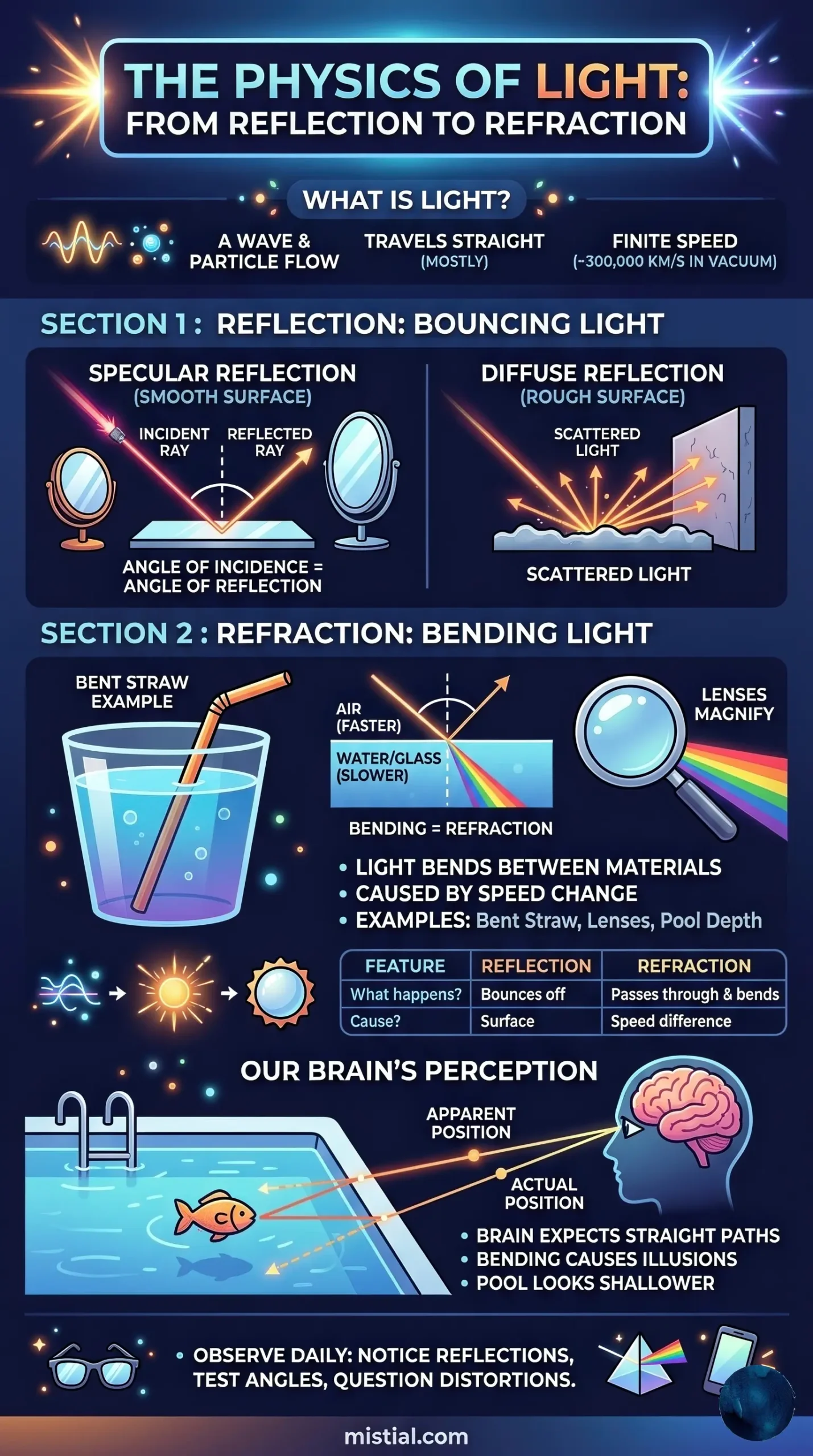
Infographic “The Physics of Light: From Reflection to Refraction”
Typical Mistakes When Understanding Light
Many people have intuitive but incorrect ideas about how light works. Here are some common ones:
1. “Light always travels in straight lines”
Only true in a uniform medium. As soon as light enters a new material, it can bend.
2. “Mirrors create images”
Mirrors don’t create anything. They simply redirect light in a predictable way.
3. “Refraction only happens in water”
It happens whenever light moves between materials — including air layers of different temperatures.
4. “Brighter reflection means more light”
Not necessarily. It may just mean the surface is smoother or the angle is more favorable.
Where This Matters in Real Life
This isn’t just theory. Reflection and refraction are used everywhere.
Technology and optics
- Cameras and lenses rely on refraction
- Fiber optics use controlled reflection
- Eyeglasses correct vision through bending light
Daily situations
- Seeing clearly through glasses or water
- Avoiding glare while driving
- Understanding why objects look distorted
Once you notice it, you start seeing these effects everywhere.
FAQ: Common Questions About Light Behavior
Why does a mirror reverse left and right?
It doesn’t actually reverse left and right — it reverses front and back. Your brain interprets this as a horizontal flip.
Why does light slow down in water?
Because it interacts with atoms in the material, which delays its overall movement.
Can light bend without changing medium?
Yes, in cases like gravitational lensing or temperature gradients, but these are more advanced phenomena.
Why do diamonds sparkle so much?
Because of strong refraction and internal reflection. Light bounces multiple times inside before exiting.
Is refraction the same as distortion?
Not exactly. Refraction is a physical process; distortion is how we perceive its result.
Short Version: What to Do Right Now
- Pay attention to reflections — notice how surface smoothness changes what you see
- Observe refraction in water or glass objects
- Test angles: move your head and see how reflections shift
- Compare clear vs rough surfaces under the same light
- Question what you see — your perception is not always physically accurate
Conclusion
Light is not just something that “illuminates” the world. It shapes everything you see — from clear reflections to subtle distortions.
Understanding reflection and refraction doesn’t just explain optical tricks. It reveals how reality is filtered through both physics and perception.
And once you see that, even a glass of water becomes a small physics experiment.
Sources
- Hecht, E. — Optics
- Feynman, R. — The Feynman Lectures on Physics
- Halliday, Resnick, Walker — Fundamentals of Physics
- Born & Wolf — Principles of Optics
- HyperPhysics (Georgia State University educational materials)

