


The water vole, or simply the water rat, belongs to the hamster family. This animal lives along waterways, although, contrary to its name, it is often found in fields, meadows and even gardens. In such areas, the vole migrates during the flood period, and later it will definitely return to its usual place.
Description of the species
The water rat is a large animal – and is second only to the muskrat in size from its family. The size of adults depends on the habitat and even on the usual landscape – usually the body weight of a vole reaches 330 grams with a body length of up to 26 cm (without a tail).
The coat of the vole consists of a coarse awn and a thick, but rather thin undercoat, and the coat does not change depending on the season – its color varies from dark to almost black. And in the north, there are even individuals with a white tail.
Appearance
Outwardly, the vole has a lot in common with an ordinary rat – but its body is shorter, the muzzle is also shortened, and the ears are smaller. But the legs, on the contrary, are longer – but they are not so noticeable because of the fur. The tail of the vole, in contrast to the rat, is covered with wool and ends in a kind of tassel. It is easy to distinguish a vole from a rat – its incisors are yellow-brown in color.

Where dwells
The vole habitat is very wide – it is almost the entire northern part of Eurasia from the very coast of the Atlantic to Yakutia and the Mediterranean Sea, including Asia and Mongolia with the territory of China. The vole occupies most of the non-chernozem territory of Russia, the Baltic States, Belarus, Ukraine, the Caucasus, the Volga region and Kazakhstan.
Moreover, of all murine rodents, the vole is characterized by the highest indicator of migratory activity. And this type differs in several types of migration, depending on the nature of the reasons that cause them:
- forage migration (usually during seasonal settlements);
- migration of dispersal and concentration;
- migration of competition (in case of crowding out);
- migration displacement by natural disasters.


Moreover, for example, migration options can be both seasonal and short-term – up to a day – when the animal goes in search of food and returns to its burrows. And the distance of such daily migrations can be up to 2 km, and in the case of seasonal movement – even up to five.
Water voles habitually put their huts on the banks of water bodies that are covered with vegetation and are not characterized by a fast current and a constant level of flow. Often this animal is found in hilly areas, and even in mountainous areas. They form their nests from grass and a wide variety of plant material – and arrange them in the trunks of plants, on floating islands, inside (or on top) of bumps.
In winter, the vole digs holes for itself away from the water – moreover, in the regions of central Europe, the vole completely switches to a lifestyle similar to the existence of a mole.
Water voles are able to settle both in the garden and in the garden – they gnaw the roots of trees, and, naturally, summer residents are fighting an irreconcilable struggle with representatives of this species.
What eats
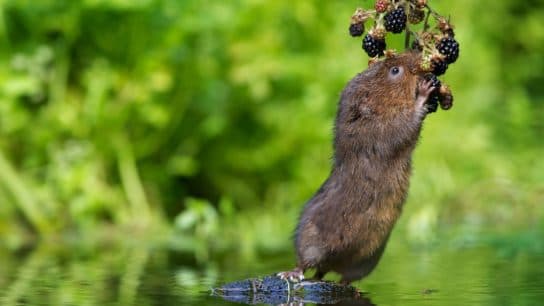
In the summer, the vole prefers to eat mainly green food – coastal and floating succulent plants (water lilies, reeds, horsetails, and much more). These animals love the roots of plants, flowers, seeds and bark of trees. The vole prefers to eat in some places, where it even forms special “feeding tables” – areas for food with the remnants of the meal.
Occasionally, the vole is able to get animal food – beetles, mollusks and something else. In autumn, after the vegetation dies off, the vole begins to feed on other parts of the plants – tubers and rhizomes. Their habits include organizing supplies for the winter.
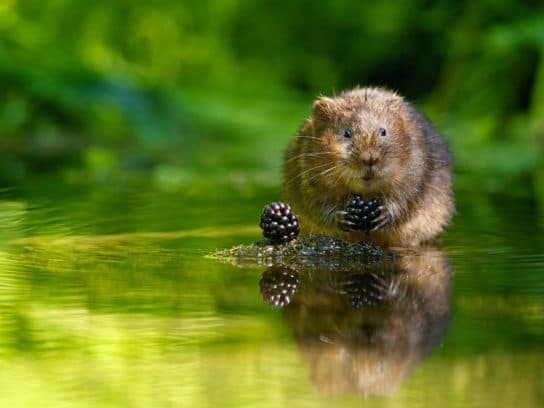

The vole, as a rule, adheres to the rule of dwelling on its territory – for example, the usual area of the male is about 130 meters of coastal territory. In the female, this area is slightly smaller. They are able to organize on their territory a branched system of holes, where there is even a place for a nest and storerooms. Voles often camouflage the entrances to their habitats under water – after all, these animals can swim perfectly.
The vole is an active animal both in the daytime and at night, but prefers the morning hours for its walks.
As a rule, water voles do not live in large families and colonies – the exception may be animals that live far from waterways.
Usually, after particularly productive seasons, an increase in the vole population occurs, which can cause significant damage to the entire agriculture. Over time, the population, of course, decreases – and such swings occur regularly, depending on the food supply. Such cycles are repeated approximately every three to four years.
Natural enemies
The water vole makes up the diet of many small predators, both terrestrial and aquatic: these are minks, foxes, ferrets, otters and even birds.
The general population of the species is characterized by very sharp changes – first of all, this is typical for those animals who live in the zone of a particularly pronounced leash mode. The number of voles also suffers from high temperature indicators in the summer, when meadow floodplains die from droughts and become completely unsuitable for voles to inhabit.


This species is distinguished by enviable fertility – voles reproduce throughout the warm season, giving up to four litters, each of which includes up to ten babies. The first pregnancy can be observed as early as May, in the last – in the month of August, and usually lasts three weeks. Naturally, the peak of active reproduction occurs in the middle of summer. The animals grow and curl very quickly – and some of them are capable of breeding within a few months.
The vole is characterized not only by sabotage, but also by its commercial value. Its skins are classified as fur raw materials (albeit of secondary importance), and the fishing of this animal is allowed for a whole year. But you need to understand that, in addition to everything, the vole, like many rodents, is a carrier of many dangerous diseases – this is the same leptospirosis, tularemia and similar diseases.
Water vole – video


