


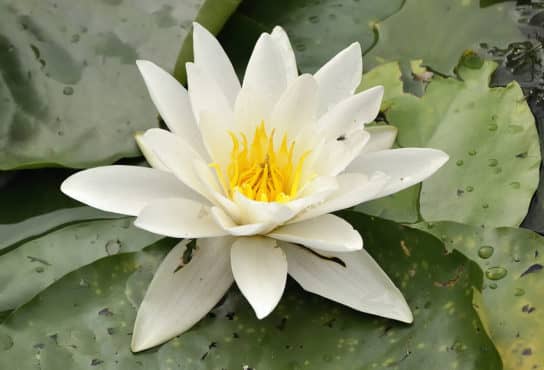


White water lily is a perennial herb. Its length can vary from one meter to two. This aquatic plant belongs to the water lily family, to the class of dicotyledons.
Where grows
The water lily grows in Europe, namely in Scandinavia, the Balkans and in the European part of Russia. You can also meet this amazing plant in the North Caucasus, in the Eastern Transcaucasia, on the territory of Asia Minor. The water lily occupies Crimea and Belarus. The plant can only be found in stagnant or “slow” waters: in lakes and ponds.


Structure
The rhizome of the water lily is creeping; large oval leaves extend from it. Pedicels are attached to the rhizome, on which white flowers with green four-leafed cups will be located. These flowers will be on the water surface, they usually do not exude a strong aroma. The White Water Lily has many stamens and one pistil, whose stigma is radiant. Often, the petals of the outer circle become stamens. Water lily fruits outwardly resemble berries and are called multileaf, they ripen under water. The stipules of the plant are lanceolate.


The roots of this plant are brown, floating and strong. There are petioles on their surface. Inside the rhizome there are many air ducts that help the plant to breathe. The stems of the water lily are erect, the section of these parts is round. The color of the stems depends on the age of the Water Lily: they are green in the young plant, and burgundy in the old one. Leaves are not attached to the stems and float freely.
Bloom
White water lily blooms in summer, namely in June-July. The plant is pollinated by beetles. After fertilization has taken place, the peduncle begins to twist in a spiral, the flower goes under the water and its fruits ripen there. Further, the multileaf disintegrates, the seeds appear on the surface of the water. After mucking, they sink to the very bottom, where they germinate.
The very bloom of Water Lilies is an unforgettable event. Flowers bloom in almost a few minutes, during the day they repeat the path of the Sun, changing their position. In the evening, the buds go under the water. When the weather is rainy or windy, the flowers of the plant do not come out. So, if the buds of the Water Lily did not open at the beginning of the day, it will rain in the evening.


Description of the medicinal properties of the white water lily
The white water lily is very often used in folk medicine. The plant contains tannins and starch, oxalic acid with flavonoids. Because of this, Water Lily has an analgesic and antipyretic effect. A decoction from this plant can also help with stress or insomnia.
To prevent hair loss, water lily broth is mixed with beer, after which the hair is washed with this composition. For the preparation of infusions, flowers and leaves are used, which are best collected in June. Sometimes for these purposes rhizomes are collected, from which the petioles and small roots are then torn off. Raw materials are often dried in a well ventilated room.


Diseases
White water lily rarely gets sick. The plant can be attacked by pests such as aphids. This pest kills the buds. Water from a hose and insecticides will help to cope with this.
Red Book
The white water lily is included in the Red Book of Russia. At the moment, this species is considered vulnerable due to the shallowing of reservoirs and their drying out, although many plants were destroyed in the 60s of the last century, but in the 90s the number of the plant caused particular concern. The largest population of Water Lilies is located in the Kuban River delta.

Security measures
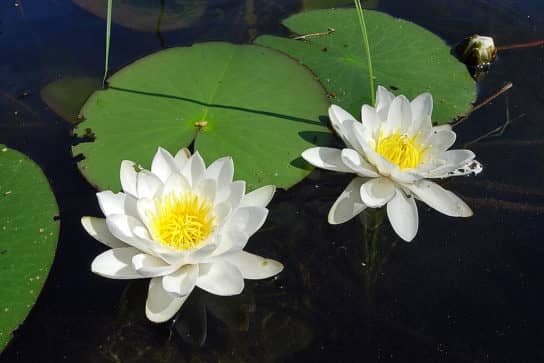
The water lily is actively protected in the Primorsky Territory, namely in the reserve located in the Azov region. In St. Petersburg and Tver there are nurseries of this plant. The white water lily has also been introduced to KubGu.
History
In the days of Ancient Russia, it was believed that the White Water Lily could protect from misfortune, they used this plant as a talisman against evil forces. Among the people, Water lily was a symbol of beauty and mercy, it was often called the overpowering grass. At this time, there was also a belief that nymphs live on the petals of a plant. The water lily also resembled a mermaid to its ancestors, because the rhizome looks like the tail of a mythical creature. In June was the Russian week. The ancestors believed that these days water lilies turn into maidens. This week, the girls did not swim, they were afraid that they would be tickled by mermaids.


Interesting Facts
- The white water lily was investigated only in the 19th century.
- Despite the fact that Water Lilies love shallow water, they are able to grow at a depth of three meters.
- On the water surface there are only plant leaves, but this is practically invisible from the shore.
- All parts of the plant are covered with a special substance that protects the plant from dirt. On the basis of this substance, paints were created.
- White water lilies are one of the most ancient angiosperms.
- During the Middle Ages, people believed that the flowers of this plant are an aphrodesiac. Alchemists collected them to create a love potion.
- There is a lot of starch in the roots of Water Lily, which the ancestors used to create baked goods. They dried the roots and pounded them to make flour.
- Water lily leaves can grow up to 40 cm in diameter and are dark green in color.
- The flowering of the plant lasts about 4 days.

