

Appearance
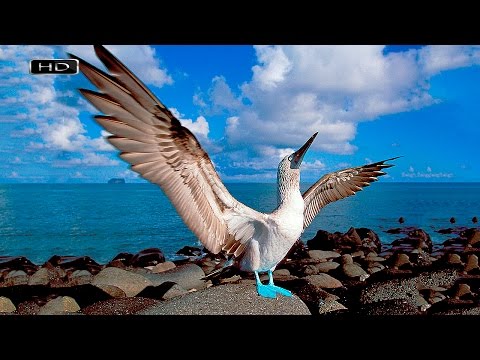
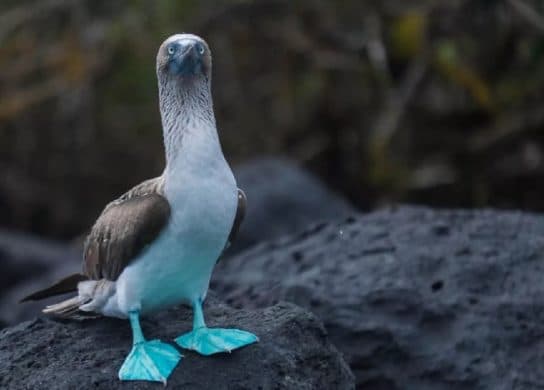
The most remarkable thing about this representative is the blue paws with wide membranes. The color may vary slightly from a bright blue to a grayish blue. Typically, this color fluctuates with age and health conditions. Also, the paws of the males are slightly brighter in color compared to the females. The head and neck color has brownish feathers with white spots. The wings are a darker shade of brown, and the entire lower torso is pure white. This alternation of shades makes for a “spiky” effect. The wings are oval in shape, which is pointed at the tip.
The bird is also remarkable for its long beak, which has a grayish-green tint. The eye color is yellow. In males, a small pigment spot is located in the eyes, which visually increases their size. According to its parameters, the bird is quite dimensional. The size of her body reaches 80 centimeters in length, and her weight fluctuates around 3 kilograms. Life expectancy in captivity reaches 20 years.

Habitat
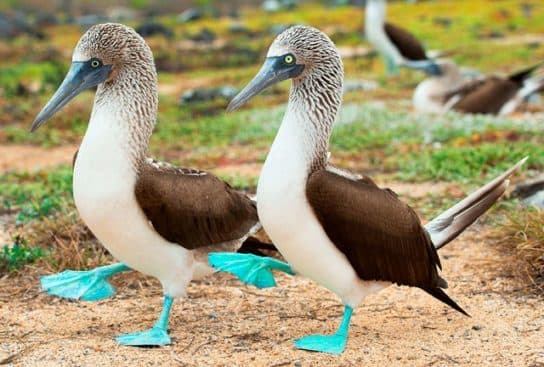
The blue-footed gannet range extends from the coast of western Mexico to the northwest side of South America. Many populations are found on the Pacific Island in tropical or subtropical climates. Most of the representatives of the blue-footed gannet have spread to the Galapagos Islands. In total, there are about forty thousand representatives of the species. Some of the birds are found in Ecuador and Peru. At the moment, only two subspecies of these birds are distinguished, which differ based on their habitat.
Nutrition
Blue-footed boobies feed only on fish. It allows them to produce a characteristic pigment called kartinoid. This pigment is the main reason for their blue paws. When they do not eat fish for a long time, the color of the paws begins to fade. Also, kartinoid has a positive effect on immunity and is a good antioxidant.
As a rule, blue-footed boobies feed on relatively small fish. For example, sardine or mackerel. They can even hunt flying fish.

Hunting
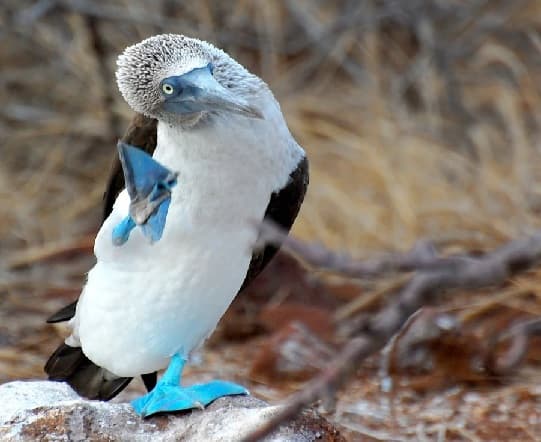
During the hunt, they prefer to gather in flocks. As a rule, they fly out in the late afternoon or at sunrise. Birds look for prey in the air. The beak is always down in flight. Some gannets go to the seas for fish. If one bird from the flock finds prey in the sea, it gives a signal for the rest of the birds in the flock.
Blue-footed boobies are distinguished by their ability to dive to great depths. They can submerge up to 25 meters under water, and move there at speeds up to 100 kilometers per hour. Birds eat in flocks on the sea surface.


Reproduction
Gannets become sexually mature at the age of three. The mating period can occur at any time of the year, but the peak occurs when the Peruvian Current cools when the number of fish increases. Males attract females with their dancing, as well as by displaying their blue paws. The final decision of the female depends on the brightness of the color, since it is determined by the nutrition and health of the male. When a pair is formed, they begin to form nests. They prefer to build nests in the soil, in which they make a small hole and lined with branches and grass. The female lays up to 3 eggs, and incubates them for 45 days. It is noteworthy that the partners incubate their offspring in shifts. The babies that appear are with their parents for up to 70 days. During this time, they feed them and teach them all the necessary skills.
Blue-footed boobies – video