


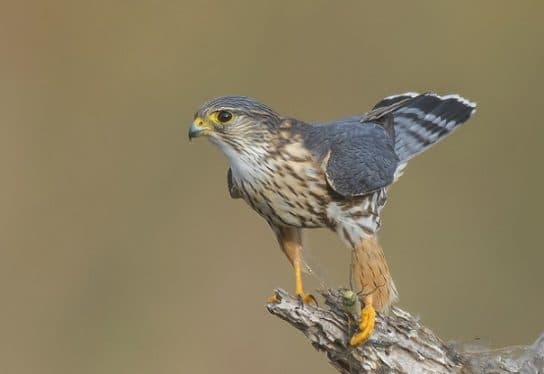


Derbnik is a small falcon that resembles a dove. Birds are rare; they breed in various places in open areas in Alaska, Canada, the north and west of the United States, Europe and Asia, and inhabit suburban and urban areas.
The appearance of merlin
They are slightly larger than the kestrels. Like other falcons, they have long, thin wings and tails, and they fly actively with short, powerful, piston-like wingspan. Unlike other falcons, merlin do not have mustache markings on their heads.
Males and females and representatives of subspecies differ from each other. Juveniles of both sexes resemble adult females. Males with bluish-gray backs and wings, 2-5 thin gray stripes on black tails. On the lower part of the body there are dark stripes, reddish spots on the sides of the chest. Females have dark brown backs, wings and tails with thin buff-colored stripes. The underside of the body is buffalo colored with stripes. Females are about 10% larger and 30% heavier.
Breeding features of merlin
As a rule, birds are monogamous. The members of the pairs hibernate separately, and each spring a new pair bond is formed or the old one is restored. Merlniks return to the same breeding zone and occupy the same nesting territory. Sockets are not reused.
“Hardworking” birds
Males return to breeding grounds a month earlier than mates. In some cases, females remain in the nesting area throughout the year. Merlniks do not build, they use abandoned nests of other birds, predators or magpies. This species also inhabits ledges on rocks, on the ground, in buildings and in tree cavities. When placed on rocks or on the ground, look for a depression and use it by adding some grass.

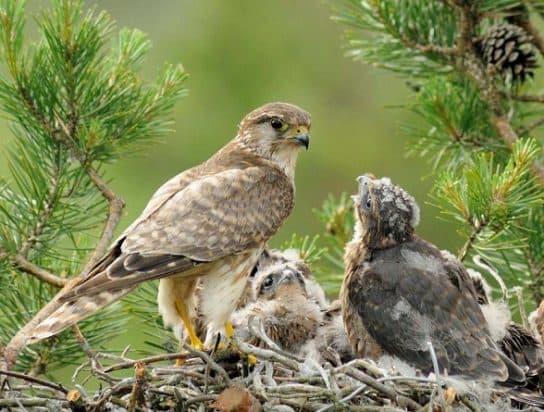
Merlin with chicks
Air dances
Pairs form one to two months before laying. Merlin exhibit aerial stunts, including wing-banging and side-to-side flips, that attract females and scare off other males. Both members of the pair take off and “whirl” to define their territory. “Fluttering flight” is when males fly slowly with short, shallow beats of their wings in a circle or figure eight near the seated partner.
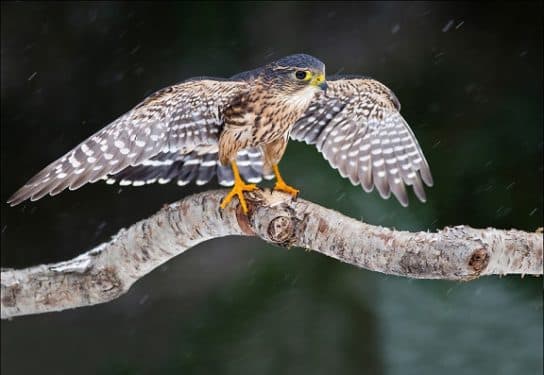

Merlniks lay 3-5 eggs. If the clutch dies at the beginning of the nesting season, the female makes a second clutch. Females spend most of the 30-day incubation. After hatching, the mother continuously sits with the chicks for 7 days. When youngsters reach the age of at least a week, mothers stay with them only in bad weather.
During the entire period, the male provides food for the chicks and the mate. During incubation, males briefly incubate eggs, the female feeds nearby. After hatching, males call females, do not return to the nest, females fly to get food for chicks from a partner. Chicks fledge when they are 25 to 35 days old. Two weeks after winging, the young merlins catch the insects on their own, even though they remain dependent on their parents for about 5 weeks after fledging.
Features of feeding merlins
Birds hunt, attacking prey from branches and in flight, using hills and other features of the landscape to covertly get close to the prey. Derbniks do not attack from high altitudes. Hunting activity is observed in the early morning and late afternoon.
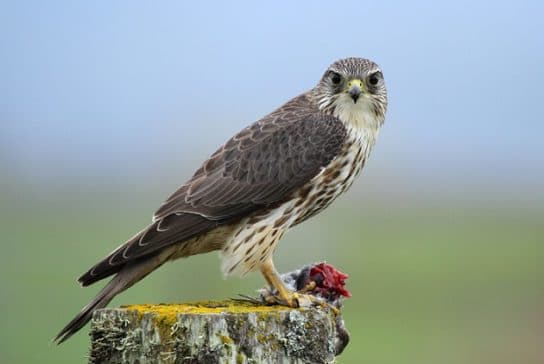

Males store excess food near the nest, and females eat when the male is late with prey. Merlin feed on pigeons, small ducks, small and medium-sized songbirds. In urban settings, sparrows are the main diet of merlin. This species also preys on insects, small mammals, reptiles, and amphibians.
Video how the merlin eats


