


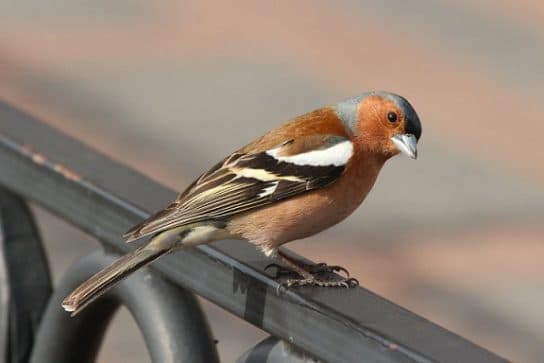


The common finch is a widespread small passerine bird of the finches family.
What finches look like
The male is brightly colored, on the head there is a blue-gray “cap”, paws and bottom of the body are rusty-red. The female is much duller in coloration, but both sexes have contrasting white feathers on the wings and on the tail.

Finch female
Males are about the size of a sparrow, females are slightly smaller. Birds are dimorphic, males are brightly colored in spring and summer. In winter, the colors fade.


Finch male
Distribution and habitat of finches
The range of the finch is Europe, Western and Central Asia, the Middle East and North Africa, islands in the North Atlantic Ocean.
Finches often fly into gardens, especially in winter, and feed with sparrows on lawns and parks. In winter, finches are divided into flocks, males and females separately.
Finches occupy different places where there are trees or bushes. They live in:
- pine and other forests;
- shrubs;
- gardens;
- parks;
- agricultural land with hedges.
Behavior and ecology
Finches will form mixed flocks with sparrows and buntings outside the breeding season if there is a good food source nearby, such as weeds growing among crops.


Finches vocabulary
Male finches sing pleasant melodies from a series of sharp, fast notes, followed by a trill at the end. Each finch has variations in performance, represented by two or three different types of songs. Regional dialects also exist in birds.
Finches of both sexes, in addition to singing, make the following calls:
- flight;
- social / aggressive;
- traumatic;
- to courtship;
- alarming.
Chaffinch singing and voice – video

What finches eat
Finches feed on seeds on the ground and in trees such as pines and beeches. Insects are found among the branches and foliage of trees, bushes, or on the ground. Finches also catch insects, especially around rivers and streams.


The finch feeds on insects and plants
Who hunts finches, what diseases do birds suffer
Chaffinch eggs and chicks are a treat for crows, squirrels, cats, ermines and weasels. Clutches in late spring suffer less from predators, they are protected by vegetation, which makes it difficult to find nests.
Adult finches are hunted by owls and hawks. If the birds spot an owl, they give a signal to mobilize the flock. Together they drive the predator away from the nests. When a hawk approaches, an alarm sounds, and finches hide among foliage and branches.
Finches develop tumors on the feet and legs caused by the papilloma virus Fringilla coelebs. The size of the papillomas ranges from a small nodule on the toe to a large tumor affecting the foot and paw. The disease is rare. Of the 25,000 finches, only 330 suffer from papillomas.
How finches breed
Finches are monogamous during the breeding season, which runs from September to February. Males occupy the territory and sing mating songs in late July or early August. The females visit the territory of the males, and one of them eventually forms a paired bond with one of the finches.
However, this link is not strong. The female can leave the territory during the construction of the nest and mate with other males in the surrounding areas.
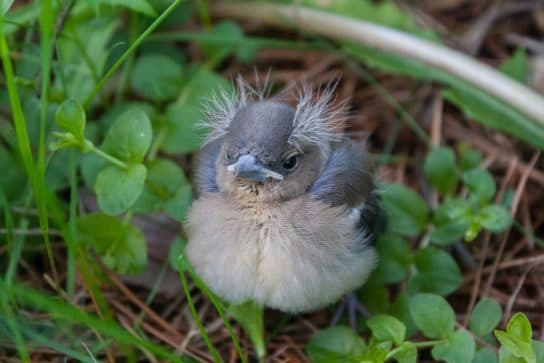
The female builds a neat bowl-shaped nest from small grass, wool and moss, and masks the outside with lichen. The nesting site is located on a tree or bush at a height of 1-18 m above the ground. The female incubates the clutch alone for 11-15 days, and when the chicks hatch, both parents bring them food. Chicks are fed for about 3 weeks after fledging.
How long do finches live
The average lifespan of a finch is 3 years, although some of them are known to live up to a maximum of 12 or even 14 years.

