


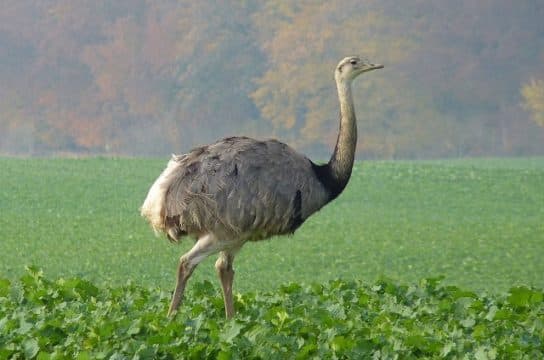


An amazing bird that cannot fly is the ostrich rhea. The animal has a number of similarities with the African representative, but there are also plenty of differences between them. Ostriches live mainly in the mountain plateaus of the Andes, in Bolivia, Brazil, Chile, Argentina and Paraguay. The flightless bird is often domesticated and often found in zoos.
Description and features
Nandu ostriches have many differences from African members of the family, namely: smaller size, the presence of claws on the wings and a neck covered with feathers. In addition, animals love water (unlike their relatives), they run slowly – up to 50 km / h. Rhea ostriches grow up to 30-40 kg, the largest individuals reach 1.5 m in height. The birds have three toes on their feet.
Despite the fact that ostriches treat people and even television cameras normally, they can attack a person who comes too close to them, while spreading their wings and emitting a menacing hiss. Animals scream when they don’t like something, which resembles the growling sounds of large predators. To get rid of attacking parasites, ostriches get dirty with dust or dirt.
It is the American rhea ostriches that are subject to domestication, because they adapt well to climate change and have an average weight.


Behavior and nutrition
Ostriches behave excellently at an altitude of 4,000 to 5,000 meters. They adapt to harsh climates and can migrate to more attractive locations. Animals prefer to live in packs. One group has 30 to 40 family members. When the mating season comes, ostriches are divided into small groups of families.
Rhea ostriches are self-sufficient birds. They lead a collective life only for security reasons. Old animals can leave their flock if they believe that the territory in which the family lives is completely controlled by ostriches and is not dangerous. As a rule, birds are sedentary. They can mix with other herds such as cows, guanacos, sheep or deer.
Nandu ostriches are omnivores. They feed on fruits, berries, grains, broadleaf plants, grasses, fish, insects, and small arthropods. Some individuals can feast on carrion and snakes, and sometimes even the waste of artiodactyls. Despite their love for water, ostriches can easily do without it for a long time. For better digestion of food, birds swallow small stones and gastroliths.


Reproduction
During the mating season, ostriches find a secluded place to which they are removed in a small group, consisting of one male and 4-7 females. Females lay 10 to 35 eggs. As a result, a common nest is obtained, which the male incubates. The shells of the eggs are very strong. On average, one ostrich egg equals 40 chicken eggs. During incubation, the male feeds on food that the females will bring him. This period lasts several months. It is the male that takes care of the hatched chicks. He protects them, feeds them and takes them out for a walk. Unfortunately, few cubs survive to 12 months. Hunting is one of the reasons for the high mortality of birds.
By the age of 2.5-4 years, the ostriches of the rhea become sexually mature. The life expectancy of animals is 35-45 years (while African relatives live up to 70 years).


Breeding ostriches
Many farms are engaged in breeding rhea ostriches. The reasons for the popularity of animals are valuable feathers, large eggs (the weight of one is in the range from 500 to 600 g), a large amount of meat at the exit. Bird fat is also used in pharmaceuticals and cosmetics.
Ostrich Nandu – video


