


Appearance
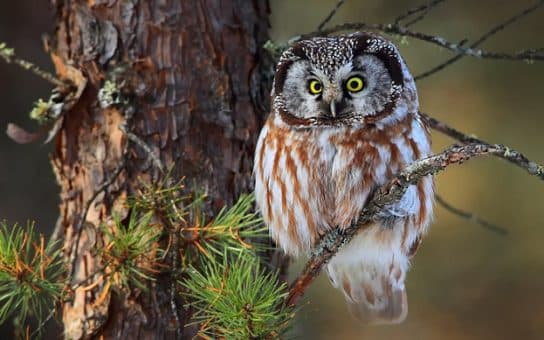
One of the smallest representatives of birds from the entire owl family. Visually, the Upland Owl looks larger due to its lush plumage, but its weight can reach a maximum of 200 grams. And the body length of this subspecies ranges from 21 to 27 centimeters. The external difference between the fur-legged owl lies in its round body structure and short legs hidden under the plumage. For such a feature of his paws, he was nicknamed “Uplifted”. Plumage color is chestnut with light spots. The lower part of the body of the owl is predominantly light with small brown and gray spots.


The chicks have a more uniform color. In this subspecies of owls, feather ears are barely noticeable and are located asymmetrically. The bird’s facial disc is adorned with prominent eyebrows with bright yellow eyes. The head is larger than the body, which makes the bird very compact. The nails are black and very sharp. Females of owls are predominantly larger than males.
There are 4 subspecies of Upland Owls. The subspecies is determined by the habitat. The most common is the common owl, the other three are the North American, Mexican and South American owls.
Nutrition
Like most members of the owl family, the Upland Owl prefers to eat small forest animals. His diet consists of:
- Voles, mice, lemmings;
- Swallows, pigeons and bats;
- Krotov, squirrel;
- Frogs and beetles.
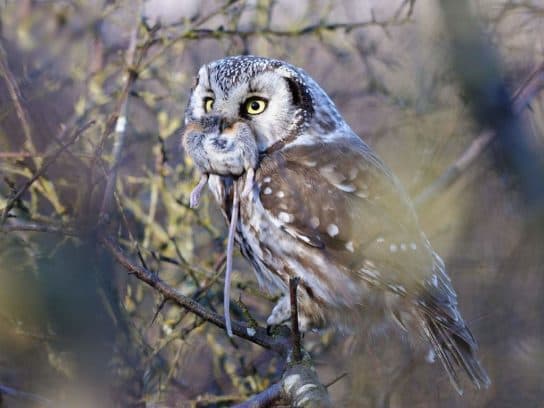
In winter, Upland Owls love to feast on birds. This species is very thrifty and makes preparations for itself in case of lack of the necessary food in its regions. It waits for its prey on low branches of trees, carefully examines the ground and catches the minimum movements of the future victim due to its excellent hearing. Stopping these movements, the fur-legged owl instantly rushes down to grab the victim with its sharp claws. The bird swallows the victim almost entirely, and regurgitates the remains that do not fit.

Reproduction
Upland owls are not monogamous. Couples form only for the mating season. As a rule, the mating season begins with the arrival of spring. When choosing a hollow, they are very picky. They prefer to populate old black woodpecker hollows. Owls ennoble the selected hollow, covering it with moss and branches. The female settling in the nest lays on average 6 eggs with an interval of several days.
During the entire period of incubation, the female is in the nest. The male at this time is looking for prey for both.
Depending on the climate, baby owls are born in 25-30 days. Little fur-legged ones hatch completely blind, and the body is covered with white fluff. They become sighted on the 11th day of life. Chicks mature by 40 days, during this period they prepare for adult life and learn to fly. Little owls remain in the care of their parents for up to 6 weeks of life. And sexually mature chicks are considered at the age of 9 months.

Owl chicks
Habitat
The range of the Upland Owl extends over the entire Northern Hemisphere. In particular, they settled in the Far East, Eastern and Central Europe, and Canada. Historically, Upland Owls have spread throughout the Siberian taiga. And in Russia they can be found in the south. The rest of the representatives of the Upland Owl live in the Western Hemisphere. The species names North American, Mexican and South American fully describe their range.
Plain and mountainous terrain is chosen as the environment. They live in coniferous and mixed foxes. Since the bird is extremely cautious, it is quite difficult to stumble upon it in nature. The bird is predominantly nocturnal; it hunts at nightfall.

Features of behavior
The Upland Owl is a resident bird, however, during the onset of cold weather, they tend to fly to warmer and more food-rich places. If the owl does not have the opportunity to migrate during the cold period, then it keeps close to the settlements. The bird does not inhabit open areas, since it is thus invisible to larger predators.
This bird has an amazing voice. During the mating season, to designate their territory, males issue “puu-puu-puu”, which is repeated at intervals of a couple of seconds. And if the male goes out in search of the chosen one, then he makes a low sound “woo-huu”

