


The steppe eagle belongs to the order of the falconiformes, the hawk family. This animal is a predator. These birds are migratory. In summer, they fly to nesting sites and breed offspring there. Such places are the mountains of the Caucasus, Sayan and the steppes of the Trans-Baikal Territory.
Appearance
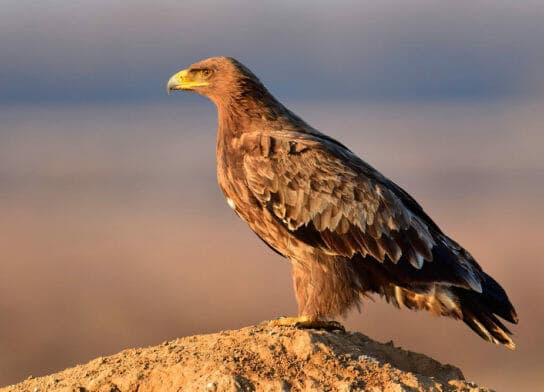
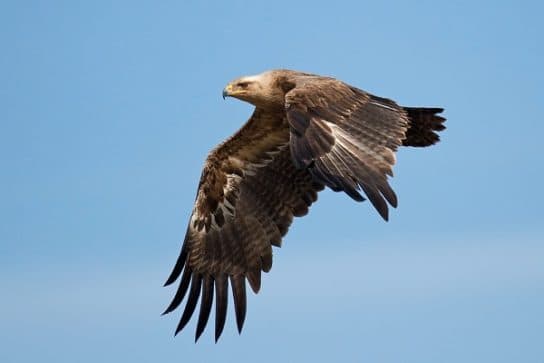
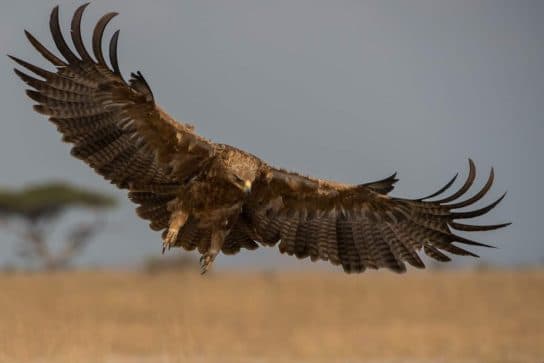
The steppe eagle is large in size, the animal has a small rounded tail. In adult birds, the color is brown, but with age it can become darker. A permanent color is formed only by the 6th year of life. Juveniles can be identified by the white stripe on the wing, while adults have transverse stripes that are found on the flight wings. They have a white spot above the tail.
Sexual dimorphism is expressed in size: the female is smaller than the male. The length of the body of males is about 70 cm, while in females this indicator is in the range of 75-90 cm. The length of the wing in animals is about 60 centimeters. Males weigh 2 to 4 kg and females 3 to 5.

Where dwells
The steppe eagle can be found in the steppe and semi-deserts in the north of Eurasia. Birds also inhabit the plains and steppe zones near the mountains. So, these animals inhabit Russia and Kazakhstan, China and part of the territory of Mongolia. The largest population is in Kazakhstan, its number is about 50 thousand bird pairs.
They winter mainly in Africa, especially in its southern and central parts, as well as in India and Turkmenistan. Russian steppe eagles prefer Uzbekistan for these purposes. This happens from the beginning of September to March.

What eats
Usually, an eagle consumes about a pound of food per day, but often he lays food in the goiter, where it is stored for a day or two. The animal feeds on gophers, mice and rats, thereby bringing benefits in the fight against these destroyers of agricultural land. It also preys on hares and other small chicks. Sometimes the steppe eagle also eats carrion, but less often – reptiles. The predator ate dead animals more actively when the saiga population was huge. 10 eagles flew on one carcass at once.
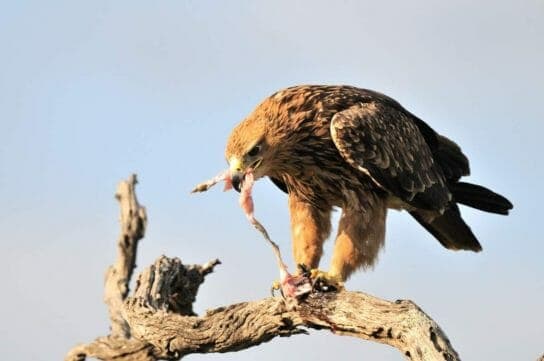

First, the bird tracks the object from a height, and then quickly rushes at the victim, having previously stretched out its paws with claws. Often, the eagle sets up an ambush near the gopher colony, using a hummock as a cover. It is worth some individual to move away from the rest, the predator grabs it and quickly runs away. There is a time when the number of gophers declines and then the steppe eagles do not create nests, but fly away in search of prey far from their habitat. Although usually only young individuals lead such a lifestyle.
Reproduction and parenting behavior
Around April, the animals are already preparing for the start of the breeding season. At the very first meeting of the future pair, the male flies not far from the female and, if she likes the territory of this individual, they become a pair.
These birds are monogamous, but if the partner dies, they will quickly find a replacement. Usually, during mating games, they like to whirl, dive and chase each other in the air for a long time.
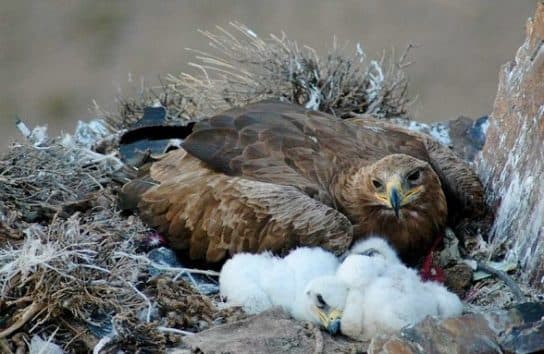

Animals can create nests both on the ground and on the tops of trees in a place where you can fly up from above. You can also find their nests on rocky ledges. In general, they love to find elevations of any kind, such as a haystack, and nest there.
In the nest of birds, there is always a bedding of manure, wool and materials created by man: paper, rags. You can often see plastic with pieces of clothing there.
The female lays eggs in May. Usually their number does not exceed 4. Their shells are light in color with spots of ocher color. The break between hatching is 3 days. The female incubates them for a little more than a month – about 40-45 days. Chicks are always of different ages, therefore often the smallest dies due to lack of food. They live in the nest for about 60 days, but they acquire full independence when they are 75-80 days old. The eagles feed on gophers.
Life span
Steppe eagles live about 30 or even 40 years in captivity, and in nature the figure drops to 8 years on average.
Interesting Facts
- During the autumn migration, eagles can fly 6 thousand kilometers. In the spring, this figure drops to 4 thousand km.
- Birds can fly at an altitude of 7 kilometers, this figure is close to the altitude of an aircraft
- Animals can see a mouse at an altitude of 2 km, they have 5 times more sensitive cells in their eyes than humans.
- A goiter can hold a lot of food: about a third of the animal’s weight.
- The female takes care of the chicks, and the male hunts.
- The voice of the birds is a scream. They make this sound during the mating season and to call for food.
- Animals do not conflict with other pairs, they usually settle in a kilometer from each other.
Number of
On the territory of the Russian Federation, steppe eagles are listed in the Red Book. In 15 years, the animal population has declined by more than 90 percent. Now there are only 1895 pairs of these birds. This is due to the fact that people are actively developing the steppes to create farmland and villages, the destruction of rodents – animal feed. Also, cattle are often driven through them, because animals die. They also die on unprotected power lines due to electric shocks.
Steppe eagle – video


