


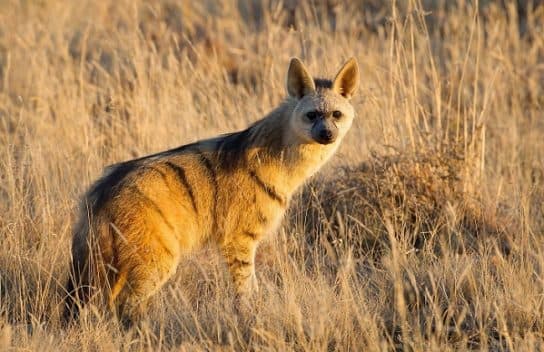


Aardwolf (lat. Proteles cristatus) Is a small mammal that lives in the African continent. Belongs to the family of hyena, suborder – cat-like. It got its name due to its appearance, habits, nutritional characteristics.
Description
The aardwolf cannot be called big in terms of predators, other types of hyenas, however, it is not a small animal. One of the features of these animals is their diet, which consists mainly of insects. Otherwise, there are a number of differences that need to be considered in more detail.
Appearance
In appearance, aardwolves are more like dogs than representatives of other species of hyenas. They have 4 toes on their hind legs and 5 on their front.
Average characteristics of earthen wolves:
- body length – 80 cm;
- height – 45 cm (at the withers);
- tail length – 25 cm;
- weight – 10 kg (extremely rarely it reaches 13-15).
The neck of these predators is longer than that of other hyenas, the limbs are thinner. In the structure of the skull, they are similar to foxes and dogs. The muzzle is long, large, pointed, triangular in shape.


The coat is thick, long enough. There is a large mane that runs almost all over the back. The color of the coat can be reddish, sandy. In the throat area, it is much lighter. There are contrasting dark stripes on the relatively light background of the body.
Where dwell
Zones of settlement of aardwolves – South and East Africa. Both populations are separated by a clear border, which is a dense tropical forest passing through the territory of Zambia, Tanzania. The favorite habitats of these predators are semi-deserts, savannas, grassy steppes, rocky foothills, plains. Moreover, they cannot be found in forests, deserts, mountains.
What do they eat
Although aardwolves are hyenas, they belong to the order of predators, their diet is the most “harmless”. The favorite delicacy of these animals is termites and their eggs. In addition to this, earthen wolves consume various larvae, beetles, and arachnids.
In times of famine, they can open nests of birds in search of eggs, hunt small animals.
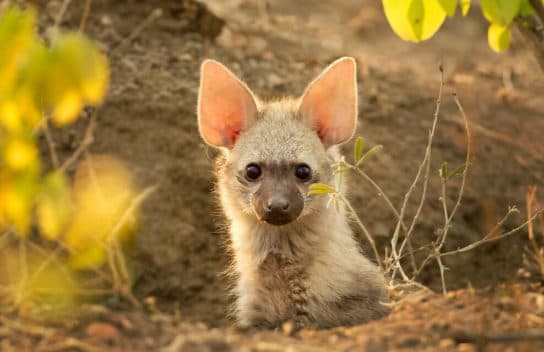
In order to feed on termites, nature has endowed these predators with a long tongue, sticky saliva. They prefer to feed at night, however, everything changes in winter, when the food supply decreases, the animal has to hunt insects during the day.
Natural enemies
Since earthen wolves are much smaller and weaker than their other relatives, they have much more enemies in their natural environment. They are often attacked:
- Lions;
- Big snakes;
- Other hyenas;
- Leopards, jaguars;
- Wild dogs.
An external threat to the health and growth of the earthwolf population is the contamination of the land with pesticides and various chemical fertilizers. This negatively affects the condition of the insects that earthen wolves feed on.
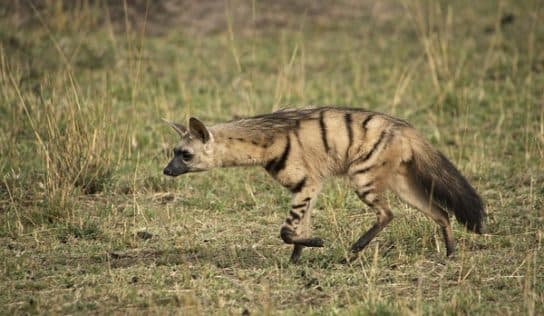

Important! In most cases, farmers who encounter aardwolves more often than not kill these animals as in the past. Due to their special diet, they are useful for agriculture, animal husbandry, and living in rural areas. However, the price of the skins of such predators is quite high, which is why poachers and aborigines hunt them.
Lifestyle
The lifestyle of aardwolves is predominantly nocturnal. After dusk, they go out to hunt for insects. For rest during the day they dig deep holes, hiding in them during the heat. They live in one place no longer than 8 weeks, after which they move to a new place of residence. The earthen wolves mark their territory, fiercely defend.
Places to live are chosen so that there is a huge number of termite mounds in the surrounding area. Within the limits of one food base, the earthen wolf equips up to a dozen holes, in each of which a certain period of time lives.
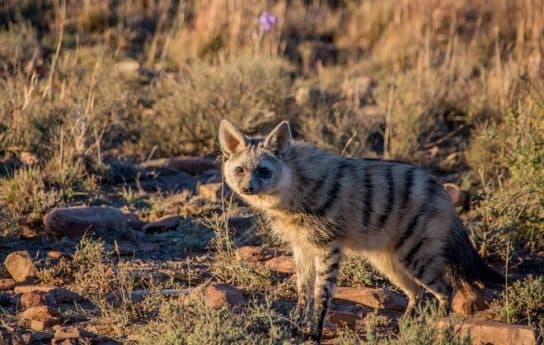

When it comes to breeding, offspring, aardwolves are very loyal predators. They form one pair, remain together for many years, until death. One litter may contain from 1 to 4 puppies. Parents take care of them together. When the kids get stronger, the family will move from the acquired place to a new one. The average life span of an earthen wolf in nature is 10 years, at home – 13 years.
Interesting Facts
In order to better understand this beast, to study it from different angles, it is recommended that you familiarize yourself with interesting facts about earthen wolves:
- One of the most dangerous enemies for these animals, apart from humans, is jackals.
- If the male cannot protect his family, territory, the female mates with a stronger male. However, her original chosen one looks after the offspring that has appeared in the future.
- A large mane is needed by aard wolves for a reason. It rears up in times of danger, making the predator look more massive.
- They spend a significant part of their time in silence, growling menacingly in fear and aggression.
- There is no way to dig their hole, earthen wolves settle in abandoned shelters in the ground, which are left by other animals.
- The average distance covered by this predator in 1 day in summer is 12 km.
- Among all the variety of termites, earthwolves feed on only one that rises to the surface, making the task of feeding the predator as easy as possible.
According to scientists who study hyenas on the African continent, an unknown population of aardwolves may be discovered in the near future, which is believed to be located in Central Africa.
Insectivorous predators are not protected, they are not included in the Red Book. However, the population of aardwolves is gradually declining. This is due to the development of new lands by people, a decrease in the food base. According to scientists, this species is not threatened with extinction in the coming decades, but this species of animals is already under control.
Video about the earthen wolf


