





The Canadian lynx is a carnivore that belongs to the feline family. Previously, the Canadian lynx was considered a subspecies of the common lynx. At the moment there are two subspecies: Subsolanus, which inhabits Newfoundland and Canadensis, which lives in the northern United States.
Appearance
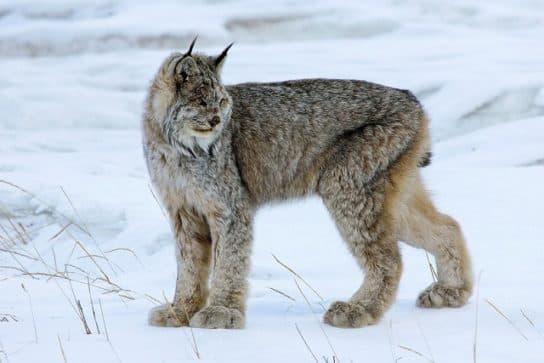
The length of the predator’s body ranges from 80 to 117 cm, and the average height is 60 cm.The tail of the Canadian lynx is quite small – its length can vary from 5 to 13 cm.The weight of the animal largely depends on the availability of food and ranges from 7-8 cm up to 14 kg. The hair of the feline is thick: its length can reach 5 cm.
In winter, the fur of the lynx is grayish; white spots can be found on the body. In summer, the color changes to reddish or dirty brown. Around the lynx’s head is a fur collar that resembles a tapered beard. The ears of the predator are black, like the fur on the tail. There are tassels at their end. The fur on the animal’s face is longer than in other areas. Retractable claws are located on the animal’s paws. The trot’s feet are quite wide.

Where dwells
The Canadian lynx can be found in Alaska, Canada and Newfoundland. This species is also common in the American states of Minnesota and Washington. The predator prefers taiga forests, but also lives in mountain crevices. The lynx almost never chooses open spaces for settlement. Often, an animal lives close to a person, but does not make contact. The habitat is large and its area is more than 7 million km2.


Natural enemies
The Canadian lynx can be hunted by bears and wolves, cougars and coyotes. Owls are also a danger to lynxes. However, it is almost impossible to catch the animal due to its ability to move easily through trees.

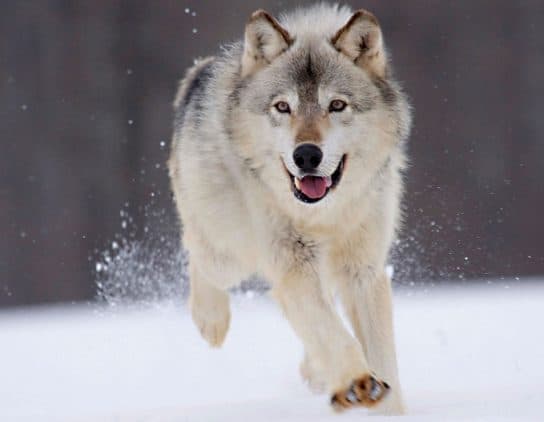
The wolf is the enemy of the Canadian lynx in nature
Life span
In the wild, they live for less than 10 years. In captivity, they can live up to 20 years.
Food and hunting
The diet of the Canadian lynx almost entirely consists of a white hare, each individual destroys two hundred of these hares per year. But the predator can also hunt beavers and squirrels, deer and bighorn sheep. During the famine period, the animal eats carrion, usually the carcass of a moose.
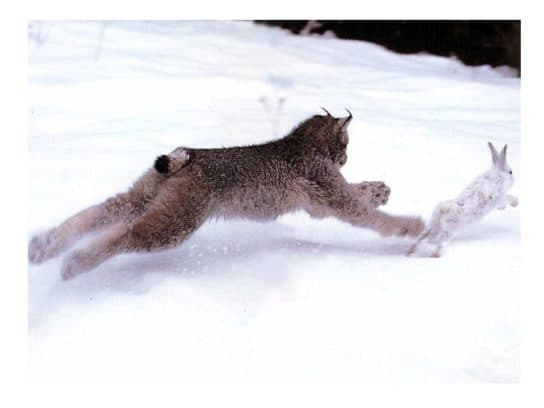

Hunting for the Canadian lynx is possible in pitch darkness, as the animals have good hearing. But even with such skills, lynxes do not always manage to find a prey, and then they walk tens of kilometers in search of food. If during this the weather worsens, the animal waits out the bad weather in a cave or on a tree. Having found a prey, the Canadian lynx lurks and then abruptly makes a fatal leap. Having caught prey, the predator can carry it to a tree and eat it there. If after a hearty dinner something remains, the thrifty animal will hide everything for the next meal.
Lifestyle
These animals are active at night, and during the day they hide in the rocks. At dawn, these felines begin to hunt. In the process, lynxes easily overcome obstacles in the form of reservoirs.
Canadian lynxes are territorial animals. An adult male usually covers an area of about 70 km2… The female needs only 25 km2… They protect the borders with their own urine.

Reproduction
The Canadian lynx is a predator that prefers to live alone. Only with the onset of the mating season do males create pairs. This happens in March – April. Sexual maturity occurs at two years in females, and in males at three years of age. Moreover, males manage to fertilize more than one female. Cubs are born after 2 months. Usually 1-6 kittens are born. During the period when the food supply is plentiful, 8 lynxes can be born.
Lynx cubs are often born on rocks or inside hollow tree trunks. Females make dens there. Their weight at the time of birth is about 17-250 grams. At first, they are completely deprived of sight, and only at the end of the second week of life do they acquire it. Cubs are born already with dense hair, which protects from low temperatures. The weight gain of the offspring directly depends on the population of the white hare and the rest of the prey. If there is enough food, then by the first winter in their life, the lynxes already weigh about 4 kg. But if there is little food, in 90% of cases, all offspring die. This is important, because the mother feeds the offspring only up to 3-5 months, adding the meat of the cubs to the diet from a month after birth.
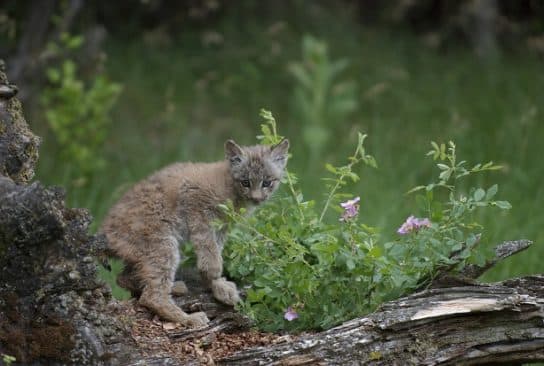

The offspring is raised by the female, she also teaches them to hunt. Upon reaching 5 weeks, the lynxes begin to hunt with their mother. At the age of 7 months, they are already involved in this process. After 3 months, they leave the “home” and start looking for a site suitable for life. They can walk almost a million meters before finding “their” territory.
Number of
This species was listed in II CITES due to the threat of extinction. At the moment, the number of the Canadian lynx is constantly decreasing, because they are often hunted for fur. This also happens because the habitats of these animals are constantly being destroyed, individuals die when crossing roads. Now the population size is about 50 thousand individuals. The maximum animal density is 30 lynxes per 100 square kilometers.


Canadian lynx at home
Today, many often get themselves an unusual pet – the Canadian lynx. This predator requires special conditions: it needs a spacious open-air cage with any strong snag for grinding claws, 1-2 kilograms of any meat per day. It is also important to add calcium to animal feed, this is especially important for newborn lynxes.
Canadian lynx – video


