


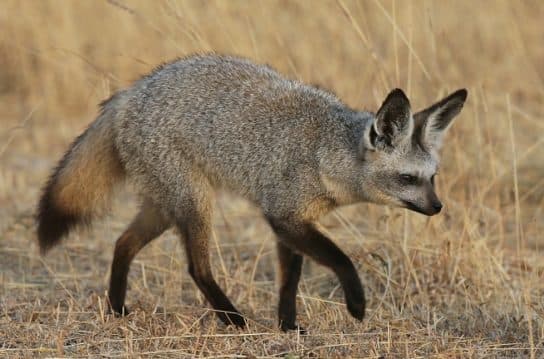


Foxes belong to the canine family. In total, there are about 23 species of various representatives of this family. Big-eared fox (lat.Otocyon megalotis) one of them. This is a rather unique animal that is endowed with an extremely unusual appearance.
Appearance
The big-eared fox has a specific appearance. The structure of the body is rather fragile with thin and short limbs. The front legs are five-toed, and the hind legs are four-toed. On which there are long sharp claws that perform a digging function. In size, big-eared foxes reach about half a meter in length. Body height rarely exceeds 40 centimeters. Weight varies from 4 to 7 kilograms.
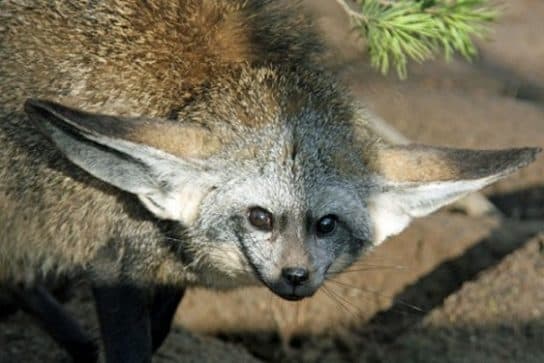
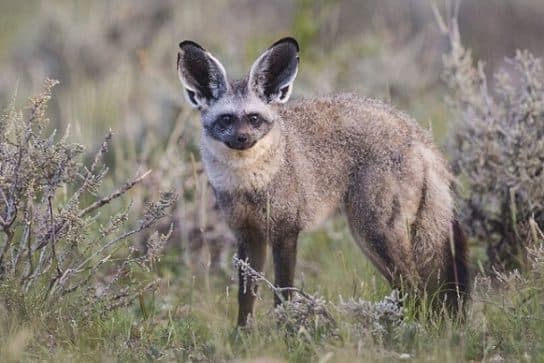
The muzzles of these animals are relatively small and sharp. It has black and expressive eyes. The very area of the muzzle is covered with dark hair that resembles a mask. Ears and limbs are black. A distinctive feature that follows from the name is the very long, triangular-shaped ears. Foxes are able to fold them, as a result of which they cover almost the entire surface of the head. These large ears have a thermoregulatory function, since they contain many blood vessels that save the animal from overheating.


The color is different from the typical fox. It has both yellowish shades and grays. The limbs are covered with dark brown hair. The area of the neck and abdomen has a distinctively light color.
Habitat
As a habitat, these animals prefer a hot climate. They have spread widely across the African continent. They live in savannas and steppes, where there are tall grasses and bushes. Thanks to them, animals can hide from the sultry heat. There they hide from their enemies.
The main habitat of big-eared foxes:
- South Africa;
- Botswana;
- Zimbabwe;
- Zambia;
- Sudan;
- Mozambique.
They are also found in Kenya, Ethiopia. Uganda, Somalia and Lisote.
In the habitat of these animals, the grass is no higher than 30 centimeters, since otherwise it will be more difficult for them to get their food. If food becomes scarce in their region, they migrate to another area.

Nutrition
Big-eared foxes are predatory animals that feed mainly on insects. The basis of their diet consists of termites. Only one big-eared fox eats up to one million termites per year. Despite the fact that there are 48 teeth in the mouths of animals, they are not adapted for eating large animals. This is due to the fact that they are not hunters, so there is no need for them to eat meat and hold on to their prey. However, they digest the food they eat very quickly. Their ears help them to get insects, which pick up the subtle sounds of insects even underground. As soon as the big-eared fox hears a sound, it quickly digs up the ground with its claws and eats the insect.
In addition to termites, these leaves feed on fruits, plants, lizards, and larvae. It is a noteworthy fact that these representatives love sweet food. They can often eat honey and fruits.
The search for food begins at night, since in extreme heat conditions they are not able to live in open spaces for a long time. During the night, they travel 14 kilometers.
Breeding period
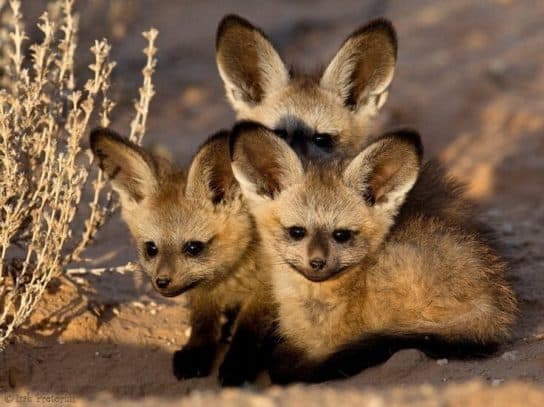
For representatives of large-eared foxes, monogamy is characteristic. Formed couples last almost all their lives. There are cases where males live with several females. During the estrus period, which lasts one day, individuals can mate several times. Foxes are born only once a year. The incubation period lasts up to 70 days. Cubs are born during the rainy season. At this time, the largest number of insects appears for food. Most often, no more than 5 babies are born. The male is actively involved in their upbringing. He protects the burrow, looks for food and looks after them.
At first, the cubs are very small and helpless. They become sighted on the 10th day of life. After two weeks, they can leave their burrows and explore the territory. At this time, they are already covered with gray fluff. Up to 15 weeks, they feed exclusively on female milk. Then they gradually switch to adult food. They become sexually mature at the age of 8 months.

Enemies
Big-eared foxes are endangered by pythons, cheetahs, hyenas, lions and jackals. However, most of the time, the greatest harm is caused by human activities. Often these animals are exterminated for meat and fur. Their remains are in great demand. Most often, young individuals suffer from animals. They fall prey to birds of prey and mammals.
Another important factor in the decline in their numbers is rabies. They are very susceptible to this disease, which takes away almost a quarter of all infected animals.


Lifestyle
These animals are characterized by a migratory lifestyle within their range. They quickly adapt to new conditions. Each pair of animals and organized group has its own area of up to 80 hectares. However, territorial behavior is unusual for them.
As dwellings, big-eared foxes equip holes that look like labyrinths. If a predatory animal finds their refuge, then they leave it and begin to equip a new place.

