


The giant mole rat can be considered a relic animal. In ancient times, he lived in vast territories, but due to climate change on Earth, most of the animals have disappeared. Some places where the giant mole rat lives have survived in some Russian and Kazakh regions. The giant mole rat belongs to mammals, the “mole rat” family, and the order “rodents”. It is the largest representative of mole rats.
What does it look like
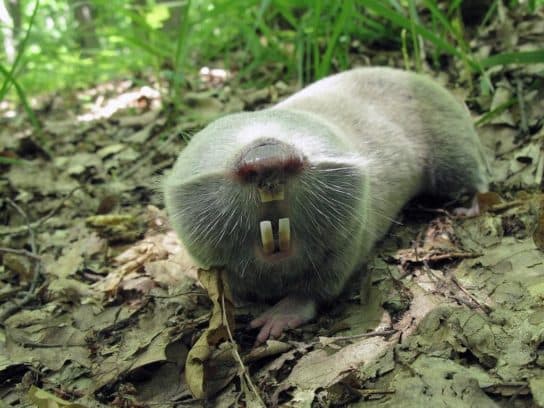
The giant mole rat has a powerful body 23-30 centimeters long and weighs about one kilogram. The shape of the body is bullet-shaped, the head is conical, tapers towards the nose, the neck is absent. There are no external ears, the eyes are covered with skin and cannot see. The rodent has well developed hearing, smell and touch. The legs and tail are short. Large claws are fitted on wider brushes. The incisors of the teeth are clearly visible from the outside. On both jaws molars are located (three pieces on the left and right sides). The lips are opened only for eating.
Rough bristly stripes run from ears to nose. The same vibrissae are found on the belly, on the back of the body and in the frontal part. They are meant to be touched. On a large nose, the skin forms folds. They protect the nostrils from dirt that can get caught while digging.
The body is covered with fur. The upper part is painted in a light color, and on the sides – in ash. In the belly, the color is usually dark gray. There is a white spot on the top of the head.


Where dwells
The giant mole rat has a small habitat:
- northeastern Ciscaucasia;
- in areas of the lower reaches of the Terek, Sulak, Kuma rivers;
- Tersko-Sulakskaya and Tersko-Kumskaya lowlands (Dagestan);
- Guryev region (northeast);
- Aktobe region (west);
- Astrakhan region;
- Kara-Agach;
- east side of the Ural River.


Lifestyle
The giant mole rat prefer to live alone. He is practically all the time in a dark underground world with a depth of 80 cm to 4 meters. The rodent is constantly digging. The holes dug by him extend over distances of 250 meters or more. The long burrow contains numerous passages and chambers. Rodents throw the soil onto the earth’s surface with their head.
Near the burrow of the giant mole rat, there is always a hill made of earth. With this earth, he fills the dug chamber with the prepared supplies and again digs another passage into the hole. A mole rat in a hole can have about ten storage chambers, and there are two hundred earth slides near its hole. In order to get food, the mole rat makes two-tiered tunnels. The greatest activity associated with burrowing activity is shown by the giant mole rat in March-April.
The rodent makes moves with long incisors, biting them into the ground. In order to prevent the earth from getting into the mouth and nasal passages, they are covered with folds of skin.


The location of the giant mole rat can be determined not only by mounds, but also by plants that have dried out due to gnawed roots or from their remains. Blind rodents molt twice a year: in spring and early autumn.
Mole burrows are located from neighboring burrows at distances within two meters. On the surface of the earth, a blind rodent rarely gets out. Under the ground, he leads an active lifestyle at any time of the year. In winter, the rodent does not sleep, it digs and digs.
Nutrition
The giant mole rat feeds on the roots of any plants that it comes across while moving. It also chews on tubers, bulbs, and sometimes eats the plant itself. The rodent prefers to eat plants of the following types:
- legumes;
- Compositae;
- labiate;
- cultural (carrots, potatoes, beets, turnips).
In summer, a mole rat can eat as much food as it weighs during the day. And in winter it eats its reserves from the pantries, partly the energy is replenished due to the fat under the skin.
Reproduction
One female reproduces offspring in the spring, but mostly once every two years. 2-5 cubs are born. The newborn baby does not have a woolen covering, it is completely naked. Cubs live near their mother until the beginning of autumn, and then they begin to build their own separate housing. Puberty occurs one year after birth.


Natural enemies
The blind rodent has practically no enemies, since its vital activity mainly takes place underground. Only when young mole rats begin to settle are they eaten by predators such as foxes, ferrets, and large birds.
Population and status
The giant mole rat belongs to a rare species of rodents in nature. It is included in the list containing rare species of animals, as well as in the Red Book of our country.
Accurate data on the number have not been collected, since his underground lifestyle does not allow mole rats to be well studied. Scientists have found that the number is not increasing, and perhaps even decreasing. Several thousand of this species of rodents have survived approximately in nature.

The population is declining due to the development of virgin lands by humans, the use of chemicals, the construction of systems for irrigation and other human activities.
It is illegal to hunt for a giant mole rat.
Interesting Facts
- If a giant mole rat needs to make a 180-degree turn and move in the opposite direction, he makes a kind of somersault, which is not typical for earth-moving animals.
- The coat of a blind rodent is able to fit in different directions. This allows you to easily move forward or backward through the dug tunnels.
- A mole rat can dig a burrow 85 centimeters long in twenty minutes, throwing away 25,000 cubic centimeters of earth.
- Large quantities of vegetables were found in storage rooms built by giant mole rats. In one of them there were about 15 kg of various vegetable vegetables, and in the other – potatoes in the amount of 18 kg.
If a giant mole rat accidentally falls on the earth’s surface, then at the beginning it will freeze for a few minutes, and then make circular movements in one place, and then move back, then burrow into the ground with great speed.

