


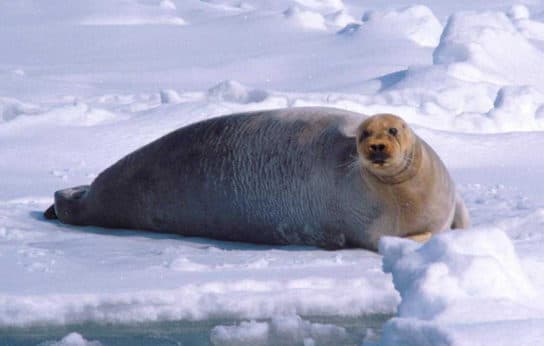


It is surprising that the sea hare does not at all look like a small eared animal – it is a large seal, popularly called a bearded seal. The animal belongs to predators and, despite its large size, is rather shy and cautious. The pinniped mammal is attractive to poachers due to its durable and flexible skin, which is used in the manufacture of shoes, ropes, kayaks and other products. Also, bearded seal meat and fat are eaten. The sea hare lives in the Arctic and Pacific oceans up to the Tatar Strait.
Description of light
Lakhtaks behave very unusual on land – they jump like hares. A large seal has a large and clumsy body, the length of which can reach 2.5 meters. On average, adults weigh from 220 to 280 kg, but bearded seals weighing 360 kg have also been encountered. The pinniped mammal has a round head and a very short neck, small flippers, which are located closer to the neck and directed upwards. The bearded seal’s muzzle is slightly elongated. A distinctive feature of this type of animal is straight, thick and long vibrissae.
The sea hare perfectly adapts to harsh climates thanks to its fatty layer, which can make up 40% of the total mass of a mammal. The bearded seal has practically no underfur, and the awn is short and stiff. Aquatic predators are brownish-gray in color, which becomes lighter closer to the belly. Some individuals have a dark blue stripe that resembles a belt. There may be whitish spots on the head of bearded seals.


Bearded seals have only internal auricles, so they look like holes on the head.
Nutrition and lifestyle
Sea hares are predators. They can easily dive to a depth of 70-150 m and get their prey. Lakhtaks feed on molluscs and crustaceans. Fish may also be present in the seal’s diet, namely capelin, herring, flounder, Arctic cod, haddock, gerbil and cod. In the warm season, animals are especially gluttonous, as they store fat for the cold season. Its survival in the future directly depends on the fatty layer of the bearded seal.
Pinniped amphibians are rather slow. They prefer to live in a developed area and do not like to migrate. Animals like a solitary lifestyle, but even if someone “wandered” on their site, they do not arrange fights and skirmishes. On the contrary, bearded seals are very friendly and peaceful.
Breeding bearded seal
Northern seals can live up to 30 years. Adults unite only during the mating season. During the mating season, males begin to sing, making ominous sounds. The female chooses her partner based on his “musical” abilities. After mating, the seal is able to retain the partner’s sperm for two months and “choose” the right moment for fertilization. The female’s pregnancy lasts about 9 months, after which one baby is born.


Female bearded seal with her cub
Newborn bearded seals weigh about 30 kg. They are born with soft and fluffy hair and are already able to swim and dive. A young mother feeds her children with milk for about a month (a baby can drink up to 8 liters in 24 hours). Cubs grow very quickly, but females do not part with small bearded bearded bears for a long time.
Sexual maturation of the bearded seal begins by 4-7 years of age.
Enemies of seals
Polar and brown bears pose a real danger to bearded seals.


Brown bear


Polar bear
In addition, being on an ice floe in the open sea, bearded seals run the risk of being eaten by killer whales, which dive from below and collapse from above with their entire huge mass. Seals are also susceptible to helminth infestation, which absorb all nutrients and kill the animal.
Lakhtak – video


