


The sucker is a striking representative of the monkey family. The animal belongs to the order of Primates, it is the only species of its kind due to its specific appearance.
Appearance
The sucker is not a very large monkey. The length of its body varies from 55 to 72 cm. The tail of the animal is very long: from 66 to 75 cm. The weight of the primate can be either 12 or 24 kg. Sexual dimorphism is expressed by the presence of a “roll” of skin on the shoulders of the male and by the fact that males weigh several times more than females. The head of the animal is round, the monkey has well-developed prehensile fingers and a strong tail.
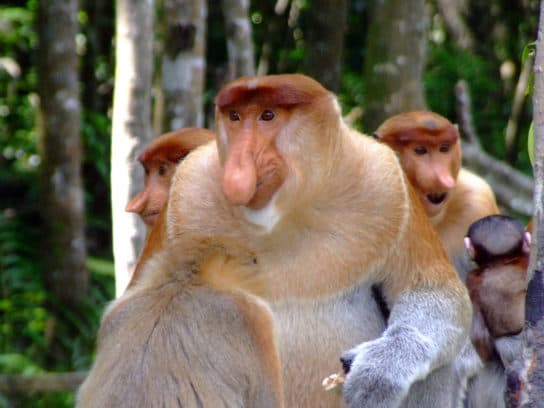
Animals began to use the tail not so long ago, because it is not as flexible as in other species of the order. The primate stands out clearly from others due to its 10 cm long nose, which often interferes with eating. In females, it is slightly upturned, while in males it is swollen and hanging down. The hair of the animals is short. The head together with the back and abdomen is red, the “ridge” is almost white, all limbs of the Nose are grayish. The skin of the face is yellowish, which makes it stand out.
Where dwells
These primates are endemic. You can only meet them in Borneo. Animals inhabit humid forests, they prefer to live near rivers and in dense thickets.
Lifestyle
Animals are more active in the evening and during the day, the rest of the time they rest. Noses look like very clumsy monkeys, but this is not at all the case. They climb trees almost all the time and jump from branch to branch. It happens like this: the primate sways, clings to a branch with its forelimbs, and then jump to a neighboring branch. During such movements, monkeys can only move on their lower limbs. This indicates a high organization of monkeys. Animals rarely go down, mainly when they are tormented by thirst.
Primates can swim and dive. Animals have membranes located between the 2nd and 3rd toes. Animals are able to swim several tens of meters, they often have to overcome water obstacles, since there are many channels in the mangrove thickets.
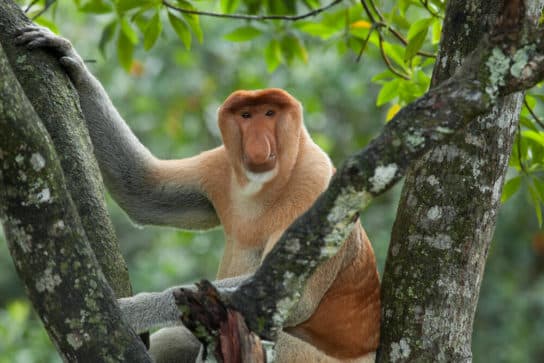

Animals form flocks, in which there are about 10 – 20 individuals. There is always a leader who subjugates young males and females. The males gradually leave the pack and live separately until they are able to compete with the leader. They usually leave the group at the age of two. It happens that several groups combine into one for success in finding food.
Sometimes the leader of the pack changes. The younger male takes power from the old master. This new leader often kills the cubs of the previous pack owner. Then the mother of the offspring and the former owner leave the flock.
In a flock, conflicts rarely happen, but no one is immune from minor clashes. Females often quarrel, but the leader quickly stops this with the help of an exclamation. The animals are quite close-knit, but they sleep separately. These primates usually like to show emotion by screaming. This is pronounced in males, they even compete with each other in the power of their cry. The winner becomes a highly respected member of the pack. But this is not the only manifestation of emotions and feelings. Noses often squeal and mutter, grumble.
What eats
Weasers eat leaves and unripe fruits. In times of famine, they eat insects and invertebrates. Feeding begins near the water, and then the animals gradually leave for the forest. In the evening they return to the water again.
Reproduction
Sexual maturity occurs upon reaching 5-7 years of age. Males become ready for mating a little later than females. The breeding season starts in the spring. In nashers, it is the female who shows her readiness for mating. She curls her lips into a tube, nods, demonstrates the genitals to the male. In turn, the readiness of the male is easy to determine: his nose will turn red and swell.
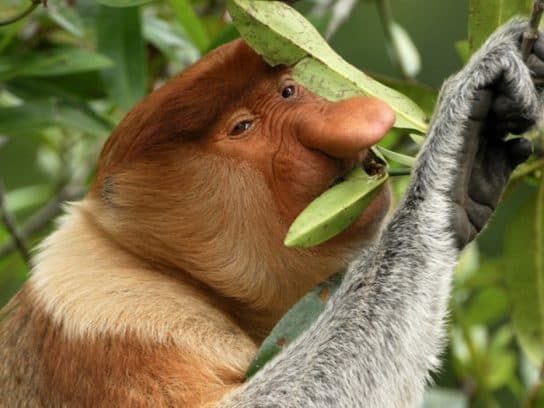

Pregnancy in these primates lasts about 200 days. The female gives birth to only one baby. The face of a small monkey is dark in color, its nose is small. Males are not born with a long nose; it takes on its final appearance only when the individual reaches puberty. The mother feeds the offspring with milk for about 7 months, but the spiritual connection between the mother and the cub never stops.
Natural enemies
Crocodiles are a huge danger to the Noses. These insidious animals constantly attack primates during crossings over water obstacles. Because of this, monkeys almost always choose the path by land, and if there is no choice, then they cross in the place where the river is already all. Leopards with pythons, sometimes eagles and monitor lizards also attack Nosachi.
Population
Primates are constantly under threat due to the increased hunting for them. The natives are very fond of animal meat, their fur is no less interesting to them. Another cause of extinction is the deforestation of the monkey habitat. Today, the population of noses is less than 3 thousand individuals. 80 of them are located in a nature reserve near Sandakan.
Life span
At the moment, it is believed that Nosachi live for about 20 years in the wild. Monkeys have problems with socialization and learning, because there is practically no data on life expectancy in captivity.
Carrier – video


