


On the surface of forest reservoirs and garden ponds, you can sometimes find amazingly beautiful perennial flowering plants – water lilies, or nymphs. One gets the impression that their flowers are just floating in the water, and they can be picked up. Of course it is not. Just like any plant, a water lily has both a stem and roots, with which it firmly holds onto the soil at the bottom of the reservoir.
It is believed that it was representatives of the water lily family that were the first flowering plants on the planet – a kind of intermediate link in evolution between gymnosperms and angiosperms. This is confirmed by various molecular studies and found fossils of ancient plants.
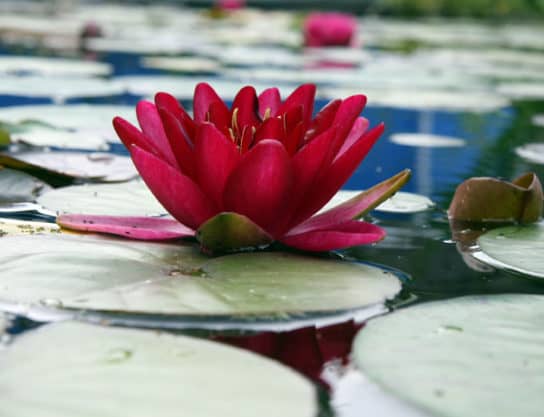
In this family, several dozen different species are represented, differing in the color of the corolla petals, the size of flowers and leaves, smell, habitat and other characteristics. The red water lily definitely stands out among them with the bright colors of its petals: from pale pink in the center to bright red and crimson at the edges.


Structure and appearance
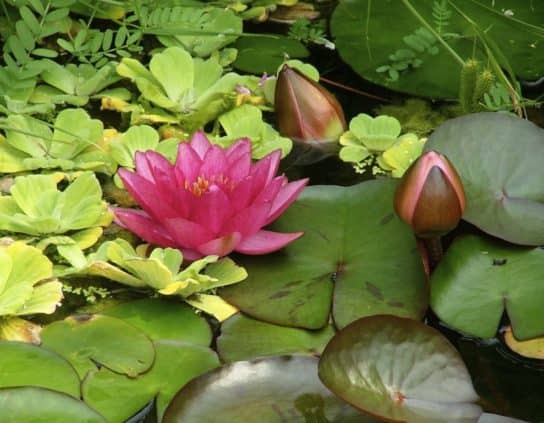
The developed root system of the water lily does not lie very deep in the ground, but it firmly holds the plant in it. This is ensured by the presence of short vertical and longer horizontal roots extending from the rhizome. The red water lily has two types of stems: one main and several additional ones. The fleshy dark green leaves of the water lily are found both in the water column and on its surface. The floating leaves are heart-shaped, rather dense and up to 25 cm in diameter. In addition, they provide additional resistance to the plant in water.


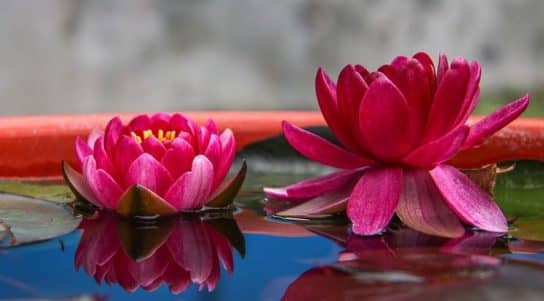
Water lily flowers can combine different shades of red and pink. Their size varies from 12 to 20 cm depending on external conditions, for example, the intensity of sunlight. The flower buds are medium in size. The opened bud emits a very pleasant and persistent scent that attracts pollinating insects.
Reproduction
The red water lily can reproduce by seed and vegetative means. Water lily bloom begins in May or June and ends in September-October. After pollination has occurred, the fruit is formed in the form of an oblong capsule with numerous seeds. The peduncle is shortened, twisted, thereby immersing the fruit under water. In water, it ripens completely, opens up, and seeds fall outside. They are covered in thick mucus that keeps the seeds afloat. Then the mucus dissolves, and the seeds sink to the bottom of the reservoir, where they germinate in the ground.

The vegetative method of reproduction consists in separating part of the rhizome, moving it a certain distance from the uterus plant and fixing it in the ground in a new place. When artificially breeding water lilies, it is the second method that is used as the most reliable.
Distribution and habitat
The red water lily lives, like all representatives of this family, in freshwater bodies of water with stagnant water or a weak, barely noticeable current. Prefers shallow depths, usually up to 1 meter, and water well heated by the sun. The water lily has the peculiarity of closing its flowers, “hiding” them under the water at nightfall, and reopening them in the morning with the coming of the sun. If the weather is cloudy, the flowers may not open.

It grows in the climate of the temperate, subtropical and tropical zones of the Earth. In Russia, it is distributed in the European part, in the Urals, in Western Siberia, in the North Caucasus, in the Far East.
Use and application
More often, the red water lily is used by humans for decorative purposes. It is specially grown in ponds for aesthetic pleasure.
However, its parts (rhizome, stems, leaves) are used as medicines for internal (infusions, decoctions) and external use (ointments, compresses, infusions). It has a haemostatic, anti-inflammatory, antipyretic, analgesic and sedative effect. Lovers of traditional medicine can find many uses for the water lily, but before that, you definitely need to consult a knowledgeable doctor. Otherwise, the desired recovery can result in even greater harmful consequences for the body. It is also important to remember that preparations from various parts of the water lilies are contraindicated for people with low blood pressure (hypotension).

Water lilies of various types are also eaten. Nymphaean seeds are used as a coffee surrogate, and rich fleshy rhizomes are used to produce starch and flour.
Pests and diseases
The water lily is highly resistant to various diseases. Pests also generally do no harm to her. However, in hot and dry times in artificial reservoirs, there is a high probability of an attack on the nymph by the water lily beetle feeding on the floating leaves of the plant. Another enemy of the water lily is aphid, which infects the flowers of the nymphea and contributes to their early fading. It is necessary to fight pests only by mechanical methods (removal of insects and affected plant parts), since insecticides have a detrimental effect on plants and animals of water bodies.


But the main enemy of water lilies is, of course, man. His excessive interference in the existence of their population in order to extract raw materials for obtaining various substances, led to a sharp decrease in the number of the red water lily. The water lily recovers extremely slowly, and the rate of its production, on the contrary, only increases. The deteriorating ecology due to human activities also adversely affects this plant. Drainage of water bodies, their pollution and other impacts on natural resources can lead to the extinction of the species. Therefore, it is extremely important to give to nature what is so perfidiously taken from her. Growing water lilies and returning to their natural habitat, refusing to collect wild-growing flowers, maintaining cleanliness while being in nature – compensate for the harm caused by humans.

