


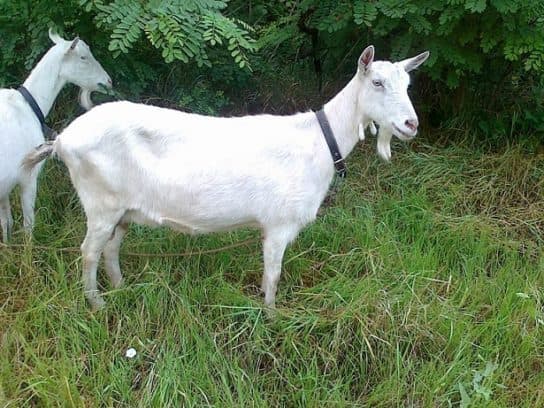


The Saanen goat is a dairy goat breed native to the Saanen Valley in Switzerland. She is also known as “Chèvre de Gessenay” in French and “Saanenziege” in German. Saanen goats are the largest dairy goat breeds. They are productive and bred in all regions, grown on commercial farms for milk production.
Saanen goats have been exported to many countries since the 19th century, bought by farmers because of their high productivity.
Characteristics of Saanen goats
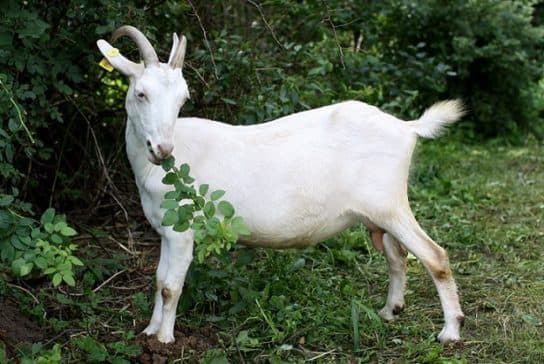
It is one of the largest dairy goats in the world and the largest Swiss goat. Basically, the breed is completely white or creamy white, with some specimens developing small pigmented areas on the skin. The coat is short and thin, with bangs usually growing over the spine and thighs.
Goats do not tolerate strong sun, because they are pale-skinned animals that are horned and hornless. Their tails are in the shape of a brush. The ears are straight, pointing up and forward. Average live weight of an adult female is from 60 to 70 kg. The goat is slightly larger than a goat in size, the average live weight of an adult brood goat is from 70 to 90 kg.
What do Saanen goats eat?
Goats eat any grass and find food even on scarce pastures. The breed was bred for intensive development in natural conditions and does not develop well if it lives on one hay on a farm. Dairy goat breed requires:
- a protein-rich diet;
- highly nutritious feed;
- sufficient amount of greenery for growth and development;
- clean and fresh water.

Breeding, offspring and cross-breeding
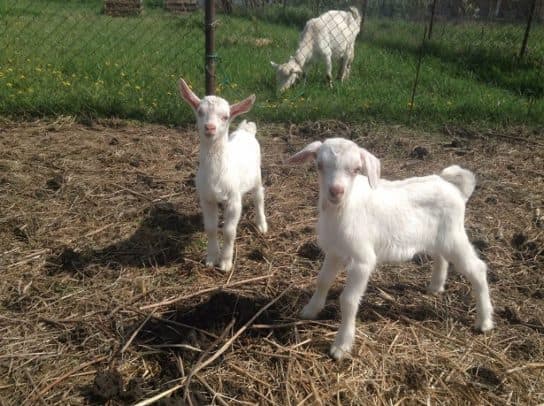
The breed reproduces throughout the year. One doe brings one or a couple of kids. Representatives of the species are often used to cross and improve local goat breeds. The black subspecies (Sable Saanen) was recognized as a new breed in New Zealand in the 1980s.

Life span, reproduction cycles
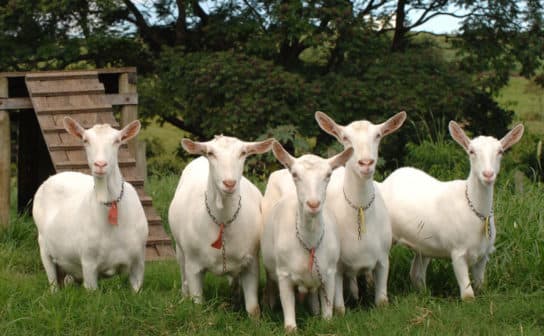
These goats live for about 10 years, reaching sexual maturity between 3 and 12 months. The breeding season is in the fall, with the female’s cycle lasting 17 to 23 days. Estrus lasts 12 to 48 hours. Pregnancy is 148 to 156 days.
The goat sniffs the air to understand if the female is in estrus, stretches her neck and head up and wrinkles her upper lips.

Benefits for humans
Saanen goats are hardy and some of the most productive milking goats in the world, and they are primarily used for milk production rather than hides. Their average milk production is up to 840 kg for 264 lactation days. Goat milk is of fairly good quality, with a minimum of 2.7% protein and 3.2% fat.
Saanen goats require little grooming, even small children can raise and take care of them. Goats get along side by side and with other animals. They have an obedient and generally friendly character. They are also bred as pets for their placid temperament. A person is required to:
- keep the goat habitat as clean as possible;
- See your veterinarian if your goats get sick or injured.
Living conditions
Saanen goats are energetic animals that are full of life and need a lot of grazing space. Light skin and coat are not suitable for hot climates. Goats are extremely sensitive to sunlight and produce more milk in cooler climates. If you are breeding Saanen goats in the southern regions of the country, providing shade in the midday heat is a prerequisite for keeping the breed.
The goats are digging the ground near the fence, so a strong fence is needed to keep the animals locked up if you don’t want them to scatter around the area in search of luscious greenery.
Features of the Saanen goat breed – video


