


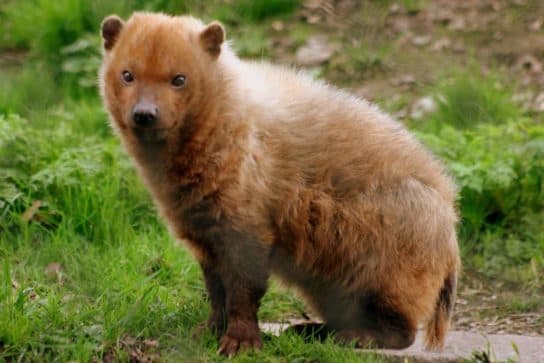


These are rather unusual animals that have a number of external similarities with badgers, but they belong to dogs because of their characteristic barking. Due to the constant deforestation, bush dogs are in a very vulnerable position. Animals are forced to migrate in search of food.
Appearance
Shrub dogs have a body with a length of up to 75 centimeters and a mass in the range of 5 to 7 kilograms. The height of individuals reaches about 30 centimeters. The physique of the dogs is quite dense, and the limbs are short. The head is large with a rounded muzzle, on which there are small ears and large eyes. The tail is covered with long hair. The coat itself is coarse and bristly, colored brown.
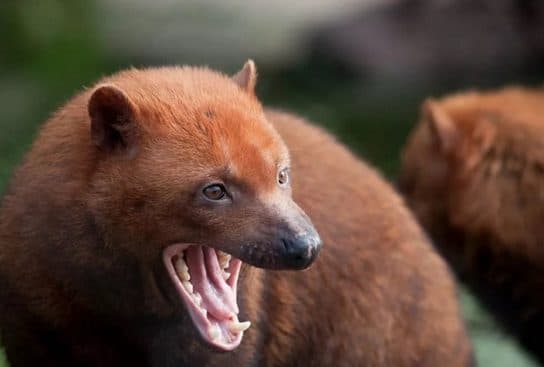
There are shrubby dogs of yellowish and chestnut shades. Puppies have a darker six than adults. In the throat area, some species have a small light spot. The mouth contains about 40 teeth with sharp canines. The jaws themselves are very powerful, making it easy to handle the victim. On the tips of the paws are webbed toes.

Habitat
The territory of distribution of bush dogs extends from the north of South America from Pana to Paraguay. In many regions, the population of bush dogs is extremely small. As a habitat, animals prefer savannas, forests with swampy regions and selva. The life of these animals is connected with water, therefore their habitat should have territories with rivers and lakes. They have swimming membranes on their feet especially for this.
To date, there are only 3 types of bush dogs. The nominative subspecies is found in Brazil, Colombia and Ecuador. Sv wingei is found in southeastern Brazil, while sv panamensis is found in Panama. For the first time these animals were described only in 1842. For a long time they were considered extinct.


Nutrition
Shrub dogs are absolute predators. Most of their diet consists of various birds, lizards and small rodents. If the dogs are in flocks, they can hunt big game. Ostriches, capybaras and large fish become their victims. They tear their prey to pieces and then chew it thoroughly.
Hunting for prey is accompanied by a well-developed strategy, when one part of the animals urges the prey to the water, and the second group waits.


Life span
The lifespan of a bush dog in captivity reaches about 10 years… In nature, the exact duration is unknown, but it is assumed that they live much less. In nature, bush dogs are susceptible to various infectious diseases, including parasitic insects on their bodies. Also, bush dogs have real enemies: ocelots, cougar and jaguars.


Reproduction
The females flow twice a year. As a rule, puppies are born in October. Males who are next to females in a flock recognize by their characteristic smell that the female is ready for fertilization. In each pack of bush dogs formed, one female is distinguished, which dominates over other female species. The incubation is about 70 days. One litter can have both 1 and 6 puppies. The mother stays with the offspring for 8 weeks and feeds them with milk for about 6 months. From the age of 4 months, puppies begin to eat solid food. The male is busy looking for prey for himself and the female. The formed couple stays together for up to one and a half years.
Some cubs live with their parents for quite a long time. Bush dogs become sexually mature only at the age of 1 year.


Bush dog with cubs
Lifestyle
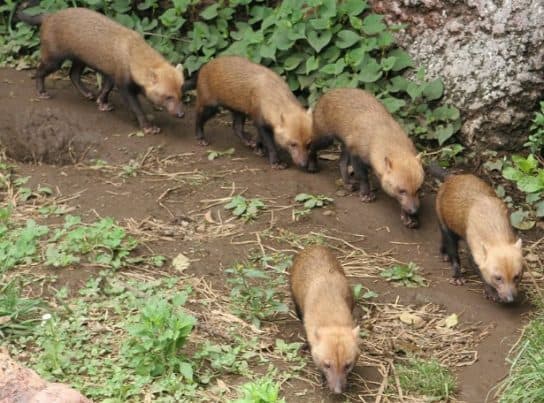
It is common for representatives of this species to organize family flocks, which are headed by dominant couples. In total, there are up to 12 individuals in one group. Shrub dogs are active at night, and they spend the day in their shelters. Their hiding places can be burrows of abandoned animals, rocky crevices and rotten stumps. These animals have perfectly adapted to existence in dense thickets of vegetation: they are short-legged and squat, thanks to this they perfectly make their way through dense thickets.
Hunting can be carried out collectively and individually. Thanks to their swimming skills, they can handle large casualties with ease. Pack members are characterized by territorial behavior. They mark the selected area with urine.
Shrub dogs do not differ in vocal skills. They make a sound similar to barking, but higher. Through these sounds, they communicate with other species of animals in the forest.

Population and status of the species
A close examination of bush dogs, in their appearance, you can find the similarities of so many animals. This amazing creature is listed in the Red Book. The extinction of the species is due to natural causes and human interference in their habitat. Hunting bush dogs is strictly prohibited, except in cases of rabies.
At the moment, there are only 10 thousand individuals. Native Americans got the hang of taming bush dogs, which then become their pets.
Informative video about bush dog


