


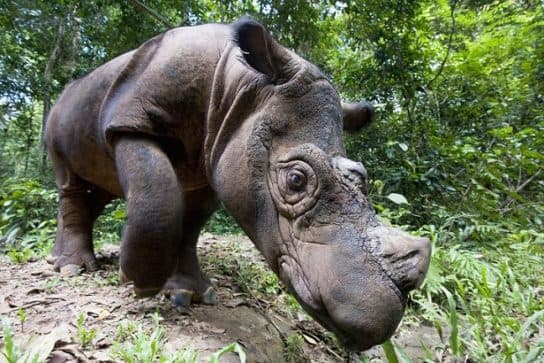


Sumatran rhinos are the smallest in comparison with other rhino species. They belong to equid-hoofed mammals. There are two living subspecies: western and eastern. The northern subspecies became extinct in the last century.
Appearance
The height of the animal can vary from 112 to 145 cm. The body length is on average 230-250 cm. The weight of a rhinoceros can range from 800 kg to two tons. The hair of animals consists of brown hairs. Most of the hair on the tail of the rhinoceros. Sumatran rhino skin – no more than 16 mm. There are small folds on the neck and abdomen. The length of the animal’s front horn usually does not exceed 25 cm. They are usually black in color. They also have a small, dark colored hind horn.
Sexual dimorphism is expressed in body structure. So, the male is much larger than the female. In addition, females do not have such long horns.
Genus of Sumatran rhinos (Dicerorhinus)

Life span
Sumatran rhinos live for about 40 years, and usually their age does not exceed 45, but this applies to life in the wild. In captivity, they do not live up to 30 years.

Where dwells
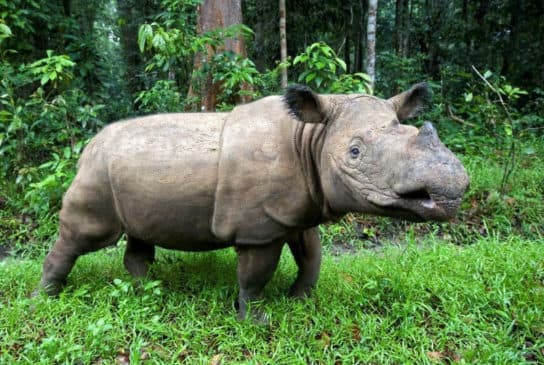
These animals live in Sumatra and the Malay Peninsula. Some experts also point out that Burma also has a small population. Sumatran rhinos can be found in the rainforest, near the swamps. They also live in mountain forests. In general, animals love areas that are well supplied with moisture.

Lifestyle
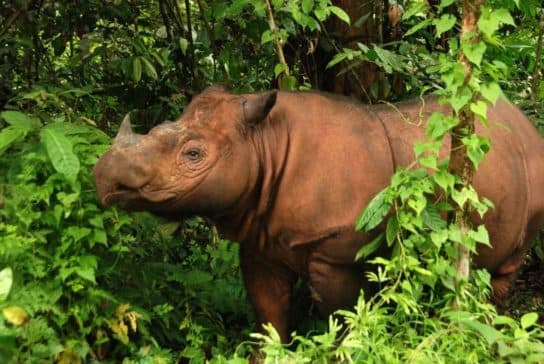
This species of rhinoceros is used to a solitary lifestyle. Only during the period of reproduction and rearing of offspring, females and males live together. Usually each male owns an area of 50 km2, and the “house” of the female is 5 times smaller. Females are almost always far from each other, but males are different. They mark their territory with excrement. Sometimes animals allocate their area of scraping soil. Sumatran rhinos are especially active in the evening. When the rainy season comes, they prefer to go high into the mountains, but with the onset of cold, the animals have to go down.
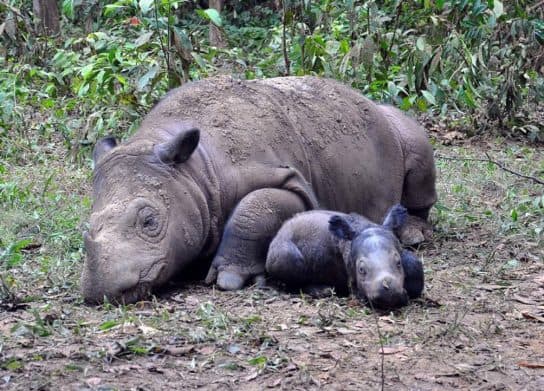

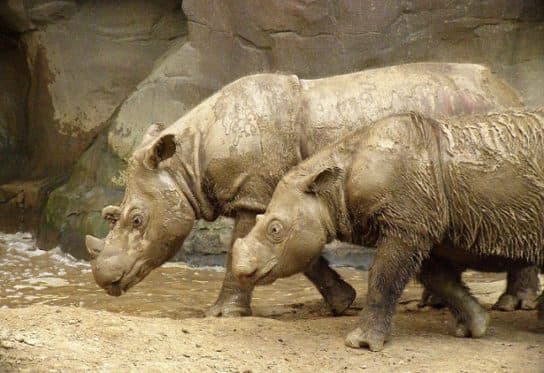
Rhinos love to spend time wallowing in the mud. When there is no suitable hole, they use the horns to expand it. Such a pastime helps to maintain the thermal balance in the body, protects against insect bites. They usually spend 2 hours a day in the mud, but in captivity this time is reduced to 40-45 minutes. Sometimes rhinos can replace mud baths with bathing.
Individuals always create trails on the territory of their “home”. There are two types of trails: the main ones, which play the role of some kind of bridges between important places, such as salt licks, and those that help you easily get to areas with the necessary food. These trails can be located on the territory of reservoirs, the depth of which can reach one and a half meters.
What eats
Sumatran rhinos prefer to graze in the evening, namely before dusk. Every day they need to eat about half a centner of food. Salt is vital for these mammals, therefore they are frequent visitors to salt licks. They eat the leaves and fruits of trees – members of the Madder family and Euphorbiacetes, Melastomaceae. These foods are high in fiber and protein.
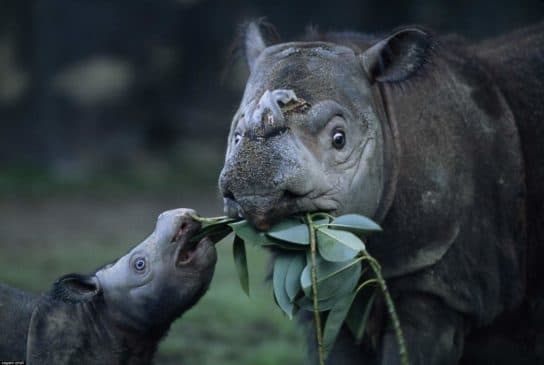
Rhinos love small seedlings the most. They put their whole weight on a shrub or tree and mercilessly eat the leaves. Most of the plant species that rhinos need can be found in small quantities in a specific area, and because of this, animals are forced to constantly change their diet and feeding places.
Reproduction
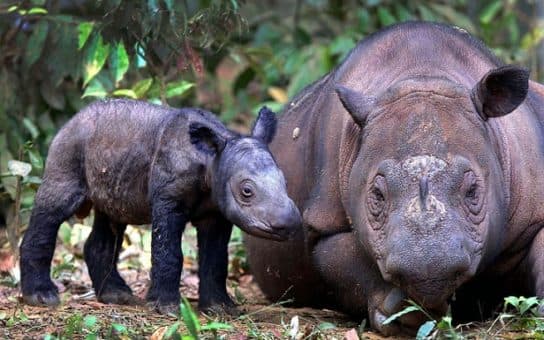
In females, puberty begins at the age of 6, and in males only at 10. Pregnancy in rhinos is long and lasts as much as 65 weeks. Having been born, the cubs weigh only 40-50 kg, the mother feeds them as much as she bears. Cubs live with the female until they reach two or three years. In the wild, females produce offspring every 4-5 years.
Sumatran rhinos have rather atypical courtship. Males often beat females directly in the face, and urinate on them. Young males sometimes kill females, but they can avoid death by being in the wild. Despite this aggressive behavior, males look after the female when she is in heat. This period lasts a day, but repeats every 20-25 days.

Natural enemies
Most often, predators attack young animals, and they are afraid of adults. Sumatran rhinoceros can fall prey to a tiger or wild dog. Sometimes they are attacked by lions. On rare occasions, rhinos kill each other.
Population and Red Book
Today there are only 275 individuals left in the world.… There are 6 populations of this mammal in the world, 4 of which are in Sumatra. That is why the Sumatran rhino is listed in the International Red Book. Back in 2011, the future of the population seemed vague, and now the species is almost on the verge of extinction. This is because poachers kill rhinos every day and it is difficult to protect the population due to its scattered habitat. This also happens due to the hunt for the horns and bones of the animal. They are actively used by the population of Sumatra to treat diarrhea and even tuberculosis. And also their horns are needed to create all kinds of elixirs that prolong life. The task is complicated by the fact that these animals are reluctant to breed in captivity.

Protection of Sumatran rhinos
All rhino problems are solved by placing rhinos in breeding enclosures. At the moment, Sumatran rhinos are bred and kept at the Cincinnati Zoo. This institution is actively involved in a program aimed at the conservation of endangered species. There, relatively recently, baby Andalas was born. There are also Sumatran rhinos at the London Zoo, where the animals are provided with all the necessary conditions.

Video about the Sumatran rhino


