


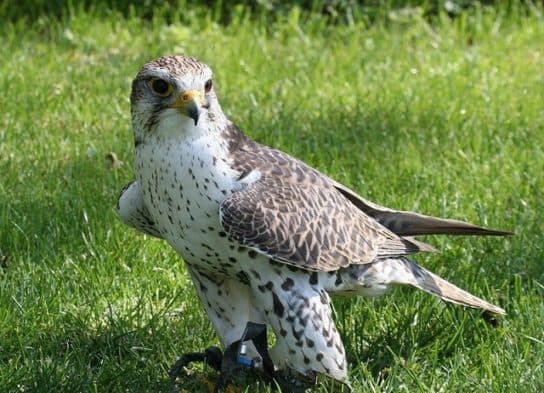


Saker Falcon (Falco cherrug) is a large falcon, body length 47-55 cm, wingspan 105-129 cm. Saker Falcons have a brown back and contrasting gray flight feathers. The head and lower body are pale brown with veins from the chest downward
The bird lives in an open habitat such as steppes or plateaus. In some countries, it lives in agricultural areas (for example, in Austria, Hungary). The Saker Falcon preys on medium-sized mammals (for example, ground squirrels) or birds.
Habitat
Saker Falcons live from eastern Europe (Austria, Czech Republic, Hungary, Turkey, etc.) eastward through the Asian steppes to Mongolia and China.
Seasonal bird migration
Saker Falcons nesting in the northern part of the range migrate to warm countries. Birds in the southern regions live all year round in the same area or migrate over short distances. Saker Falcons survive in the winter in temperate climates, when there is prey, for example, in Eastern Europe. Adult birds migrate less often with sufficient food, from central and eastern Europe they fly to southern Europe, Turkey, the Middle East, North and East Africa, if the winter is severe.


Reproduction in vivo
Like all falcons, Saker Falcons do not build egg-laying sites, but use the nests of other large birds such as crows, buzzards or eagles. They nest in trees or rocks. Recently, people have been making artificial nests for Saker Falcons, placing them on trees or pylons. In Hungary, about 85% of the 183-200 known pairs breed in artificial nests, about half of them are on trees and the rest on pylons.

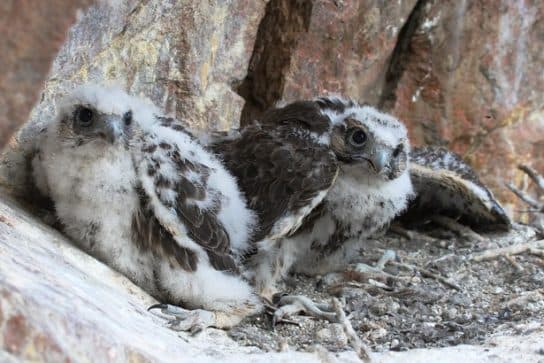
Saker falcon chicks in the nest
Saker Falcons become sexually mature from the age of two. Clutch of eggs in southeastern Europe begins at the beginning of the second half of March. 4 eggs are a common clutch size, but females sometimes lay 3 or 5 eggs. Most of the time, the offspring is incubated by the mother, the male hunts for food. Eggs incubate for about 36-38 days, young falcons need about 48-50 days to become on the wing.
What the Saker Falcon eats
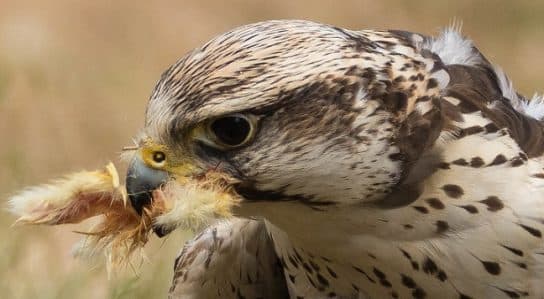
Saker falcons are medium-sized mammals and birds. The main food source is hamsters and gophers. If the Saker Falcon preys on birds, then pigeons become the main prey. Sometimes the predator catches reptiles, amphibians and even insects. Saker Falcon kills mammals and birds on the ground or birds on takeoff.

The number of Saker Falcons in nature
The European population numbers up to 550 pairs. Most of all Saker Falcons live in Hungary. Birds leave their nesting sites in the mountains because prey populations, such as the European ground squirrel, disappear after deforestation. Saker Falcons migrate to lowlands, where people equip nests and leave food for birds of prey.
In Austria, this species was almost extinct in the 70s, but thanks to the efforts of bird watchers, the population is growing.
Other countries where Saker Falcons are not on the verge of extinction are Slovakia (30-40), Serbia (40-60), Ukraine (45-80), Turkey (50-70) and European Russia (30-60).
In Poland, Czech Republic, Croatia, Bulgaria, Moldova and Romania, Saker Falcons are practically extinct. In recent years, birds have been bred in Germany in nature reserves. Future expansion of the population to the north and west is possible, given the increase in the number of Saker Falcons in Eastern Europe.
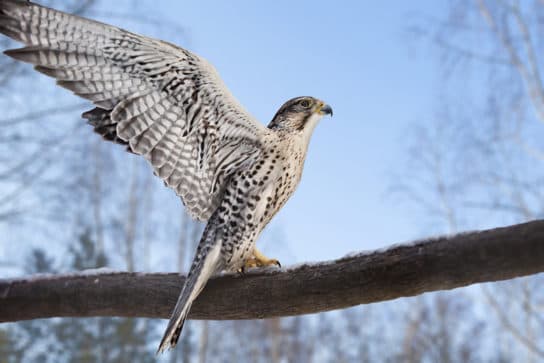
What are the main threats to Saker Falcons
- electric shock while sitting on wires;
- destruction of the habitat reduces the types of prey (hamsters, gophers, birds);
- inaccessibility of a suitable nesting site.
It is one of the fastest endangered falcon species in the world. The main threat is (at least in Europe) the illegal collection of eggs and chicks during the breeding season. The birds are used in falconry and sold to wealthy people in Arab countries.
Sokol-baloban – video


