


- 1 How radishes grow
- 2 Radish chemical composition and calorie content
- 3 Why are radishes useful?
- 4 Radish benefits
- 5 How to choose a radish
- 6 How to store radishes
- 7 The use of radish in cooking
- 8 Radish contraindications
- 9 Is it possible to radish during pregnancy
- 10 Is radish possible while breastfeeding
- 11 Is it possible to radish with diabetes


Radishes may not be your favorite vegetable, but they are still one of your healthiest and healthiest foods. Although radishes are now available almost all year round, they are one of the earliest early vegetables to grow in our garden beds and provide us with many beneficial nutrients.
Not a single hostess ignores the radish sold in the market. After all, this vegetable is one of the first vitamin sources after a long winter. Vitamin C alone contains almost 14 percent of the daily value. In addition, it is a low-calorie product. Therefore, it is very important to tell more about radishes in order to learn more about the benefits and help in choosing and using this root vegetable.
How radishes grow
Radish is an annual or biennial plant and is grown as an annual plant for a tasty root vegetable. This vegetable comes from the Radish genus and the Cabbage (or Cruciferous) family. Its original main Latin name is radix, meaning root.
For the first time it became known about a vegetable in Central Asia. Although this plant was grown in parallel in Ancient Egypt, Greece and Rome. In the Middle Ages, interest in radishes declined. And again he was remembered only in France in the 16th century. The root crop appeared on Russian territory thanks to Peter the Great, who brought it from Amsterdam.
Today, this one-year (European type) or two-year (Japanese or Chinese species; refer to winter varieties), a frost-resistant plant Raphanus sativus is a representative of a vegetable crop and a direct “relative” of the sowing radish.
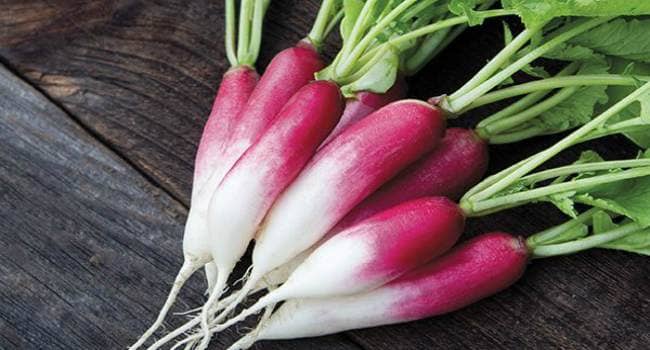
Depending on the varietal affiliation (and there are at least 20 varieties), root crops can be spindle-shaped, cylindrical, elongated or round, and their color varies from yellow, purple, pale pink to dark red. It should also be noted that there are early, mid-season and late varieties of radish, which allows you to feast on vegetables from April to October.
Growing radish is not particularly labor-intensive. It is sown in early spring. Seedlings appear in about a week. And the first crop can be harvested in three weeks.
Since this plant has a short daylight hours, the second summer sowing is carried out when daylight hours begin to decrease, i.e. in the second half of summer.
Radish chemical composition and calorie content
Everyone knows the fact that plant products are very rich in a variety of vitamins and minerals necessary to maintain a high-quality human life. Radish is no exception and it is worth dwelling on in more detail. In a small-sized root crop, there are:
- Water (up to 95%);
- Proteins;
- Fats;
- Carbohydrates (represented by mono- and disaccharides);
- Ash products;
- Dietary fiber (non-digestible fiber)
- Starch;
- Essential oils, in particular mustard oil glycoside;
- Retinol (vitamin A);
- Beta-carotene;
- B vitamins (thiamine, riboflavin, pyridoxine, choline, niacin, pantothenic and folic acids);
- Vitamin C;
- Phylloquinone (or blood-clotting vitamin K);
- Tocopherol (vitamin E);
- Macronutrients such as potassium, magnesium, calcium, sodium and phosphorus;
- Minerals represented by iodine, iron, manganese, cobalt, chromium, boron, vanadium, copper, nickel, lithium, fluorine, selenium and zinc.
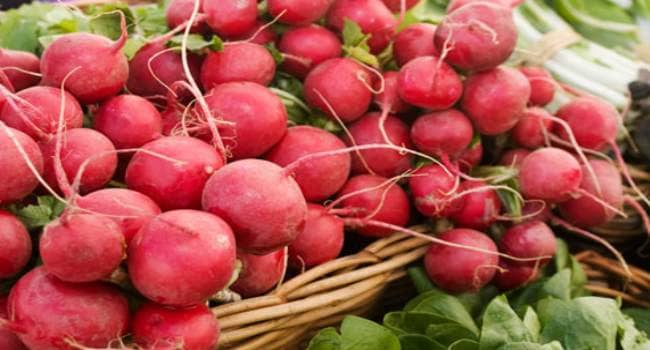
Many will be interested in the question of how many calories are in this vegetable? It is worth delighting those who are constantly fighting extra pounds – 100 grams of radish contains only 14 calories.
The energy percentage of protein / fat / carbohydrates is 24/5/68%.
Why are radishes useful?
Radish has many health benefits. The volatile substances present in it kill pathogenic microbes. According to some doctors, eating radishes can reduce the risk of developing malignant neoplasms due to the presence of anthocyanins in it.
Dietary fiber reduces the risk of developing the cardiovascular system, bowel diseases, in particular diverticulitis, and constipation.
A number of vitamins with antioxidant properties help prevent free radical damage to cells and are needed for cell repair and wound healing. Folic acid prevents fetal neural tube malformations, and vitamin B6 improves brain function and protein metabolism.
Potassium is needed to maintain water-salt metabolism. Magnesium normalizes the functioning of the nervous system, blood pressure, and is involved in building a strong skeletal system.
In addition, radish has mild choleretic, diuretic, anti-inflammatory properties, stimulates appetite, improves intestinal motility. Radish juice improves digestion and metabolic processes. It is useful for those with gout, obesity, diabetes.
Scientifically proven fact that radish stimulates the secretion of gastric juice, thereby helping to improve digestion. Fiber removes cholesterol. It is recommended in nutrition for the prevention of atherosclerosis, cardiovascular system.
By the way, radish juice is not inferior in its properties to onions or garlic in the treatment of colds.
With a severe headache, it is recommended to apply radish cut into slices to the temples or rub them on the places where the pain is more felt. And with radiculitis, a compress of grated radish will help.
Radish benefits
Despite the familiar appearance and many varietal accessories, radish has a huge beneficial effect on the human body and the use of this vegetable can bring certain benefits to the human body. For example, he
- Acts as a natural antiseptic;
- Has a moderate choleretic effect;
- Has a diuretic effect;
- Stimulates appetite;
- Stimulates the formation of gastric juice;
- Stabilizes blood glucose levels;
- Improves intestinal motility;
- Reduces the level of “bad” cholesterol;
- Prevents the development of cardiovascular diseases;
- Improves metabolic processes;
- Heals wounds on the mucous membranes of the gastrointestinal tract;
- Reduces the negative effects of gout;
- Promotes the treatment of obesity.
How to choose a radish
In order not to get negative impressions from the consumption of spring root crops, which embody a rich vitamin composition, it is necessary to take a responsible attitude to their choice. Fresh radishes should be firm and the leaves should be bright green.
When buying a radish, be sure to adhere to the following recommendations:
- Do not buy radishes during the “off-season” (that is, in winter and early spring), because the presence of pesticides can lead to serious poisoning;
- Try to choose homemade root vegetables;
- Watch out for visible damage and dark spots;
- Take fruits with a flat and smooth surface;
- Buy radishes with green stems or tops.
Soft roots will become firm again if placed in ice water for an hour.
How to store radishes
The storage of the vegetable also plays an important role in the preservation of all nutrients. Experienced gardeners and cooks advise:
- Store radishes in the refrigerator;
- If the roots have tops, then their term for consumption is no more than two days, and the leaves must be sprinkled with water;
- Peeled vegetables are kept as long as possible for a week;
- It is better to remove the tops so that it does not “pull” moisture from the root crop.
You cannot freeze radishes.
The use of radish in cooking
As a rule, the use of such a vegetable product in the culinary business is somewhat limited, due to the specific spicy taste due to the presence of mustard oil glycoside in the radish.
Thus, most often root vegetables can be seen as an ingredient in pure vegetable salads or with the addition of meat, as well as in okroshka.
Radish salad slightly seasoned with vegetable oil, fresh herbs of garlic and onions is an excellent vitamin dish. For those who count calories, it is enough to simply chop the radish and sprinkle it with lemon juice.
In more rare cases, tops are used, which are part of cold and hot first courses (the same soups and stewed vegetable stews).
Also, culinary specialists reveal one secret: fruits and tops cut with a metal knife lose some of their useful qualities. Therefore, it is better to use a ceramic knife for slicing.
Radish contraindications
Radish is beneficial to humans in many ways. But, like other edible products of plant origin, this root vegetable can cause some harm to the body.
For example, such a vegetable is forbidden to people:
- Individual intolerance to the product (or the presence of allergic reactions);
- Suffering from chronic diseases of the cardiovascular system;
- With increased acidity of the stomach, stomach ulcers and duodenal ulcers;
- Prone to increased gas production;
- For some diseases of the mucous membranes of the gastrointestinal tract.
Abuse of this vegetable, in spite of everything, can provoke a “disorder” in the work of the pancreas, gallbladder and liver.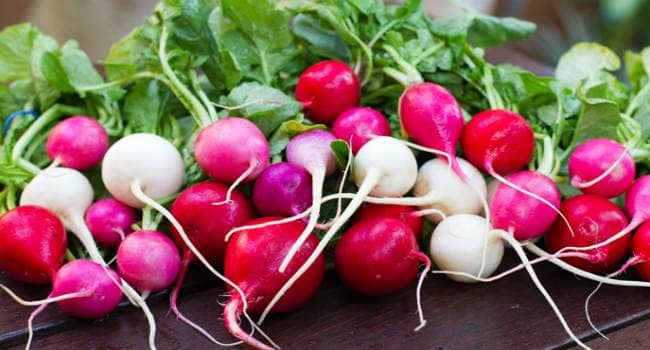
Is it possible to radish during pregnancy
As you know, many pregnant women are characterized by their inconsistency in culinary dishes. But more often than not, they want something spicy. And such a desire is directly related to the development of toxicosis.
Many, after listening to the advice of their loved ones, try to exclude a large amount of food from their diet. But it’s worth thinking about radish. After all, this particular vegetable is the owner of the vitamin and mineral complex, which is so important during pregnancy.
Therefore, using at least a small amount of root crops, a woman:
- Appetite will appear;
- The production of gastric juice will improve;
- Improve digestion and work of the intestinal tract;
- Bile will drain better;
- Puffiness will decrease.
And the intrauterine development of the baby will take place without the danger of fetal pathologies (potassium, calcium and folic acid will help in this).
Is radish possible while breastfeeding
For many years, radish was not recommended for nursing mothers due to the fact that it can negatively affect the baby. To date, doctors have somewhat reconsidered their attitude to the vegetable product widespread in the spring.
It has already been proven that women who regularly consume this type of root crops improve their overall health, the body is saturated with microelements and vitamins.
But in infants who consume milk from mothers who like radishes, the immune system is strengthened and the activity of the cardiovascular system is stimulated (blood flow improves, the risks of heart pathology are reduced).
True, in order to bring the baby the maximum benefit during breastfeeding, mothers must adhere to certain rules:
- You should not eat radishes in the first three months after the birth of a child;
- Eat small amounts of radish – up to 30 g per day (it is better to eat one small fruit in the morning, half an hour before the main feeding);
- After feeding, it is necessary to carefully monitor the child’s reaction for two days (at this time, the radish is not consumed); there should be no redness and peeling of the skin, swelling of the tummy, constipation;
- Introduce a vegetable into the diet no more than 1-2 times a week;
- Choose fruits that are not too bitter (so that the taste of milk does not radically change);
- Soak root vegetables for 20 minutes in cool salted water (and it is best to cut off the skin altogether);
- Eat radish dishes with fermented milk products (although in this case it is worth consulting a doctor).
Is it possible to radish with diabetes
Although some argue that diabetes is not a death sentence, people facing this disease have to limit themselves in many ways. With the appearance of radish in the spring, it cannot be thrown out of sight even for diabetics.
Everyone knows the fact that with diabetes metabolic processes in the body are disrupted, the level of glucose in the blood “jumps”. True, doctors also point out that the level of choline (vitamin B4) in the blood decreases, which is responsible for fat metabolism. Therefore, it is very important to maintain the endocrine system of the body. In this case, radish comes to the rescue, which contains lysozyme, which:
- Stimulates the immune system and suppresses the development of bacteria and fungi;
- Balances blood glucose levels (therefore, suitable for patients with the first and second types of diabetes);
- Has an anti-sclerotic effect;
- Removes excess fluid;
- Reduces blood pressure.
But there is one caveat – the amount of radish consumed is agreed with the attending physician.
About plz radish, how to choose and store a video on a topic


