


- 1 What Is a Self-Custody Crypto Wallet (and Why It Matters)
- 2 Best Self-Custody Crypto Wallets in 2026
- 3 How to Choose the Best Self-Custody Wallet
- 4 Typical Mistakes with Self-Custody Wallets
- 5 Real-Life Example
- 6 FAQ: Self-Custody Crypto Wallets
- 7 Short Version: What to Do Right Now
- 8 Conclusion
- 9 Sources


Would you still trust a bank if it could freeze your account overnight? That’s exactly the situation many crypto users faced with centralized exchanges. One day everything works. The next — access is gone. That’s why self-custody wallets are no longer just a “crypto nerd thing.” They’re becoming a necessity.
If you’ve ever thought, “Where should I actually store my crypto safely?” — this guide is for you.
What Is a Self-Custody Crypto Wallet (and Why It Matters)
A self-custody wallet means one simple thing: you control your private keys — not a company. No intermediaries, no frozen accounts, no withdrawal limits.
“Cold wallets… store private keys offline, making them significantly more secure than online solutions.”
Unlike exchange wallets, where a platform technically owns your assets, self-custody gives you full ownership. But it also comes with responsibility.
Two Main Types of Self-Custody Wallets
| Type | Examples | Best for | Risk level |
|---|---|---|---|
| Hot wallets (online) | MetaMask, Trust Wallet | Daily use, DeFi, NFTs | Medium |
| Cold wallets (offline) | Ledger, Trezor | Long-term storage | Low |
Key idea: hot wallets = convenience, cold wallets = security.
Best Self-Custody Crypto Wallets in 2026
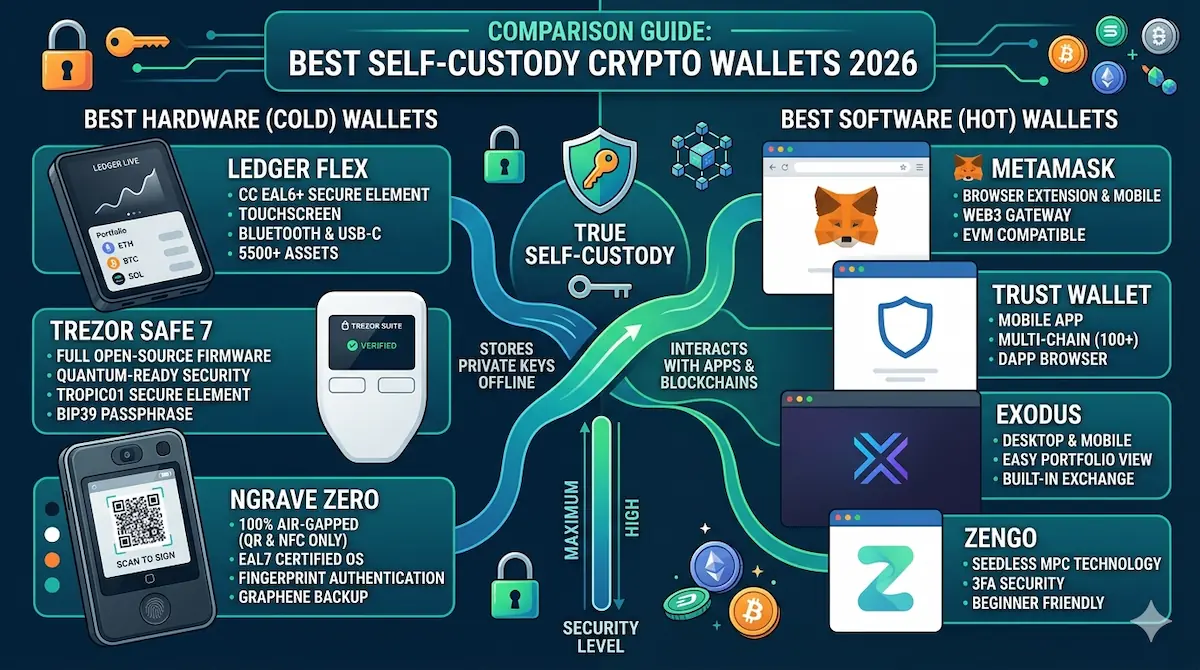
There’s no “one-size-fits-all” wallet. The right choice depends on how you use crypto. Below are the most reliable categories and top options based on security, usability, and real-world use.
1. Hardware Wallets (Best for Security)
If your goal is long-term storage, hardware wallets are the gold standard. They keep your private keys offline, protecting them from hacks and malware. :contentReference[oaicite:0]{index=0}
- Ledger (Nano, Flex) — strong security chip, wide asset support
- Trezor (Safe series) — open-source approach, transparency
- Tangem — simple card-based cold storage
Hardware wallets are widely considered the safest option because they remain disconnected from the internet most of the time. :contentReference[oaicite:1]{index=1}
When it makes sense
- You hold significant amounts of crypto
- You plan to store assets long-term
- You don’t need daily trading access
2. Mobile Self-Custody Wallets (Best for Daily Use)
Mobile wallets are fast, convenient, and ideal for interacting with apps and services.
- Trust Wallet — supports many blockchains
- Exodus — beginner-friendly interface
- Zengo — no seed phrase (uses MPC technology)
They’re great for everyday transactions but remain connected to the internet — which increases risk compared to cold storage.
3. Web3 Wallets (Best for DeFi & NFTs)
If you use decentralized apps, you need a wallet that connects to Web3.
- MetaMask — Ethereum ecosystem standard
- Phantom — popular for Solana
These wallets are powerful but require caution — especially when approving smart contracts.
How to Choose the Best Self-Custody Wallet

Instead of asking “Which wallet is best?”, ask:
1. What’s your main use case?
- Long-term storage → hardware wallet
- Daily transactions → mobile wallet
- DeFi/NFTs → Web3 wallet
2. How much crypto are you storing?
The more you hold, the more security matters. Many experienced users combine wallets:
- Cold wallet → savings
- Hot wallet → spending
3. How comfortable are you with responsibility?
Self-custody means:
- No password recovery
- No customer support to restore funds
- Full control — and full risk
Typical Mistakes with Self-Custody Wallets
This is where most people fail — not because of technology, but habits.
1. Storing seed phrases digitally
Saving recovery phrases in notes, screenshots, or cloud storage makes them vulnerable.
2. Using only one wallet
All funds in one place = single point of failure.
3. Ignoring transaction verification
Hardware wallets show addresses for a reason. Skipping verification can lead to loss via malware attacks.
4. Blindly approving smart contracts
Many hacks happen not because wallets are broken — but because users approve malicious actions.
Real-Life Example
You buy crypto on an exchange. Everything looks fine. Then withdrawals are paused. Support is silent.
If your funds were in a self-custody wallet, this scenario wouldn’t matter. You would still control your assets.
That’s the real difference: not convenience — but independence.
FAQ: Self-Custody Crypto Wallets
Is a hardware wallet really necessary?
Not always. For small amounts, a mobile wallet may be enough. But for long-term storage, hardware wallets significantly reduce risk.
Can self-custody wallets be hacked?
The wallet itself is rarely the problem. Most losses happen due to phishing, malware, or user mistakes.
What happens if I lose my seed phrase?
You lose access permanently. There is no recovery option.
Is it safe to use multiple wallets?
Yes. In fact, it’s a common strategy to reduce risk.
Are free wallets safe?
Many are secure, but “free” doesn’t guarantee safety. Always check reputation and security features.
Should beginners use self-custody?
Yes — but start small. Learn how it works before storing large amounts.
Short Version: What to Do Right Now
- Decide your goal: storage vs daily use
- Start with a trusted wallet: hardware or mobile
- Write down your seed phrase offline
- Use two wallets: one for storage, one for transactions
- Stay cautious: double-check every transaction
Conclusion
The “best” self-custody crypto wallet isn’t a brand. It’s a setup that matches your behavior.
Security is not a product — it’s a process.
The safest users don’t just pick a good wallet. They understand how it works and avoid common mistakes.
Sources
- Money.com — Best Crypto Wallets 2026
- VentureBurn — Best Crypto Wallet Guide
- Business Insider — Crypto Wallet Overview
- CoinGecko Learn — Cold Wallets Guide
- Ledger Official Documentation

