


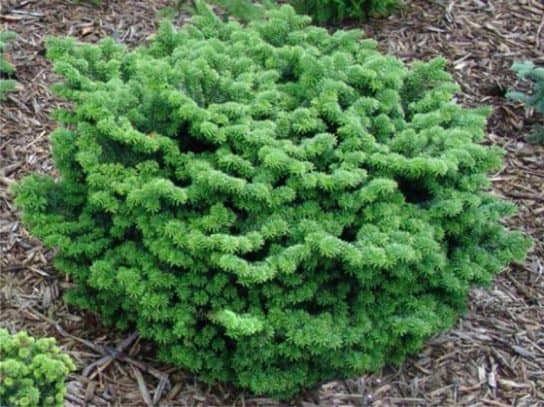


There are some plants that retain their green foliage all year round. These are, for example, the conifers of the gymnosperm division. This class of plants includes many species, including one very beautiful representative – balsam fir from the pine family.
Description of balsam fir
Fir of this species is a fairly tall woody plant. On average, its height is 12-20 m, but there are trees reaching a height of 27 m. The annual growth is from 10 to 15 cm. The life span of a fir under favorable conditions of the wild environment can reach 150-200 years.
The crown of the correct conical shape covers the entire tree to the very ground so that the trunk is not visible. The bark of the trunk is smooth to the touch and has a brownish-gray color. Fir has a shallow root system, which is why it can easily be pulled out of the ground during strong winds.
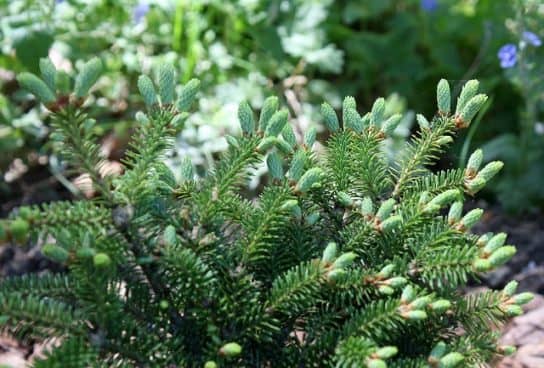
Fir needles are dark green, shiny above and lighter below. The needles are not very sharp, their average length is about 25 mm. On the branches, oval-elongated gray-brown cones are formed, which secrete a lot of resin. Their length is from 5 to 10 cm, and their diameter is up to 2.5 cm. Young cones have a dark purple hue and grow upwards. They fully ripen and sprinkle the seeds in October. Seeds 5-8 mm in size are colored brown.

Habitat
Balsam fir is common in North America, mainly in the United States and Canada, where it is used for forestry purposes. It grows in temperate latitudes, preferring a humid continental climate, as well as close to the sea. The plant is very thermophilic, although quite frost-resistant. Far in the north, you can not find it, the coldest latitude of the fir is located at the level of the Canadian province of Alberta. Areas of permafrost are also not favorable for the growth of this plant. It makes up a vast part of the coniferous and deciduous forests of the southern taiga of the North American continent. It is found in the forest-tundra zone of the second largest Labrador Peninsula in the world, since the local climate there is much milder than in the rest of the northeastern part of North America.


Specially bred and varied decorative varieties of balsamic fir are adapted for growth on other continents and are distributed all over the world.
Culture characteristics
This type of fir prefers loamy moist and well-drained soils. It can grow on soils containing sand and peat, but the growth rate in such conditions slows down sharply. The plant will be small. Fir tolerates shade well, while developing best in areas open to light.
Balsam fir is very sensitive to a gassed or smoky environment, therefore it grows poorly within the city. It feels best when it is warm, while it perfectly tolerates negative temperatures, even a frosty winter.

Planting and leaving
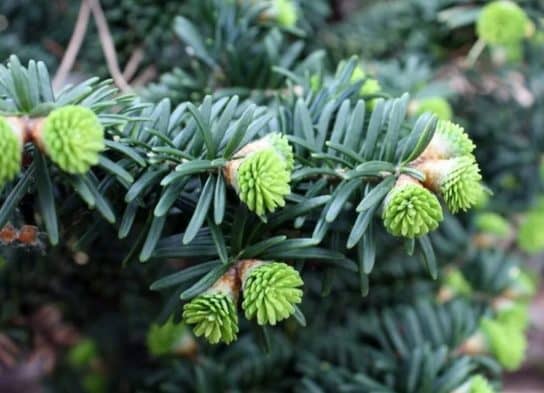
Fir propagation is possible both by seeds and cuttings. The first method of growing is possible in autumn or spring. When propagating by cuttings, it is necessary to wait for the roots to appear (about 8 or 9 months). Upon reaching the age of one year, the cuttings are planted in the soil.
The most common is the second way. Planting of seedlings is carried out in the spring (the plant takes root better during this period, although autumn planting is also possible). Young trees, unlike mature and matured ones, grow very slowly, so the seedlings are grown for a long time for better survival (about 5-10 years). You need to choose calm areas for planting. The soil must be prepared in a certain way.
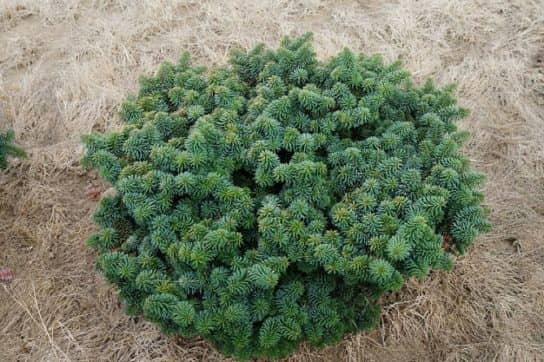

Landing scheme in pre-dug pits measuring 0.5 x 0.5 m:
- a drainage layer is placed on the bottom of the pits in the form of a layer of fine gravel or expanded clay;
- then fall asleep mineral fertilizers and sawdust, preferably rotted;
- then follows the soil layer, which should include earth, clay (fir loves loam), a small amount of sand and peat;
- a plant is placed in the hole and the roots are sprinkled with a layer of soil.
Fir is planted mainly singly (tapeworms) or in small groups. Trees should not be planted very close to each other, as balsam fir has a shallow root system, which tends to grow in breadth. A distance of about 3 meters must be maintained.
Fir is a rather unpretentious plant, which is quite easy in time and effort of care. But it is still necessary to take care of the plant. Fir requires regular watering and sprinkling of the crown. No need to trim the crown, its shape is formed naturally.
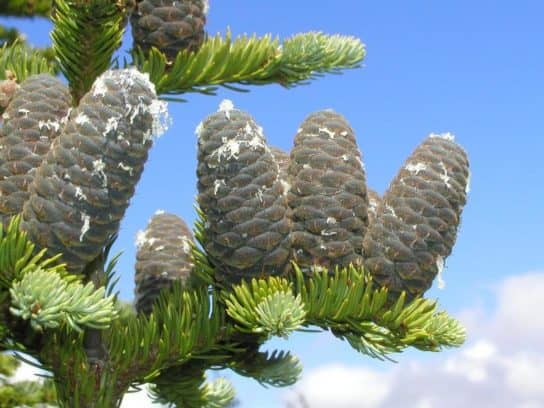
Balsam fir – cones
Balsamic fir is appreciated for its appearance, so it can often be found in alleys, parks, on lawns near buildings and gardens. In addition to aesthetic properties, it also has healing properties. Its oil is very valuable and is used in herbal medicine.

