


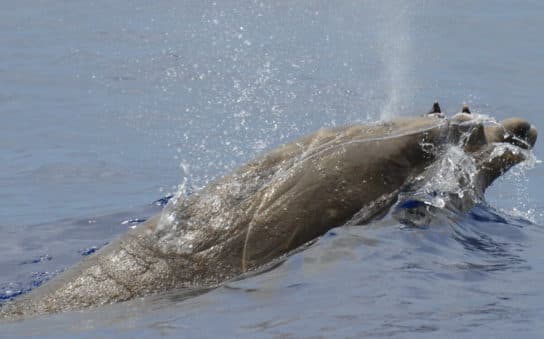


Commander’s Belttooth (Steineger’s Belttooth) (lat.Mesoplodon stejnegeri) is a species of cetaceans of the beaked family (Ziphiidae). In 1885, the American scientist Frederick True first described a marine animal of the beak-beaked family called the Commander’s belt-toothed. It is also called Steineger’s belttooth because it was Leonard Steineger, together with the zoologist Nikolai Grebnitsky, who found the mammalian skull on Bering Island. It was on this part of the skeleton that the description was made. Other scientists denied the existence of the species until the corpse of this whale was discovered in 1904 in Yakin Bay in the United States.
Description
This species is the most poorly studied representative of the genus belt-toothed. It is extremely rare. Almost all studies of their anatomy were done on the bodies of deceased individuals. Most of the whales were found on the shores of the Pribylov Islands, as well as the Aleutian and Commander Islands.
The Commander’s belttooth is a member of the infraorder cetacean beak-tailed family. After dolphins, this family is considered the largest. In the waters of Russia, from the genus of belt-toothed, only this species is represented.

Appearance
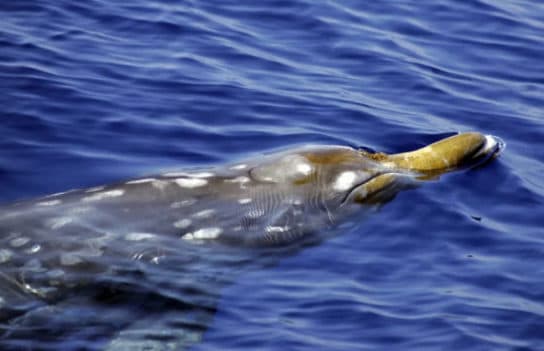
An adult whale has a spindle-like body 5-6 m long and weighing from 1 to 1.5 tons. Moreover, females are somewhat inferior in size to males. They have a medium-sized pointed head, a flat forehead and a medium-sized preorbital region of the skull. The whale’s forehead merges smoothly into an elongated narrow beak. The mouth line is curved. The eyes are set low.
In males, the lower jaw is very curved upwards. In front of it there is a pair of flat tusks, which protrude several centimeters forward. Females have a straight mouth line, so their canines do not protrude outward.
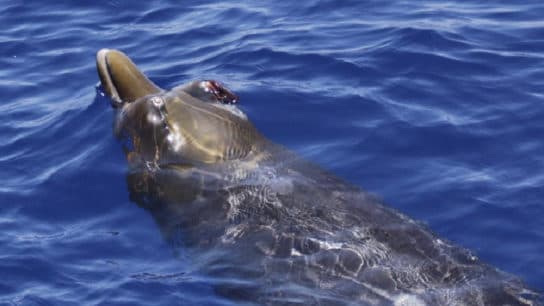

The body color of the commander’s belttooth is dark, mostly gray or brown. The abdomen, chest and lower jaw are light. The whale’s beak is also whitish. The pectoral fins are small and elongated. The low dorsal fin is located closer to the back of the body and is slightly deflected back. The caudal fin has curved edges of a triangular shape and a notch in the middle. The entire body of the belttooth is covered with scratches and scars of various sizes. Most likely they are traces of fights between males for the right to own a female.
Habitat
The conclusions about the habitats of the commander’s belttooth were based on the facts of the discovery of the dead individuals. From such finds, scientists have established that the range of the belttooth covers the northern part of the Pacific Ocean. It also occurs in the Atlantic Ocean. In the Russian water area, it lives in the area of the Bering Island, the Kamchatka Peninsula, the Kuril Islands and the Sea of Japan.

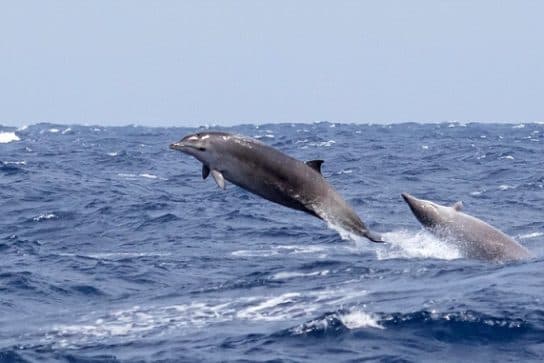
Atlantic straptooth
Nutrition, behavior, reproduction
According to the contents of the digestive tract of the dead Steineger’s belt-teeth, scientists have established their approximate diet. The whale menu includes cephalopods (deep-sea squid) and salmon fish (such as pink salmon). A few sightings with this rare whale were recorded in the places where salmon accumulate.
The Commander’s belttooth belongs to the poorly studied species. The features of its reproduction are currently unknown. But it is known that they can be alone or in small groups (up to three individuals) in the coastal zones, where they come to feast on salmon. They can also join in flocks of 5 to 15 whales. While moving, they follow each other in a column. They go to the depth simultaneously and stay under water for up to 10-15 minutes. Belt Teeth release a low water fountain that can be overlooked among the small waves. What these whales are sick with and whether they suffer from any parasites is also unknown to science.
Red Book
The population size of the species has been and remains a mystery to zoologists and ecologists. The commander’s belt-toothed never had commercial value. The threat to them, as to all marine life, is environmental pollution. This is evidenced by the organochlorins accumulated in large quantities in their muscles, liver and other internal organs.
This type of belt-toothed is listed in the IUCN Red Data Book as a species about which there is “insufficient data”. It is also listed in the Red Book of Russia and Kamchatka as poorly studied and rare.
Interesting Facts
In the language of the Indian tribe Makah (USA), the name of the commander’s belt-toothed one sounds like “kvov-kvov-e-aht-le”. And the local population of the Aleutian Islands gave him the name “Kigan-Agalyuzokh”.
The most famous sighting of Steineger’s whales took place in the summer of 1979 near the Aleutian archipelago. Then the whales were watched from the side of the ship for a month. During this time, belt-teeth appeared there seven times.
The Commander’s Belttooth is considered a rare animal. Or, perhaps, representatives of this species lead an extremely inconspicuous lifestyle. They dive very quietly and do not emit loud bursts or other noise. If not for a couple of rare encounters and the bodies of whales found by people on the shallows, nothing at all would be known about this species.
Video about the Commander’s belttooth


