Spotted hyena (Latin Crocuta crocuta) is a large mammal that lives in various regions of Africa. Today it is the only species of the Crocuta genus. Belongs to the family of hyena, a suborder of felines.
Description
Spotted hyenas are the largest members of their family. They hunt in packs, rarely eat carrion. It is this species that is famous for its ominous laughter, which animals use to communicate in a group. The flocks are dominated by females, among which there is a certain hierarchy.
Appearance
Average parameters of spotted hyenas:
- body length – 130 cm;
- height – 85 cm (at the withers);
- male weight – 50 kg;
- the weight of the females is 60 kg.
The coat of these predators is short and coarse. The color is predominantly gray, dark spots of various sizes are located throughout the coat. The neck is wide and thick. The skull is large, dull. The ears are large and rounded. The hind legs are shorter than the front ones.


Where dwell
Spotted hyenas live only on the territory of the African continent. Here they can be found mainly in the east and south. Most often, spotted predators compete with their striped cousins, pushing them out of their territories. They prefer to live in savannas, on grassy plains, among bushes, in the foothills, semi-deserts.

What do they eat
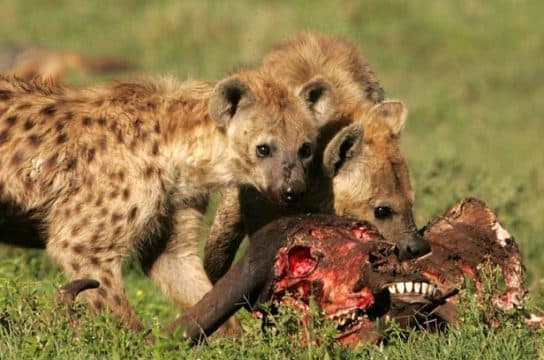
The diet of spotted hyenas is quite varied, and carrion in it occupies no more than 20%. They gather in flocks and hunt various animals. These can be both large herbivores and more powerful predators. Hyenas do not disdain to hunt small animals, birds. Researchers have repeatedly recorded when hyenas attacked giraffes, small or sick elephants, and buffaloes.
In terms of food intake, these predators eat absolutely everything, even bones. This is possible due to very strong teeth, strong jaws, and a hardy stomach.

Lifestyle
By way of life, spotted hyenas differ little from their relatives of other species. They live in groups, hunt in a flock. The main activity is shown precisely at night. The highest positions in groups are occupied by females, displacing males from there. They are the first to try prey, occupy cooler places to live. At the same time, among females, their own hierarchy operates. To take a leading position in it, females often fight with each other.
Individual clans of hyenas often fight between each other. Bats go beyond the territory, often end in bloody massacres.
The older female is usually the most fertile, and her offspring are the healthiest. Most often, no more than 7 puppies are born in one litter. Initially, babies are kept in burrows, earthen shelters, and caves. Until they grow up, the mother protects them.


Interesting Facts
To better understand these predators, it is recommended that you familiarize yourself with interesting facts about them:
- Spotted hyenas are the largest, strongest of all members of their family. They are the ones who come to mind first, since they use frightening laughter for communication in the flock.
- These predators are most often raised in earthen burrows. In order not to build such a shelter on their own, they find ready-made burrows, expel other animals from them.
- Hyenas are not afraid of water, on the contrary, they like to “take a bath” on very hot days.
- These predators hunt in packs, however, do not adhere to any tactics. There are no driving and meeting individuals. Due to its endurance, ability to develop high speed and not slow down for a long time, in most cases the hunt ends successfully.
- Females of spotted hyenas are much larger, more aggressive than males, and occupy leading positions in flocks.
- Spotted hyenas can be seen in mountainous areas, at an altitude of 4 km above sea level.
- Hyenas do not take prey from other predators as often as they do. This is especially evident in their relationship with lions.
- Most of the food hyenas get themselves.
- Hyena can be tamed. They lend themselves well to training if you take a cub to raise. With proper nutrition and care, the total life expectancy in captivity almost doubles.
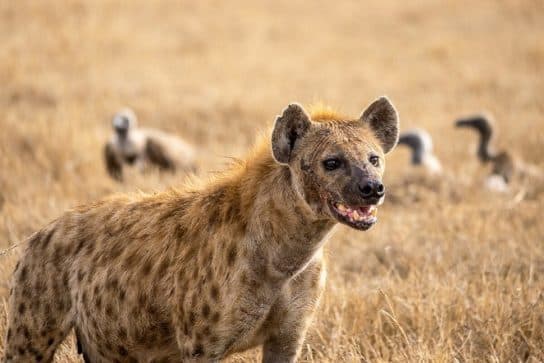
Hyenas are prone to aggression towards each other when fighting for food. Situations often occur when two schools of predators are found near one prey – striped and spotted or spotted and brown. In this situation, it is the large individuals that most often win.
According to official statistics, spotted hyenas are at risk of extinction in many regions of Africa. Human beings contributed to the population decline. In order to prevent the complete disappearance of these predators, in some African countries, their population has been taken under control. In addition to this, animals live in many zoos in the world, where their number is gradually increasing.
Spotted hyena video