


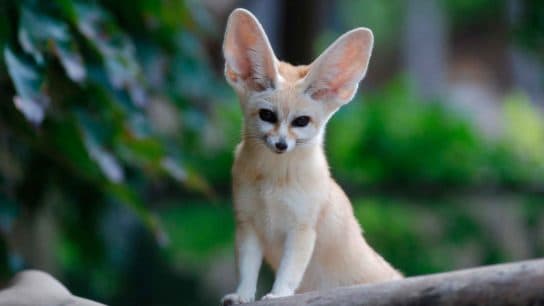


Fenech is a small, unusual-looking fox. Scientists argue to what genus the fenech is attributed, since there are significant differences from foxes – these are thirty-two pairs of chromosomes, and physiology, and social behavior. That is why in some sources you can see that the fenech is attributed to a separate family of Fennecus (Fennecus). Fenech got its name from the word Fanak, which means fox in Arabic.
Fenech is the smallest member of the canine family. An adult fennec fox weighs up to one and a half kilograms, and it is slightly smaller in size than a domestic cat. At the withers, the Fenech is only 22 centimeters long, and up to 40 centimeters long, while the tail is quite long – up to 30 centimeters. Pointed short muzzle, large black eyes and distinctively large ears (they are rightfully considered the largest among all representatives of the predatory order in relation to the size of the head). Fenech ears grow 15 centimeters long. Such large ears of Fenechs are not accidental. In addition to hunting, Fenech ears are involved in thermoregulation (cooling) during hot daytime. Fennec foci have downy pads, so that the animal can easily move along the hot desert sands. The fur is quite thick and very soft. The color of an adult: a pale-red top, and a white and fluffy tail below with a black tassel at the tip. The coloration of juveniles is different: it is almost white.
Habitat
In nature, the fennec fox is found on the African continent in the central part of the Sahara Desert. Fenech is also found from the northern part of the Kingdom of Morocco to the deserts of the Arabian and Sinai Peninsulas. And the southern habitat of Fenech stretches to Chad, Niger, Sudan.

What eats
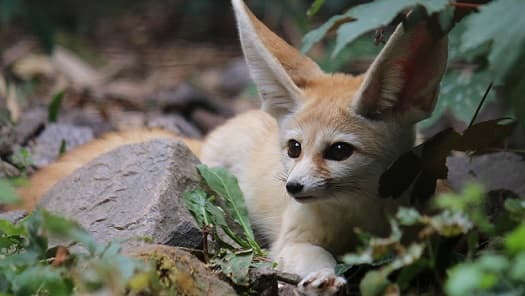
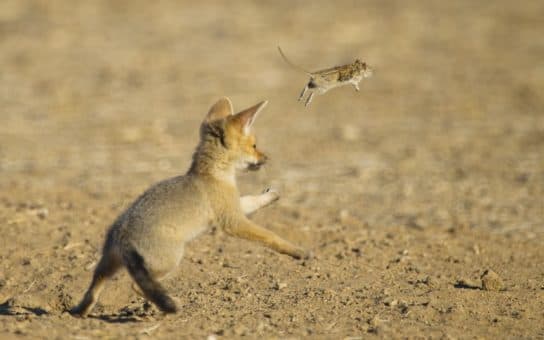
Fennec fox is a predator, but despite this it can feed on everything, i.e. omnivorous. The main diet of the sand fox is rodents and birds. Also, fennec fox often ruins bird nests by eating eggs and already hatched chicks. Sand foxes usually go hunting alone. All excess fennec fox carefully hides in caches, the location of which they remember very well.
Also, insects, especially locusts, are included in the diet of Fenech.

Since fennecs are omnivores, all the various fruits, plant tubers, and roots are included in the diet. Plant food almost completely satisfies Fenech’s need for moisture.
Natural enemies of Fenech
Fenecs are quite nimble animals and in the wild it has practically no natural enemies. Given that fennec fox’s habitats overlap with striped hyenas and jackals, as well as sand foxes, they may pose an indirect threat.
However, despite the nimbleness and speed in the wild, the fenk is still attacked by an owl. During the hunt, since the owl flies silently, it can grab the cub near the burrow, despite the fact that the parents may be very close.
Another enemy of Fenech is parasites. It is possible that wild fennecs are susceptible to the same parasites as domestic animals, but so far there has been no research in this area.

Interesting Facts
- The Fenecs have fully adapted to live in the desert. So, for example, they completely calmly do without water (permanent fresh water bodies). All the moisture of fennecs is obtained from fruits, berries, leaves, roots, eggs. Condensation also forms in their vast burrows, and they lick it off.
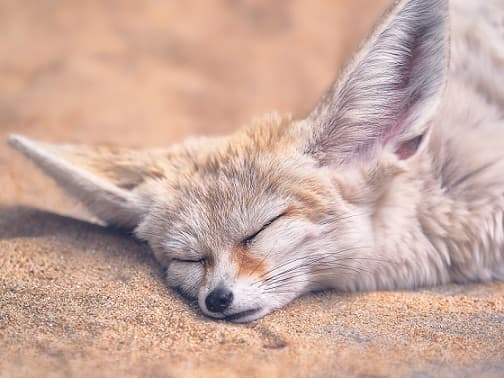
- Like most animals of the desert, the fennec fox is active at night. Thick fur protects the fox from the cold (the fennec fox begins to freeze already at plus 20 degrees), and large ears help in hunting. But Fenechs also love to bask in the daytime sun.
- During the hunt, Fenech can jump 70 centimeters up and almost 1.5 meters forward.
- Fenech is a very social animal. They live in small flocks of 10 individuals, usually one family. And they really love to communicate.
- Like many representatives of the animal world, fennecs are devoted to one partner all their lives.
- In the wild, fennecs live for about 10 years, and in captivity there are centenarians, whose age reaches 14 years.
Fenech vs snake


