

Meeting a whale on the high seas is the dream of many sailors and sailors. Then they tell friends about her for a long time, show photos and videos of such meetings. Why do they evoke so much emotion? Many species of whales have become rare. It is even less common to meet them. The uncontrolled hunting of these animals, their large size, their low fertility have led many of them to partial or complete extinction. Therefore, more and more often it is easier to meet fin whales on the pages of the Red Book than in the sea.
Description and appearance
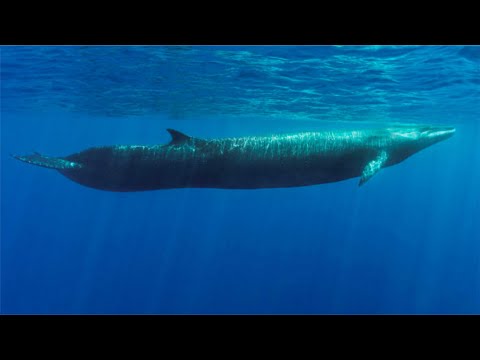
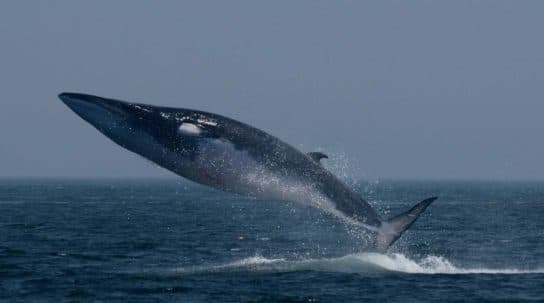
One of the vulnerable species of whales is northern fin whale or, in another way, herring whale… He is a mammal of the order of cetopods. Finwala, along with blue and humpback whales, belongs to the minke family. Blue and herring whales are often mixed species. Such hybrids are found in the northern parts of the Pacific and Atlantic oceans.
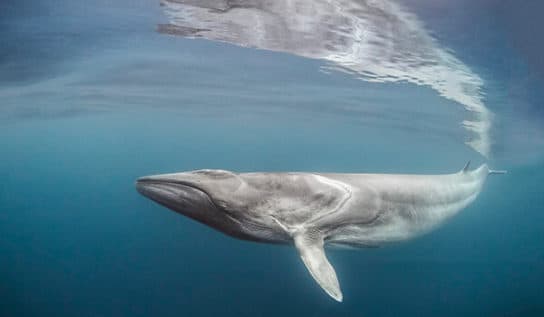
Finwhale, in comparison with other species, has a slender body 18-27 m in length, depending on the region of residence. The head is small. Body weight is 40-70 tons. Females of this species are larger than males, with the same body weight. The whale has a high dorsal fin. It is located in the outer quarter of the body. The whisker has a height of 70 to 90 cm. Each half of the jaw has 260 to 470 plates.
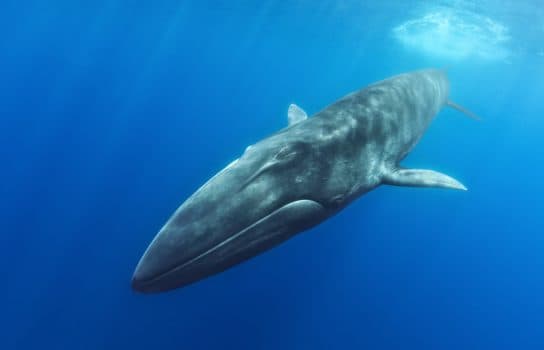

The color of the whale has two tones. The back is dark gray or dark brown and the belly is white. There are light gray spots on the back of the back. On the belly there are skin folds in the amount of 56-114 pieces.
Distribution and lifestyle
Finwhale is present in all oceans. It is a pelagic organism, as it lives in the water column and on the surface. He prefers to avoid coastal areas. The northern fin whale migrates to the colder regions of the Arctic in summer. Here the whale gets food, feeds up the mass before the mating season. In winter it goes to subtropics and latitudes of temperate climates for mating and reproduction of offspring. It practically does not swim into the equatorial zone and does not intersect with the subspecies of southern fin whales. They differ from their northern counterparts in larger sizes (about 10%).


The whales’ menu consists of small crustaceans (plankton) and medium-sized fish (herring, navaga, Arctic cod, capelin). Fin whales chase schools of fish at high speed, knock them into a dense heap and eat them. And for convenience, they do it on their side. Sometimes they feast on squid. One fin whale can consume up to 2 tons of food per day.
Northern fin whales reach sexual maturity by 4-6 years after birth. Whales mate throughout the year. The peak of the mating season is in the winter. Females carry babies for 11 or 12 months. The lactation period is 6-7 months. Fin whales keep in groups of 2-7 individuals, sometimes they are solitary.
Red Book
Previously, herring whales had no enemies. Habitat far from the coast and significant speed of movement made them practically invulnerable. In the 19th century, with the development of technological progress in the field of sea fishing, this species of whales underwent mass extermination, just like other species of the family. From 1868 to 1967, 57.2 thousand fin whales were caught in the North Atlantic. In 1982, the International Whaling Commission imposed a complete ban on the herring whale fishing. However, in 2006, fishing was allowed in Iceland again. Although the population of the species had not recovered by this time.

Before the northern fin whale became an object of fishing, its population in the waters of the North Pacific was more than 40 thousand individuals. By 1972, it had dropped to 15-17 thousand. Now there are about 5 thousand representatives of this species of whales.
In the IUCN Red List, the northern fin whale is designated as a vulnerable species. The decline in its abundance was largely influenced by uncontrolled fishing in the past. But even now, whales are dying when they meet long ships, when entering rivers and harbors. Also, fin whales often become victims of attacks by killer whales. At a low reproduction rate of a population, all this greatly affects its recovery.
Interesting Facts
The northern fin whale has several other names. In addition to the herring whale, it is also called the common minke, real minke and herring minke.
Finwhale is the second largest animal on the planet after the blue whale. Also, these two species are closely related.
The first scientist to describe the species in the 17th century was Frederic Martens. It was later described by Paul Dudley. Finally, a complete description based on the data of these scientists was given by Karl Linnaeus in 1758. At the beginning of the 19th century, Count Laseped gave the finwhale the name Balaenoptera physalus.
The existence of the herring whale is very important for the cycle of organic matter, biodiversity and the functioning of animal communities in the North Pacific Ocean. In Russia, the species is listed in the Red Book and is protected under the law of the Russian Federation, which provides for large fines for illegal fishing. The measures taken must be followed with the utmost rigor so that encounters with whales in their natural habitat occur much more often.
Finval – video