


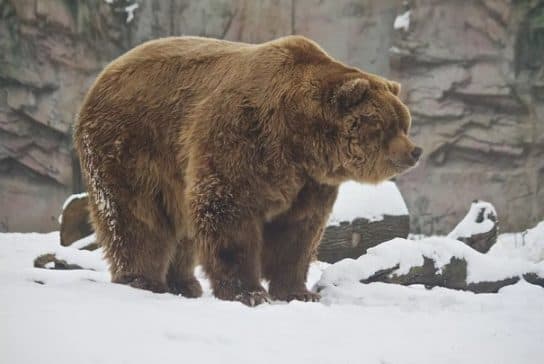


Kodiak has another name – Alaskan bear… It is distinguished by its large size and is considered one of the largest predators. The population of this species is extremely small and threatened with extinction.
Appearance
The size of this representative is about 3 meters in length and 1.6 meters in height. One of the claws of a kodiak reaches 15 centimeters in length. Sexual dimorphism lies in size: females are half the size of males. The average weight of a male is 500 kilograms, and that of a female is 250 kilograms. The greatest weight of the bears is 780 kilograms. As a rule, their maximum weight occurs before hibernation.
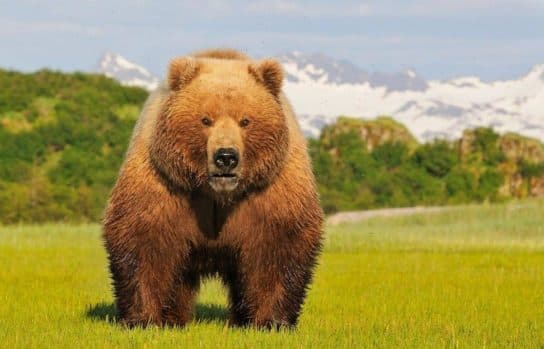
Bears of this species have a very large muzzle with brown eyes. The head area is lighter than the rest of the torso. This distinguishes the kodiak from the grizzly. The body of the bear is rather dense with powerful paws and a healthy head. The sole of the hind legs is covered with rough skin, which allows the animal to easily tolerate cold climates and humidity. Also, Kodiak bears have a tail that does not perform any function.


There are sharp fangs in the mouth. The jaws themselves are quite powerful, which can easily gnaw through the bones and hard stems of plants. The claws are endowed with a specific ability to advance. Poor vision is compensated by excellent sense of smell and hearing.
Kodiak is covered with dense wool of medium length. The fur can be either brown or beige. Most often, dark brown representatives are found.
Habitat
This predatory animal received the name “Kodiak” because of its habitat. They are located on the territory of the islands of the Kodiak archipelago, which is located southwest of Alaska. Only here the Kodiak bear lives.
Animals choose places rich in food sources. They can change their habitat in the absence of a sufficient amount of food. The period of cold weather is spent hibernating in caves. When they cannot find a suitable burrow, they set up their own dens, which are lined with leaves and dry grass.


Nutrition
The diet of bears is extremely varied. They are characterized by both animal and plant foods. The choice of food depends on the season. Animals such as goats and deer can become victims of the Kodiak. But only adult bears are engaged in hunting.
In springtime, animals prefer to eat various carrion and vegetation. At the end of hibernation, they actively feed to recuperate. Since Kodiaks live near the Pacific Ocean, they often eat various fish. To do this, they approach small bodies of water and expect fish. They can also fish it out of the water.


In autumn, animals prefer nuts and mushrooms. This food helps them to stock up on nutrients during hibernation. Females feed especially strongly, which are forced to feed their offspring during hibernation.
Breeding period
The mating period in animals lasts from May to June. This period is due to the large amount of different foods. Due to the lack of competition, animals calmly organize pairs without fights and clashes between males. A formed couple can live together for several days or several weeks.
Females are characterized by a long pregnancy process. In this regard, the egg cell with the calf begins to develop only from the end of November. The birth of the cubs dates back to January, when the female is still in hibernation. From one litter, 2 to 3 cubs appear. Until spring, they feed on mother’s milk. If the female refuses offspring, then another bear picks it up.

It is a sad fact that literally half of the little cubs do not live to be 2 years old. The rest half is with the mother until 3 years old. During this time, they learn to hunt and defend themselves. After this age, they begin to live independently. Females become sexually mature at 4 years old, and males at 5 years old.
Character and lifestyle
Kodiaks are characterized by a solitary lifestyle, with the exception of pairs in the mating season and females with offspring. Each bear has its own territory. Males have twice as much territory as females. In order to protect it from predators, they mark their area with urine and rub against trees. This is how other animals understand that the place is occupied. However, it is not common for Kodiaks to get into fights if another bear appears in their area.
Animals are characterized by a diurnal lifestyle. Hibernation begins with cold weather and lasts until spring. During this time, they store fat.
Kodiaks are not afraid of people and treat them with interest. However, they can attack if they sense danger. It is important not to let them get close, since they are much stronger than any person. If the bear approached himself, then you can try to scare him away with a cry, but in no case run away.
Comparison of human and Alaskan bear height


Enemies
Among the predatory animals, the Kodiak has no enemies in their habitat. But their populations are heavily influenced by hazards in the form of parasites, disease and poaching. Due to the low density of habitat, diseases are transmitted very quickly.
For small cubs, adults are dangerous. The female fiercely protects her offspring, but is significantly inferior in size to the males.
Another reason for the decline in the population is human activities. Some poachers have reduced the number of these animals to the limit, when their number was almost impossible to restore.

