


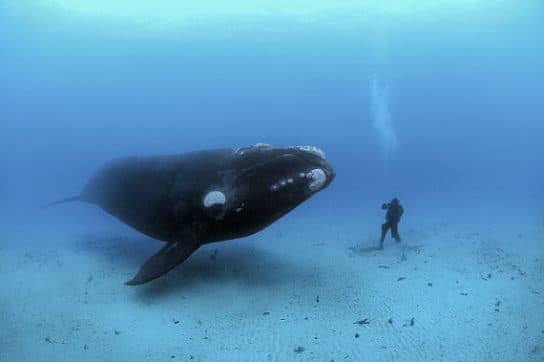


Bowhead whale settled in the Northern Hemisphere, in the region of the earth’s pole. Therefore his called polar… And the name of the mustachioed whale was also assigned to the bowhead whale. The reason is the presence of a huge mouth, in which there are three hundred mustache plates, reaching a length of 3-4.5 meters.
Description
The bowhead whale is inferior in weight to the largest blue whale and fin whale. The maximum weight of an adult polar whale can reach up to 150,000 kilograms. The whale is capable of diving to a depth of 3,500 meters and staying in the water column for up to forty minutes.
Although the whale is polar, its body temperature is 36-40 degrees. While driving, it develops a speed of 20 kilometers per hour.
Features of appearance
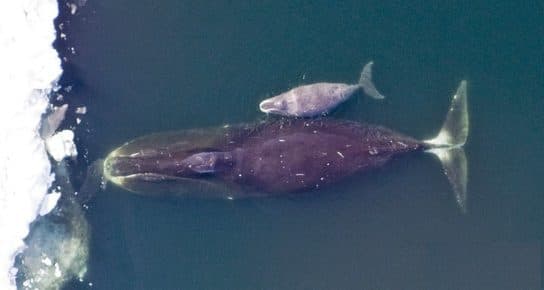
The body of the bowhead whale is streamlined. The body length of females can be from 18 to 22 meters, and males are smaller. They are 14-17 meters long. The polar whale does not have a fin on its back. The fins are located on the sides. They are small in size compared to the body, their length is about 2 meters. There is a thick layer of fatty deposits under the skin, their thickness is almost 60 centimeters.
The dark gray body is sharply different in color from the lower jaw. The jaw is light and arched. In general, the jaws of the bowhead whale are very large: the lower one is slightly pushed forward and is much smaller in size than the upper one. On the lower jaw, there is a long mustache serving as organs of touch. The mouth is at the top of the head.
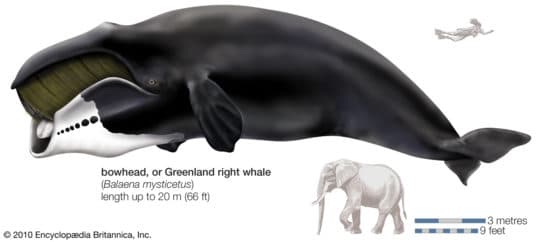

The head is large: it occupies a third of the entire body in size. There is a gap between the head and the body, similar to the neck. In the parietal part of the whale, there are two small slits that serve as nostrils. Through them, the whale releases water fountains of great power. It is capable of breaking through ice 30 centimeters thick.
Bowhead whale eyes are small. They are located near the corners of the mouth and are covered with thick horny growth. Eyesight is very weak. Although the whale has no ears, it hears well with the inner ear. It perfectly picks up various sounds, including ultrasound. Due to this, the whale is well oriented in the water.
Life span
The bowhead whale can be classified as a long-liver. Based on studies of the eyeballs of whales that were killed in the hunt, scientists determined their age. It turned out that bowhead whales can live for over a hundred years. Individuals were found that had stone harpoons in their bodies. According to experts, some of them were about 200 years old.
Habitat
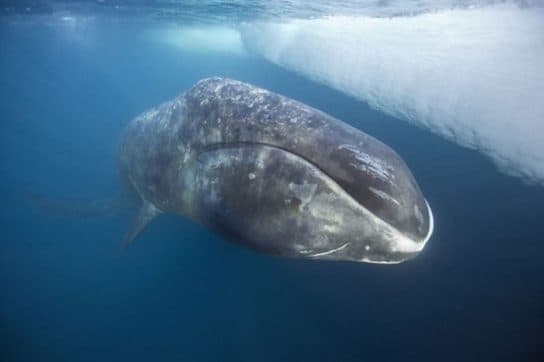
Bowhead whales currently inhabit polar waters. There was a time when they swam in all the waters of the northern hemisphere of the Earth. Over the past hundred years, there has been a sharp decline in the number of polar whales. It is estimated that there are less than a thousand individuals remaining in the North Atlantic, and about 7,000 animals in the North Pacific.
Bowhead whales migrate away from ice floes and do not swim to places with temperatures below -45 degrees. In spring, whales swim to the north, and in autumn they go south. The southernmost herds reach the Sea of Okhotsk.

Nutrition
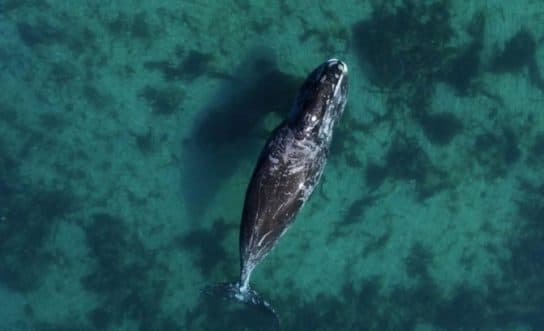
The diet of the polar whale includes crustaceans, molluscs, and plankton. The animal, while drifting in the water, keeps its mouth open. The whale swallows a large volume of water and filters it. Filtration takes place within a minute. Plankton and crustaceans remain on the whiskers. The whale lifts the food off with his tongue and swallows it. So in just one minute, almost 50,000 marine inhabitants enter its body.
An adult polar whale needs to consume approximately 2,000 kg of plankton to saturate. By the autumn season, the animal is gaining a lot of fat. It is necessary in order to preserve life in the winter.

Lifestyle and characteristics
The constant migration of whales determines their way of life. During migration, polar whales line up in schools and move in a given direction. In the summer – to the north, and in the winter – to the southern zone.
During migration processes, whales are divided into flocks of three categories: young, sexually matured young and mature individuals. When the flock arrives at the place, it disintegrates. Some animals unite in small flocks, and there are those that swim separately.
Arctic whales love to dive and jump out of the water column. Having slapped their fins and assuming an upright position, they jump up. When during the jump most of the body floats up with its head, the whale sharply turns sideways and dives into the water. The immersion depth is two hundred meters. Diving games usually take place in the spring. And young whales play with any objects found in the water.
During sleep, whales are first at the surface of the water, and then gradually submerge into the water. When the immersion occurs to a certain depth, the animal makes a sharp movement with its huge tail and again rises to the surface of the water.
Bowhead whales hide under the ice from predators. They make holes in the ice for air intake and can stay there for a long time.

Reproduction
Bowhead whales mate in the spring. After that, migration begins. Puberty in males begins by 20 years of age, and in females two years earlier.
During the mating season, males use the following methods:
- Rotation around its axis;
- high jumps from the water;
- embracing fins;
- performing songs and making groaning sounds.
The gestation period in females lasts 12-16 months. Cubs are born during April-June. The body length of newborns is about five meters with a fat layer of about 15 centimeters. This is necessary for the whale to survive in icy water.
After birth, the female immediately pushes the cub to the surface of the water. On the first day, the baby eats more than one hundred liters of milk. The female feeds the offspring for a whole year. During this time, the whale grows up to fifteen meters, and its weight becomes about 60 tons.
For another two years after breastfeeding, the cub is near the mother. The female constantly takes care of him, teaches him how to get food on his own and protects him from the attacks of predators.

Population today
For thousands of years, humans have hunted whales. By the beginning of the 20th century, the extermination of bowhead whales had reached colossal proportions, and they were in the category of an endangered species.
It was forbidden to catch bowhead whales back in 1935. In the seventies of the last century, it was listed in the Red Book as an endangered species. The population is in the process of extinction. A herd of bowhead whales in the Beringo-Chukotka region was classified as a rare category 3.
Scientists have determined that only 11,000 bowhead whales remain today.
Enemies of the whale and its guards
The enemies of the polar whale are killer whales. They attack the whale in a large flock, in which there are up to forty individuals. But the main and merciless enemies of polar whales are people. They are constantly exterminating these animals.

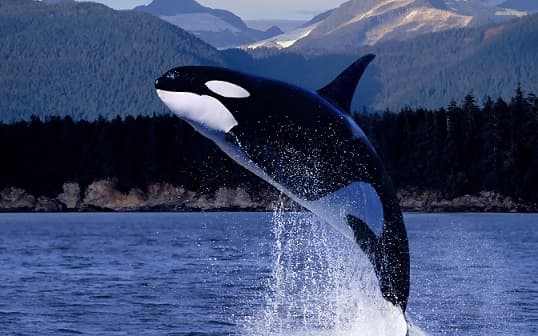
The killer whale is the enemy of the bowhead whale
To preserve the population, a partial ban on hunting has been introduced. Eskimos and Chukchi can kill a whale once every two years. Polar whales need protection. Population growth is slow. The female can give birth to a cub once within three to seven years. If the extermination of bowhead whales continues, then this species of animals may disappear on Earth.
Bowhead whales – beautiful video


