


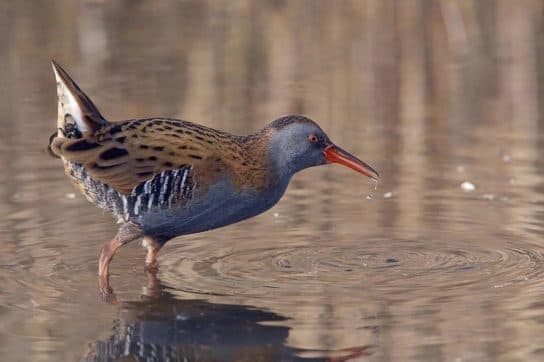


A small bird slightly larger than a starling, preferring to hide in thickets and be nocturnal, is a water shepherd from the family of shepherds. It is not in vain that the bird prefers not to show itself – after all, at the moment it is more realistic to see it in the Red Book than in nature.
Description
In terms of body structure, shepherdesses resemble quails or partridges – not a large, neat bird about 26 cm long and weighing a little less than 200 grams. Its disproportionate and laterally flattened body resembles a corncrake – however, unlike it, the shepherd has a long and curved beak.
This bird has a special, distinctly distinct from any other waterfowl, cry – a rather characteristic likeness of a pig’s squeal. Voice activity, like the life cycle, is mainly associated with the night time.


Appearance
The plumage of the shepherdess does not differ in brightness, but attracts attention with its variegation. The main role in the appearance of the bird is played by the beak: thin, long, almost the same size as the head – usually it is brightly colored with a red or orange tone. The rest of the plumage is steel-gray, and narrow light gray stripes stand out on the sides. Olive brown feathers with wide dark stripes can be seen on the back and wings. The tail of the bird is short, softened – and does not stop wiggling when moving. Red-brown legs, too thin in relation to the body, complement the dandy appearance of the shepherdess.
It is interesting that the main and practically the only difference between females and males of this species is that the males are slightly larger than their partners.
The average lifespan of these birds is impressive for this size – they live on average up to nine years. Moreover, the fertility of this species allows you to create several clutches per season.


Habitat
The shepherd lives on almost all continents – in Europe, and in Asia, and in the Americas, and in Africa – in a wide variety of regions, but in very small quantities. Until now, scientists argue about the presence of this bird species in India – the data on its distribution there are contradictory.
Regarding habitats, the shepherd prefers to settle along the banks of reservoirs, choosing the most stagnant, flooded and even swamps: thanks to this, they get access to reeds, reeds and other vegetation. It is the presence of near-water greenery as the main material for nesting and just shallow water for obtaining food that can be called the main criteria for choosing a habitat for a bird.
And the most interesting thing is that even if the territory ideally meets all the needs, this does not mean at all that it is here that the population will resettle – and scientists do not find an explanation for this.

Diet
Shepherd boy feeds mostly on small insects, larvae, molluscs and other invertebrates. He does not neglect aquatic vegetation, as well as small amphibians and fish. The prey is usually found in a reservoir: on the surface, at the bottom, on the coastline.
Since the shepherd boy in the daytime is in dense grass and rarely appears in open spaces, he practically does not fly – he runs more, is quite agile and fast.
Moreover, a bird rises into the air only in case of extreme danger – and even then not higher than a meter (of course, not taking into account the moment of migration). In especially acute cases, he can swim and even dive.
For the most part, water shepherdesses live alone, maximum in pairs. This is due to their aggressive nature, however, sometimes there are cases when birds form impressive groups of up to thirty individuals: but such groups disintegrate very quickly.
Water shepherd – video


